[0010] Controllers according to the present invention are advantageous in a number of respects as compared to prior art controllers. Such controllers are compact or smaller as compared to prior art controllers, particularly when compared to prior art controllers that
handle comparable power. Such controllers also will be generally lighter as compared to comparable prior art controllers, which is particularly beneficial if the motor and controller are located at the
actuator end of a
robot link.
[0011] Such controllers of the present invention embody fewer components as compared to prior art controllers, especially components that are generally bulky and costly (e.g., isolators, wiring for plural axes, EMI control stacks, and fans. A controller of the present invention preferably conducts heat being generated within the controller to the exterior of the controller. Such a controller can provide good
heat control or
heat management without the cost, bulk and
power consumption associated with the fans as well as other finctionalities of
convection type of cooling systems. Such
heat control characteristics of the controller beneficially result in a substantially isothermal temperature profile within the controller.
[0012] Such controllers can be located proximal to the motor it is controlling yet has the beneficial effect of being relatively insensitive to
noise that may be generated by the
power level circuitry. Such controllers also can provide a high-precision positional determination for the motor that can be preferably achieved without increasing the bulk of the controller.
[0013] Such controllers can be used or easily adapted for use in motor network topologies and further to allow for
power sharing and power generation. For example, the controller of the present invention can be used to cause power to be generated by one motor / generator that can be utilized by another motor(s) of the network which in turn can lead to other beneficial effects (e.g., reduced wiring size). Such controllers are preferably constructed so as to be resistant to environmental effects such as if the controller were submerged in liquids or corrosive fluid environments.
[0020] The sensor can include an
encoder, such as an optical
encoder, that detects the position of the output of the motor and is co-located on and integral with the controller. Also, the conductors that connect the
encoder with the
signal circuit (e.g., the
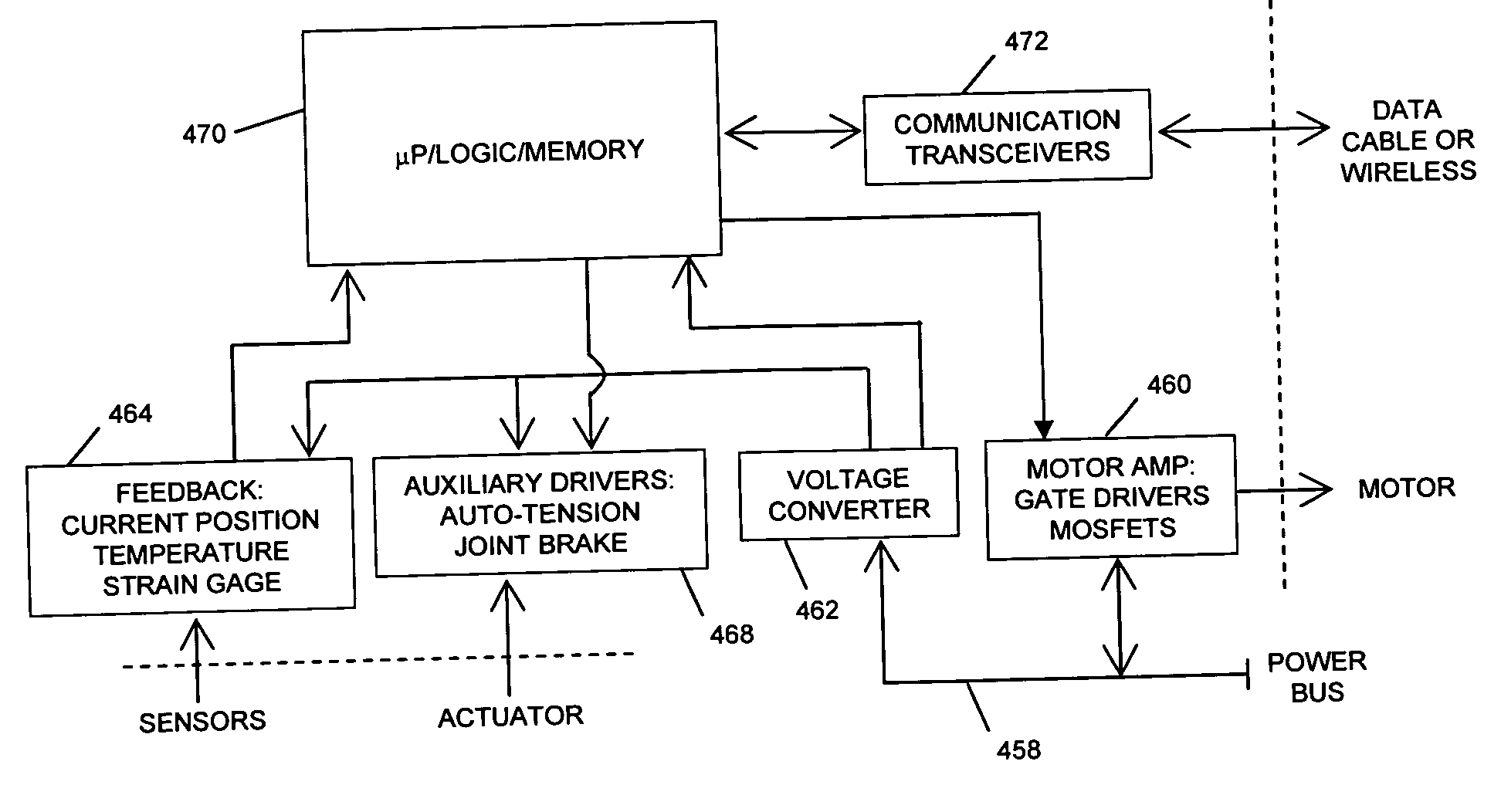
digital signal processor or DSP) provide the positional detection information. In more particular embodiments, such encoder conductors have a length of less than about 10 mm. In conventional uses, high precision encoders normally limit motor RPM due to bandwidth limitations, however, the controller arrangement of the present invention such as the short leads or conductors between the encoder and the signal circuitry enable calculation of useful velocity information even at extremely
low speed.
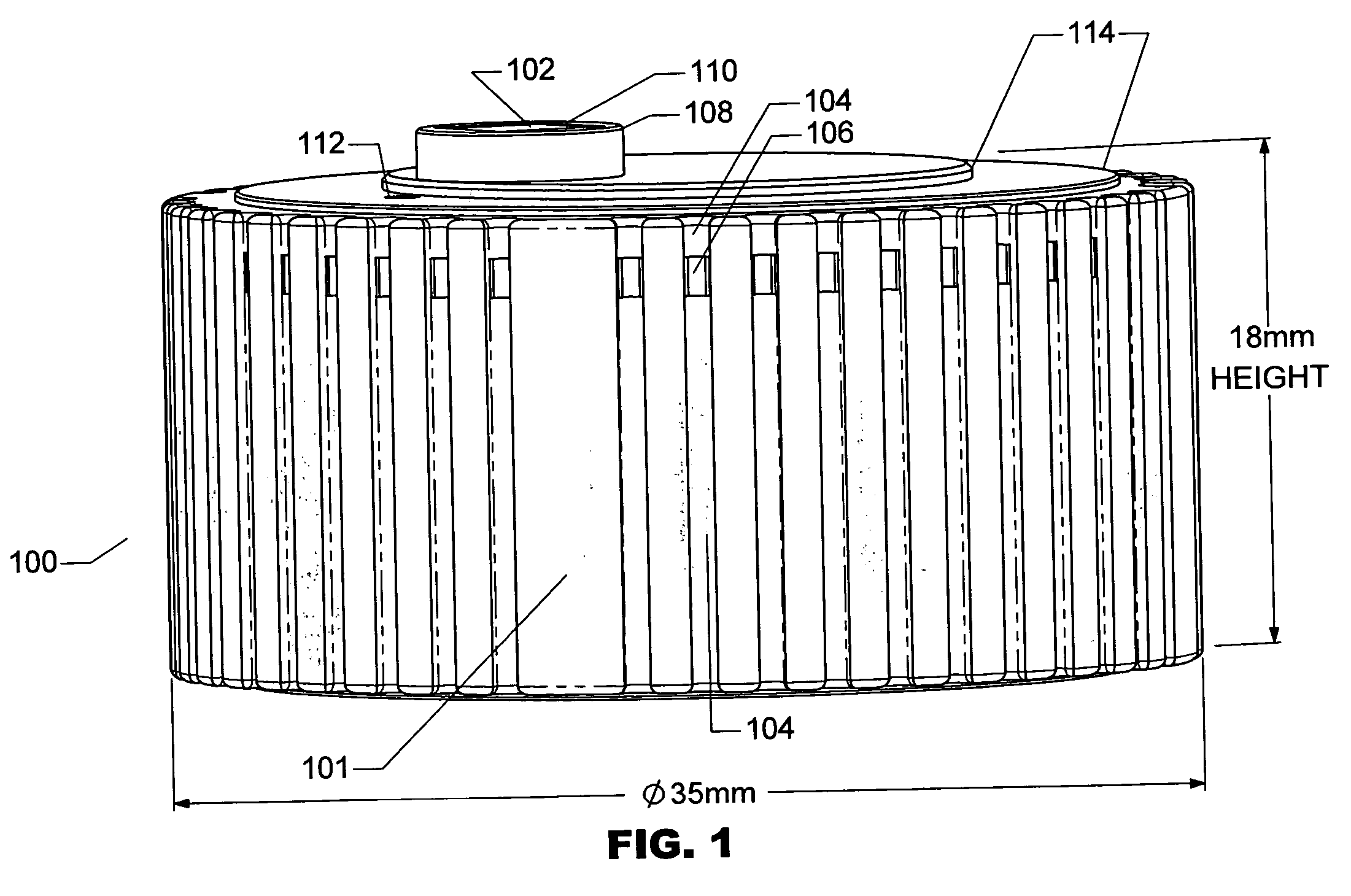
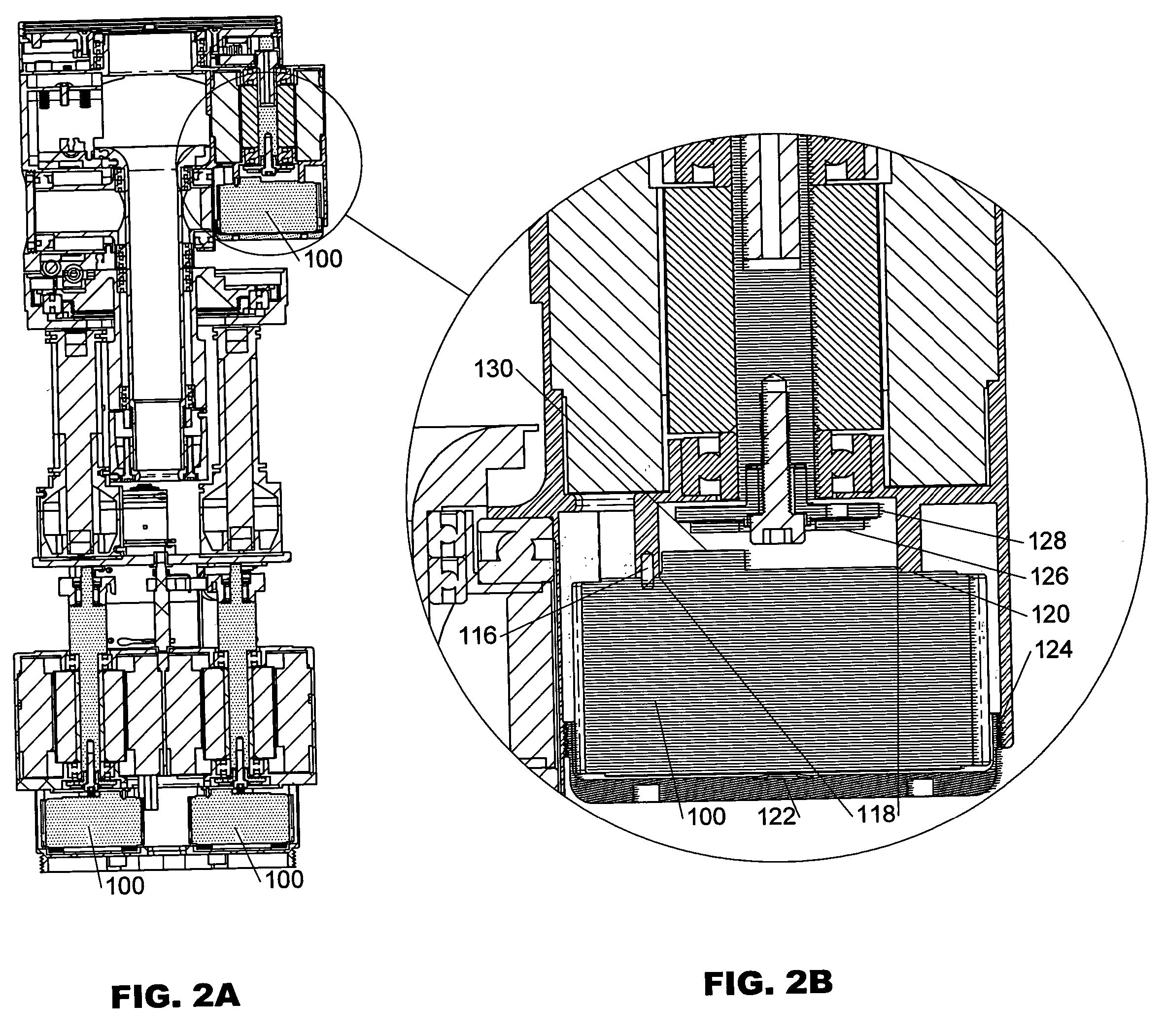
[0023] In exemplary embodiments, the present invention features a controller for a motor that is ultra-compact, with a
power density of at least about 20 watts per cubic cm (W / cm3). Such a controller embodies a common ground for noisy power circuitry that energizes the windings of the motor as well as the signal circuitry that controls this energization in response to signals from one or more sensors. The circuits, their components and connectors are sized and located to minimize their
inductance. Also, the ground is held at a stable potential without the use of
galvanic isolation. Heat is communicated by conduction from heat generating functionalities within the controller to its exterior. This conduction is preferably provided by a
casting of a thermally conductive and electrically insulating material such as a potable
epoxy. Flutes are formed in the outer surface of the
casting (e.g., the outer surface of the
casting corresponding to the side(s) of the controller) not in thermal communication with the
heat sink to transfer
heat energy to the outer environment (e.g.,
atmosphere, fluid medium). Such flutes also serve as connectors to exterior wires or connector pins. The controller uses a single
current sensor for plural windings and preferably a single heat sensor within the controller. The controller can be networked to enhance power efficiency and the body of the controller can function as the sole plug connector.


 Login to View More