
Solid state image pickup element and method of manufacturing solid state image pickup element
a technology of solid state image and pickup element, which is applied in the direction of television system, radio frequency control device, instruments, etc., can solve the problems of void where no color filter is formed, fluctuation in size and shape, and fluctuation in production fluctuation of recent solid state image pickup element, so as to reduce the characteristic distribution of in-plane photoelectric conversion portion and reduce image non-uniformity
- Summary
- Abstract
- Description
- Claims
- Application Information
AI Technical Summary
Benefits of technology
Problems solved by technology
Method used
Image

Examples
first embodiment
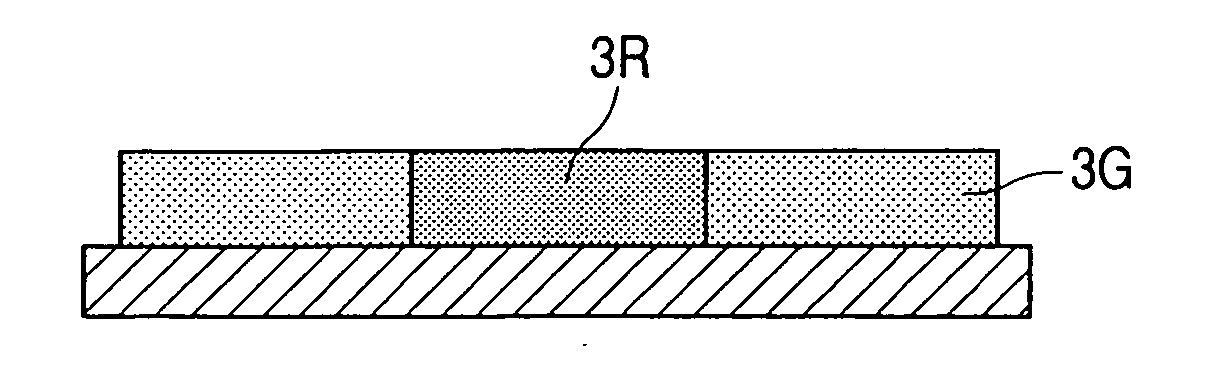
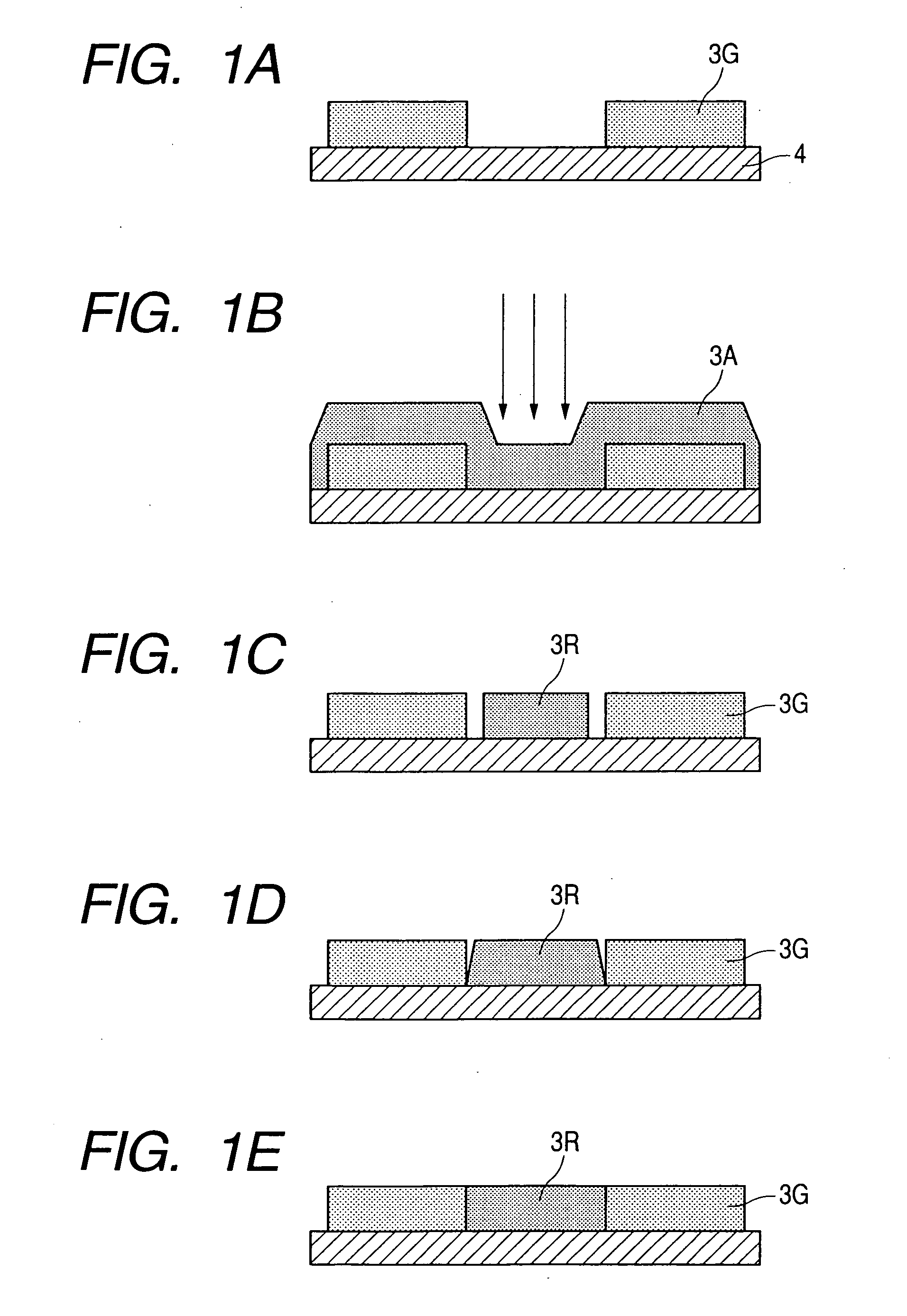
[0052]FIGS. 1A to 1E are sectional views showing a manufacture procedure in a first embodiment of a solid state image pickup element of the present invention.
[0053] The solid state image pickup element shown in FIGS. 1A to 1E has a pixel pitch of 9 μm and color filters are arranged in accordance with the Bayer pattern similar to the conventional solid state image pickup elements shown in FIGS. 12 and 13. The structure of this solid state image pickup element is identical with that of the conventional solid state image pickup element shown in FIG. 8 except the shapes of the color filters, and therefore a description of the identical part is omitted here.
[0054] In a solid state image pickup element manufacturing method of this embodiment, the first step is to apply negative color resist with, for example, a green (G) pigment dispersed therein to a surface of a first planarization film 4 as shown in FIG. 1A. Then a mask which blocks light except where G filters are to be formed is pl...
second embodiment
[0062]FIGS. 3A to 3E are sectional views showing a manufacture procedure in a second embodiment of a solid state image pickup element of the present invention.
[0063] The solid state image pickup element shown in FIGS. 3A to 3E, similarly to the first embodiment, has a pixel pitch of 9 μm and color filters are arranged in accordance with the Bayer pattern.
[0064] In a solid state image pickup element manufacturing method of the second embodiment, the first step is to apply negative color resist with, for example, a green (G) pigment dispersed therein to a surface of a first planarization film 4 as shown in FIG. 3A. Then a mask which blocks light except where G filters 13G are to be formed is placed for irradiation with ultraviolet rays having a wavelength of, for example, 365 nm, and for subsequent development. Thus G filters 13G are formed on the first planarization film 4.
[0065] In this embodiment, the G filters 13G are exposed to light through ultraviolet irradiation of varying ...
third embodiment
[0074]FIGS. 6A to 6E are sectional views showing a manufacture procedure in a third embodiment of a solid state image pickup element of the present invention.
[0075] The solid state image pickup element shown in FIGS. 6A to 6E, similarly to the first embodiment, has a pixel pitch of 9 μm and color filters are arranged in accordance with the Bayer pattern.
[0076] In a solid state image pickup element manufacturing method of the third embodiment, similarly to the first embodiment, the first step is to apply negative color resist with, for example, a green (G) pigment dispersed therein to a surface of a first planarization film 4. Then a mask which blocks light except where G filters 23G are to be formed is placed for irradiation with ultraviolet rays having a wavelength of, for example, 365 nm, and for subsequent development. Thus G filters 23G are formed on the first planarization film 4 as shown in FIG. 6A. In this embodiment, the G filters 23G are exposed to light through ultraviol...
PUM
| Property | Measurement | Unit |
|---|---|---|
| wavelength | aaaaa | aaaaa |
| width | aaaaa | aaaaa |
| width | aaaaa | aaaaa |
Abstract
Description
Claims
Application Information
 Login to View More