

N-aryl diazaspiracyclic compounds and methods of preparation and use thereof
a technology of diazaspiracyclic compounds and diazaspiracyclic amines, which is applied in the field of naryl diazaspiracyclic compounds and methods of preparation, can solve the problems of nicotinic compounds and various undesirable side effects, and achieve the effects of reducing the number of nicotinic cholinergic receptors of the brain, preventing and suppressing symptoms, and increasing blood pressure and heart ra
- Summary
- Abstract
- Description
- Claims
- Application Information
AI Technical Summary
Benefits of technology
Problems solved by technology
Method used
Image

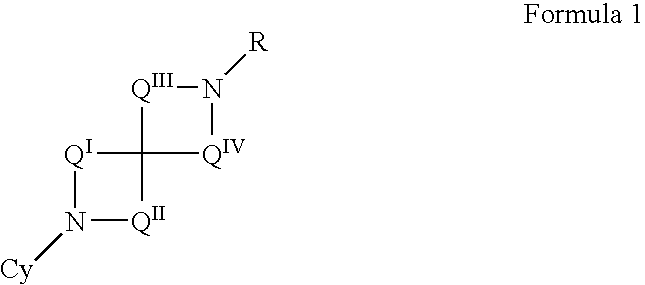
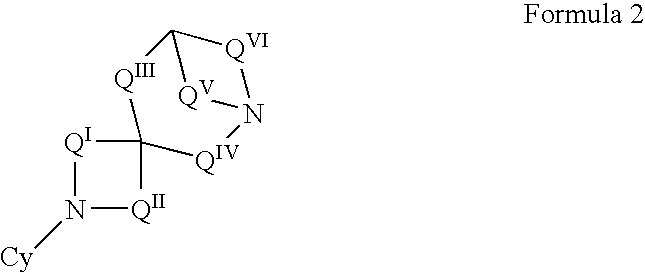
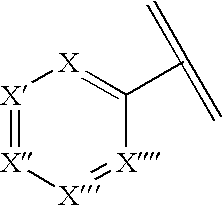
Examples
example 1
[0247] Sample No. 1 is 7-(3-pyridyl)-1,7-diazaspiro[4.4]nonane dihydrochloride, which was prepared according to the following techniques:
[0248] Nitroethylene was prepared accordingly to the procedure reported by Ranganathan, et al., J. Org. Chem. 45: 1185 (1980).
Ethyl 2-(2-nitroethyl)-1-benzylpyrrolidine-2-carboxylate
[0249] Under a nitrogen atmosphere, a solution of diisopropylamine (4.34 g, 6.01 mL, 42.9 mmol) in dry THF (50 mL) was cooled in an ice bath as n-butyllithium (17.1 mL of 2.5 M in hexane, 42.8 mmol) was added by syringe. The ice bath was removed and the solution of lithium diisopropylamide was first warmed to ambient temperature and then transferred by cannula into a stirred solution of ethyl (S)-N-benzyl pyrrolidine-2-carboxylate (10.0 g, 42.9 mmol) (Fluka) in dry THF (50 mL), held at −78° C. under nitrogen. The addition took 10 min. After stirring an additional 30 min at −78° C., the enolate solution was treated (via cannula) with a solution of nitro...
example 2
[0254] Sample 2 is 1-(3-pyridyl)-1,7-diaza-spiro[4.4]nonane dihydrochloride, which was prepared according to the following techniques:
tert-Butyl 6-benzyl-2,6-diazaspiro[4.4]nonane-2-carboxylate
[0255] Di-t-butyl dicarbonate (1.45 g, 6.64 mmol) was added to a solution of 1-benzyl-1,7-diazaspiro[4.4]nonane (1.30 g, 6.01 mmol) and triethylamine (1 mL) in dichloromethane (25 mL), and the mixture was stirred at ambient temperature overnight. The mixture was poured into saturated aqueous sodium bicarbonate (10 mL) and extracted with chloroform (4×25 mL). The extracts were dried (K2CO3) and concentrated by rotary evaporation. The residue was column chromatographed on Merck silica gel 60 (70-230 mesh), eluting with 95:5:1 chloroform / methanol / aqueous ammonia, to give 1.85 g (97.4%) of viscous, colorless oil, after concentration of selected fractions.
tert-Butyl 2,6-diazaspiro[4.4]nonane-2-carboxylate
[0256] A solution of t-butyl 6-benzyl-2,6-diazaspiro[4.4]nonane-2-carboxylate (1.70 g, 5.37...
example 3
[0259] Sample 3 is 1-methyl-7-(3-pyridyl)-1,7-diazaspiro[4.4]nonane, which was prepared according to the following techniques:
1-Methyl-7-(3-pyridyl)-1,7-diazaspiro[4.4]nonane
[0260] 7-(3-Pyridyl)-1,7-diazaspiro[4.4]nonane (30 mg, 0.15 mmol) was dissolved in 98% formic acid (0.5 mL) and formaldehyde (1 mL, 28% aqueous solution). The reaction mixture was heated to reflux for 8 h. The reaction mixture was cooled to room temperature, basified with saturated aqueous sodium bicarbonate to pH 9-10 and extracted with chloroform (4×3 mL). The combined chloroform extracts were dried (K2CO3), filtered and concentrated on a rotary evaporator to afford 30 mg of the desired compound (93.6%) as a light brown liquid.
PUM
 Login to View More
 Abstract
Description
Claims
Application Information
 Login to View More