

Reactive codoping of gaalinp compound semiconductors
a technology of reacting codoping and compound semiconductors, which is applied in the direction of chemically reactive gases, crystal growth process, polycrystalline material growth, etc., can solve the problems of difficult to achieve high p-type conductivity, heavy p-type doping of gaalinp compound semiconductors with high al content, such as alinp, and difficult to achieve single acceptors
- Summary
- Abstract
- Description
- Claims
- Application Information
AI Technical Summary
Benefits of technology
Problems solved by technology
Method used
Image


Examples
example 1
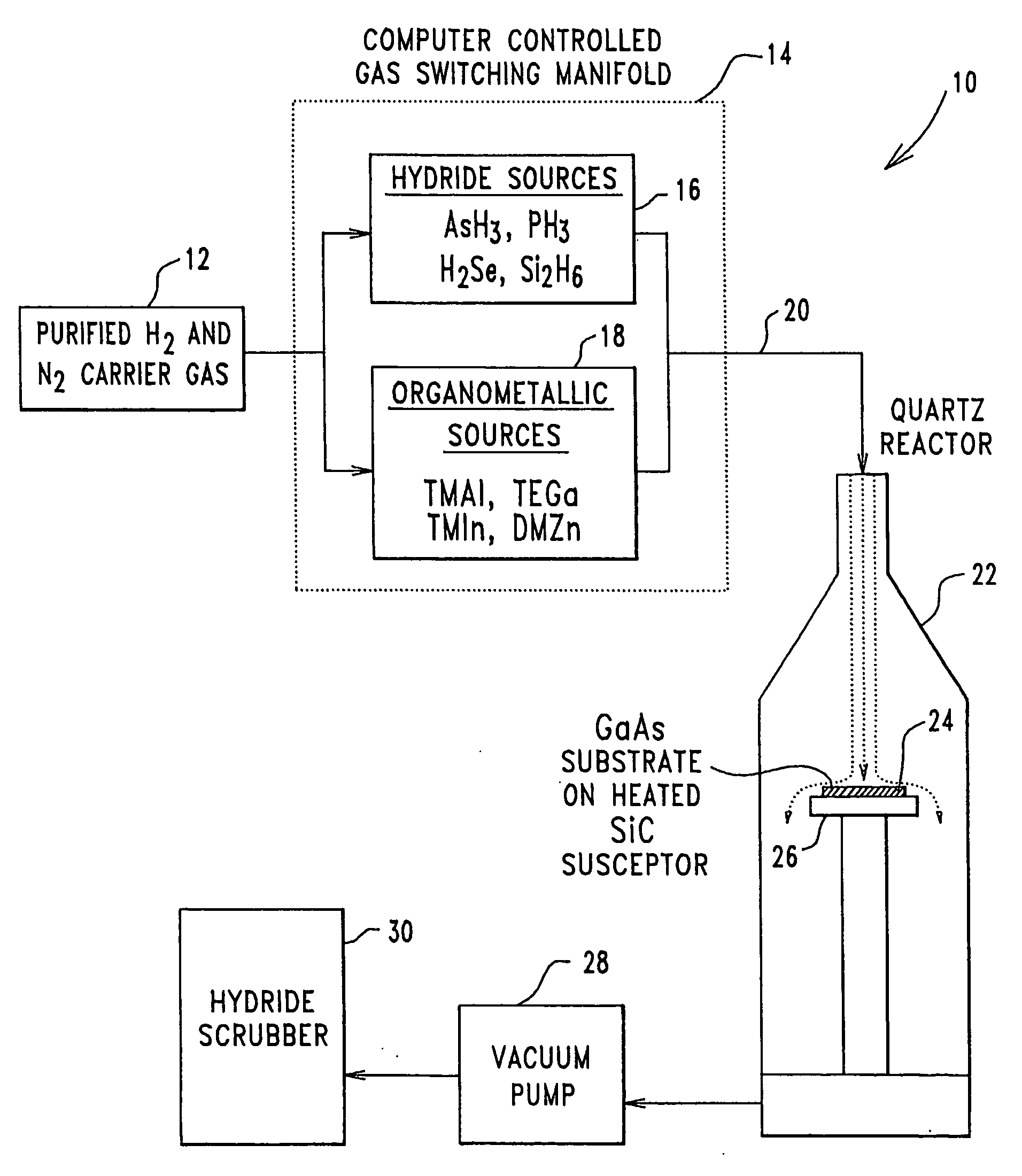
[0021] A GaAs single crystal with a 511A crystallographic orientation was used as a substrate for the growth of an AlInP single crystal and was located in a metal organic chemical vapor deposition (MOCVD) reactor held at seventy-five (75) torr. AlInP single crystals closely lattice matched to the GaAs were epitaxially grown at temperatures of 540° C.-600° C. by supplying 0.4 sccm of trimethylaluminum, 0.22 sccm of trimethylindium, and 250 sccm of phosphine in ten (10) slm of hydrogen carrier gas. Zn doping was accomplished by introducing dimethylzinc at flow rates of 0.32 to 3.2 sccm. Se doping was accomplished by introducing a gas mixture consisting of 100 ppm of H2Se in hydrogen at flow rates of two (2) to one hundred (100) sccm. Various combinations of Zn doped only and Zn+Se codoped AlInP crystals were grown. The atomic Zn and Se concentrations, NZn and NSe, respectively, were measured by secondary ion mass spectroscopy (SIMS) and are summarized in Table 1. In the AlInP crystal ...
example 2
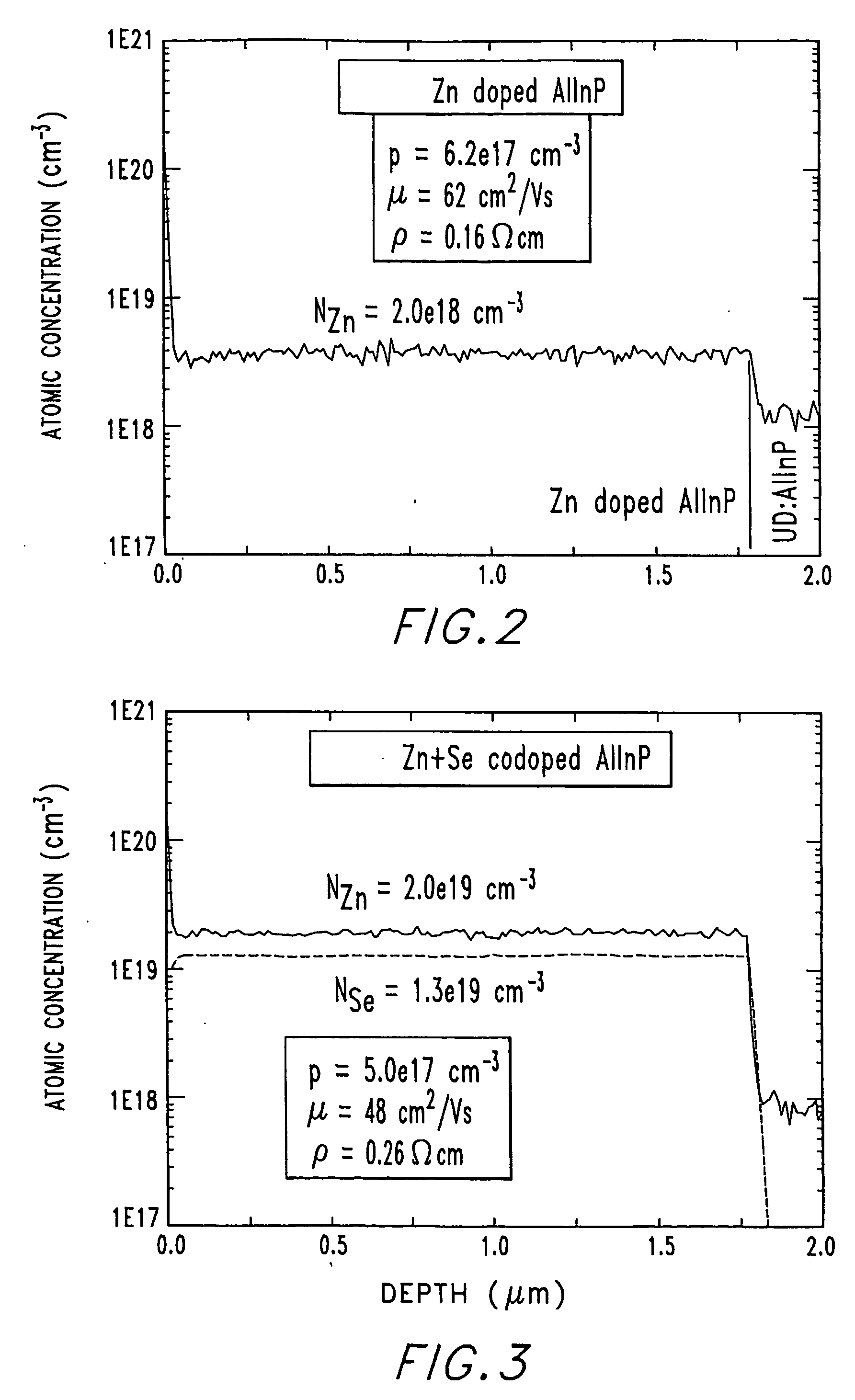
[0022] A GaAs single crystal with a 511A crystallographic orientation was used as a substrate for the growth of an AlInP single crystal and was located in a metal organic chemical vapor deposition (MOCVD) reactor at held seventy-five (75) torr. Zn doped only and Zn+Se codoped AlInP single crystals closely lattice matched to the GaAs were epitaxially grown on an undoped AlInP buffer layer at temperature of 600° C. by supplying 0.4 sccm of trimethylaluminum, 0.22 sccm of trimethylindium, and 250 sccm of phosphine in ten (10) slm of hydrogen carrier gas. Zn doping was accomplished by introducing dimethylzinc at flow rate of 1.6 sccm. Se doping was accomplished by introducing a gas mixture consisting of 100 ppm of H2Se in hydrogen at a flow rate of ten (10) sccm. The profiles of atomic Zn and Se concentrations, NZn and NSe, respectively, in Zn doped only and Zn+Se codoped AlInP single crystals were measured by secondary ion mass spectroscopy (SIMS) and are illustrated in FIGS. 2 and 3, ...
example 3
[0023] A GaAs single crystal with a 511A crystallographic orientation was used as a substrate for the growth of an AlInP single crystal and was located in a metal organic chemical vapor deposition (MOCVD) reactor at held seventy-five (75) torr. Very heavily Zn doped AlInP single crystals closely lattice matched to the GaAs were epitaxially grown at temperature of 540° C. by supplying 0.4 sccm of trimethylaluminum, 0.22 sccm of trimethylindium, and 400 sccm of phosphine in ten (10) slm of hydrogen carrier gas. Zn doping was accomplished by introducing dimethylzinc at a flow rate of 0.32 sccm. Se doping was accomplished by introducing a gas mixture consisting of 100 ppm of H2Se in hydrogen at a flow rate of one hundred (100) sccm. The profiles of atomic Zn and Se concentrations, NZn and NSe, respectively, in Zn doped only and Zn+Se codoped AlInP single crystals were measured by secondary ion mass spectroscopy (SIMS) and are illustrated in FIG. 4 and FIG. 5, respectively. At these high...
PUM
 Login to View More
 Abstract
Description
Claims
Application Information
 Login to View More