

Separatory and emulsion breaking processes
- Summary
- Abstract
- Description
- Claims
- Application Information
AI Technical Summary
Benefits of technology
Problems solved by technology
Method used
Image

Examples
example 1
[0045] 97 ml of crude oil along with 3 ml of D.I. water were admitted to each test cell along with the candidate emulsion breaker materials. The crude / water / treatment mixtures were homogenized by mixing each of the test cell tubes at 13,000 rpm for 2 seconds. The test cell tubes were heated to about 250° F. Water drop (i.e., water level) in ml was observed for each sample after the predetermined time intervals according to the schedule. Results are shown in Table 1.
TABLE 1Treatmentppm1 min2 min4 min8 min16 min32 min64 minSumI / FBlank0000.10.10.20.20.20.8.4 IF10.500.20.40.81.622.257.251200.20.81.422.52.59.41500.11.41.82.83312.111000.10.81.62.42.5310.42W1571000.40.611.825.82W1575001.41.6233112W157100011.422.52.59.4Blank000.20.811.4227.4.3 IF10.500.22.2344518.41200.12.544.55521.11500.11.833.544.516.911000.21.422.533.512.62W157100.2233.544.517.22W157500.22.53.54.55520.72W1571000.22.5444.54.519.7Blank000.2122.53412.70.3P-84500.41.4233.5515.32500.433.544.5520.45500.433.53.54519.40.53500....
example 2
[0046] Another series of tests was performed using the simulated desalter apparatus described in Example 1. In this series of test, 95 ml of crude oil and 5 ml of D.I. water plus treatment were added to the test cells. Results are shown in Table 2.
TABLE 2Treatmentppm1 min2 min4 min8 min16 min32 minSumBlank000.21.422.54.510.62W15750234.55519.56500.422.52.5310.4P-845012.534515.52502.54.54.85521.8
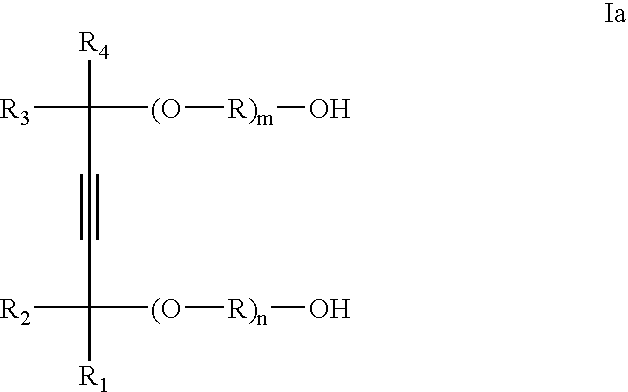
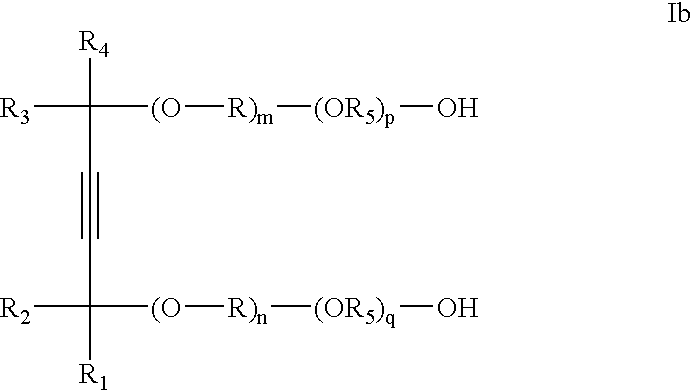
Treatment 6 = (TMDD-5)-
example 3
[0047] Another test series was undertaken to assess the efficacy of candidate materials in breaking bitumen emulsions. These tests were similar to those reported in Example 1 with exceptions noted in the table and the fact that an electrical field was not imparted to the test emulsions. Results are reported in Table 3.
TABLE 3Ratio of bitumen emulsion to diluent 80%::20%Conditions: Blended at 10,000 rpm for THREE secondsGrids offAmount of emulsion remaining afterDiluent + mLTreatmentppm1 min2 min4 min8 min16 min32 minsumOil recoveredBlank080808080808048002W157500505050505050300180 7500454848505050291189 850080808060706543545 950053535452545432016010500808080607063433471150050505050555831316712500454747474747280200
Without treatment, the bitumen emulsion was completely unbroken under the conditions used. [0048] Treatment 7=combination of a) TMDD-5 and b) PEO / PPO block copolymer, PEO=40 molar %; mw≈4,000; a) is present in amount of 5 wt %; remainder b) [0049] Treatment 8=combination ...
PUM
| Property | Measurement | Unit |
|---|---|---|
| Fraction | aaaaa | aaaaa |
| Fraction | aaaaa | aaaaa |
| Percent by mass | aaaaa | aaaaa |
Abstract
Description
Claims
Application Information
 Login to View More