

Method for Identification of Enzymes
a technology of enzymes and enzymes, applied in the field of enzyme identification, can solve the problems of low yield of synthetic or semi-synthetic production of natural products, uneconomical or impossible to synthesize, and limited extraction of natural products from native sources
- Summary
- Abstract
- Description
- Claims
- Application Information
AI Technical Summary
Problems solved by technology
Method used
Image

Examples
example 1
Isolation of Eleutherobin, Nucleic Acids and Protein from Cultured Erythropodium caribaeorum
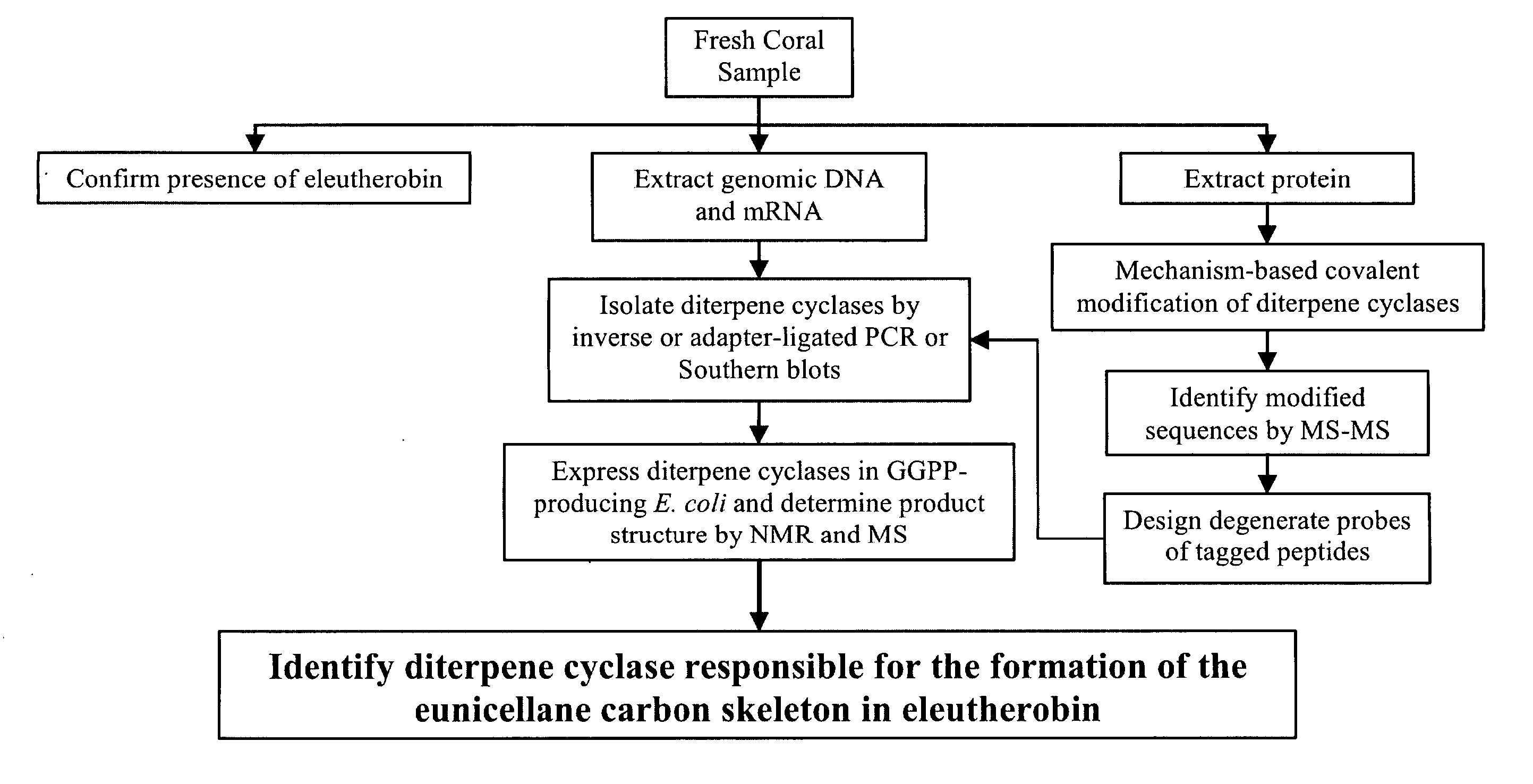
[0128] Approximately 2 kg of cultured Erythropodium caribaeorum is obtained from a commercial source, such as Ocean Dreams Inc. in Tampa, Fla. This is shipped in chilled seawater to retain the coral viability. This sample is divided and used for three purposes: 1) to verify the presence of eleutherobin within the sample, 2) to obtain genomic DNA and mRNA to be used in hybridization and PCR-based identification of terpene synthases, and 3) to obtain cell lysates to be used in the functionally-based covalent modification of diterpene synthases.
Eleutherobin Extraction
[0129] Eleutherobin is extracted from approximately 500 g of coral through a methanol extraction, as described in Taglialatela-Scafati et al. (2002) Org Lett 4(23):4085-8. Briefly, extracts are vacuum concentrated and hydrophobic organic compounds are back extracted with 50% v / w ethyl acetate. The organic layer is partitioned be...
example 2
Functionally-Based Covalent Modifications of Diterpene Synthases in Erythropodium caribaeorum and its Symbionts
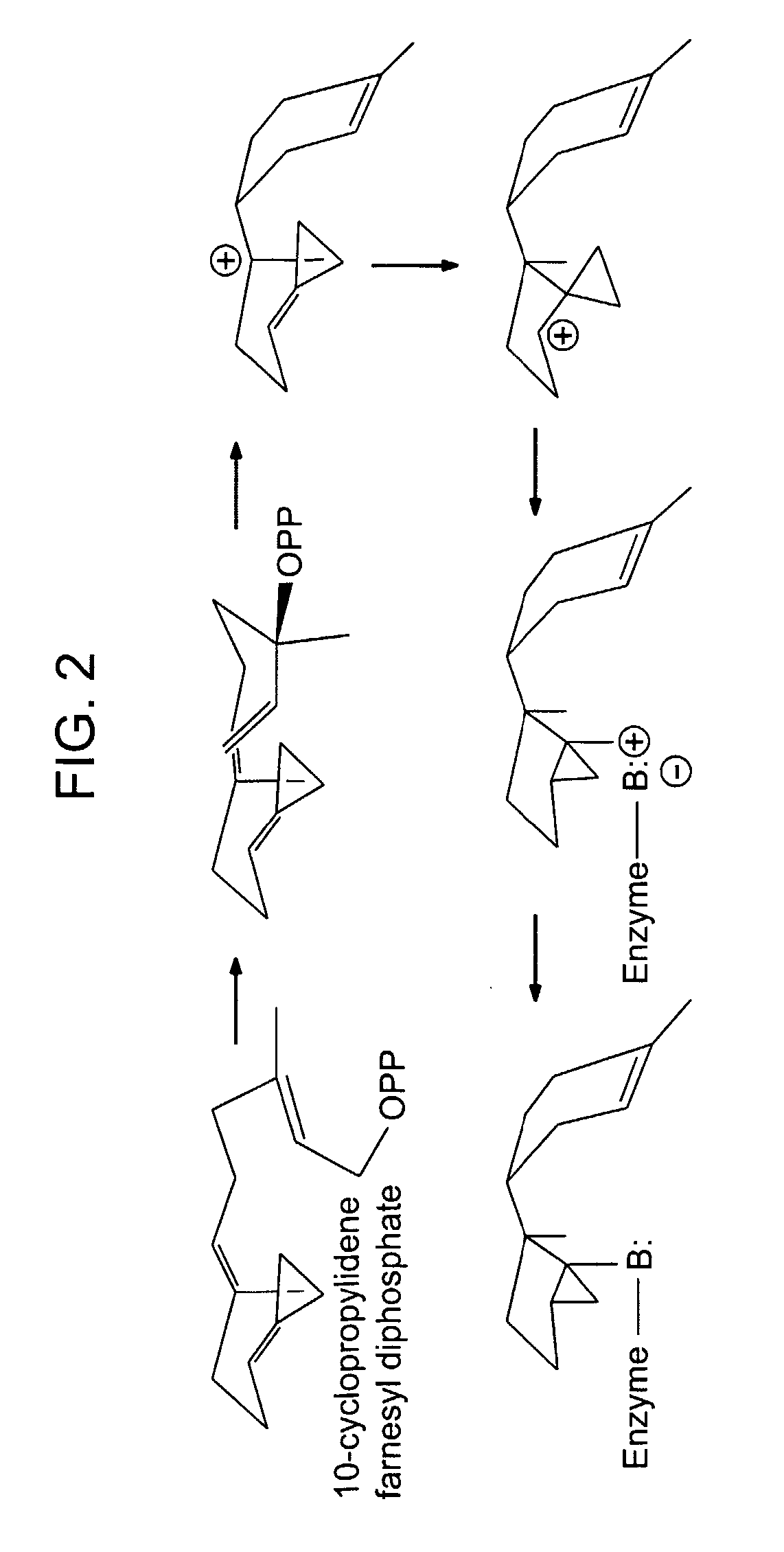
[0132] In order to obtain probes specific for diterpene synthases in the coral sample, the terpene synthase inhibitors developed by Cane et al., supra, (specifically, CP-GGPP) are used to covalently modify all enzymes that cyclize GGPP. The inhibitor-tagged synthases are identified and the peptides that comprise the enzymes are sequenced using liquid chromatography-tandem mass spectrometry (LC tandem-MS) analysis, on Applied Biosystems QTRAP and QSTAR mass spectrometers.
[0133] Upon inspection of the eunicellane skeleton, the reaction mechanism is expected to be analogous to that of epi-cubenol and cadinene synthases (sesquiterpene synthases) (Benedict et al. (2001) Plant Physiol 125(4):1754-65). An initial ring closure at C1 to C14 would be followed by a migration of the carbocation from the C-15 position to the C-1 position due to a 1,3-hydride shift (FIG. 7). While the ...
example 3
Isolation of Full Length Diterpene Synthase Gene Sequence(s)
[0141] Full length diterpene synthases genes are isolated by PCR of adaptor-ligated cDNA or from a partial genomic library. PCR amplification of adaptor-ligated cDNA uses one gene specific primer and one primer which anneals to the double stranded adaptor ligated to the cDNA (Chenchik et al. (1996) Biotechniques 21(3):526-34). For purposes of this experiment, synthase specific, degenerate primers are designed to hybridize to all possible codon sets corresponding to the specific peptide sequences identified from the diterpene synthase inhibitor tagging LC-tandem-MS experiments previously described. cDNA is synthesized according to well established protocols using both random hexamer primers (for archeal and bacterial mRNA) and an oligo-dT approach (for eukaryotic mRNA) in order to assure coverage of mRNA from Erythropodium and its symbionts. The Marathon cDNA amplification kit from BD Biosciences Clontech (Palo Alto, Calif....
PUM
| Property | Measurement | Unit |
|---|---|---|
| temperature | aaaaa | aaaaa |
| temperature | aaaaa | aaaaa |
| pH | aaaaa | aaaaa |
Abstract
Description
Claims
Application Information
 Login to View More