
Sterilization of Flowable Food Products
a flowable food and sterilization technology, applied in auxillary pretreatment, instruments, separation processes, etc., can solve the problems of simultaneous heating and dilution of liquid products, difficult treatment at temperatures of about 250° f., and difficult using traditional pasteurization equipment, so as to avoid browning and flavor degradation, prolong heating times, and high heat treatment
- Summary
- Abstract
- Description
- Claims
- Application Information
AI Technical Summary
Benefits of technology
Problems solved by technology
Method used
Image

Examples
example
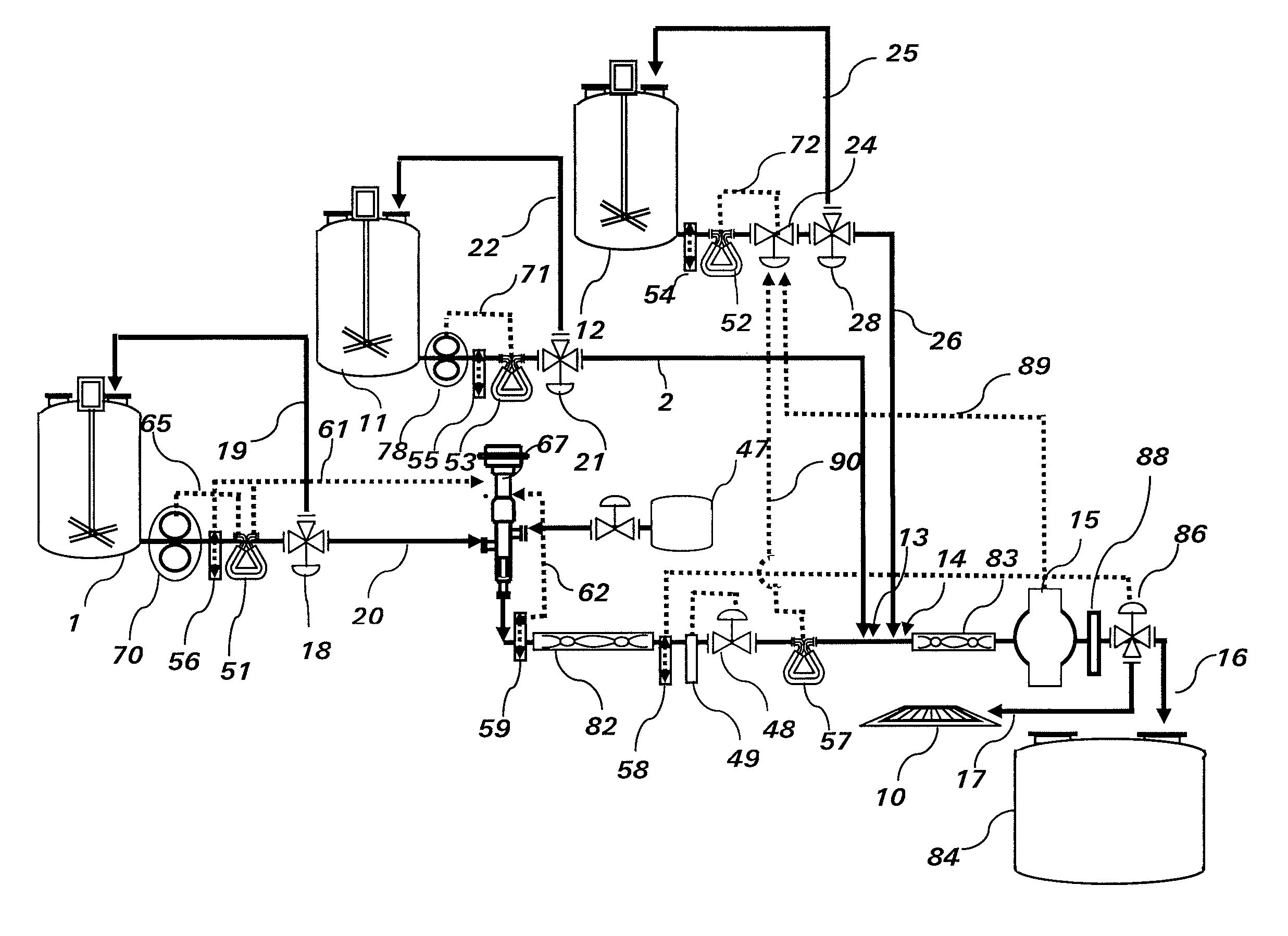
[0070]A finished juice product was prepared by continuously blending three streams of liquid: hot juice concentrate (treated with direct steam injection), high fructose corn syrup, and hot water. A stream of juice concentrate compound held at about 20° F. to 70° F. was passed through a tube at approximately 0.3 gallons per minute and sterilized by direct steam injection at 255° F. for 3.5 seconds at 100 psig. The resulting stream of sterilized juice compound was continuously blended with a stream of high fructose corn syrup (HFCS) with a flow rate of approximately 2.5 gallons per minute and a temperature of about 90° F. and a stream of hot water with a flow rate of approximately 17 gallons per minute at a temperature of 195° F. The finished product was pasteurized at about 185° F. to about 195° F. for about 2 seconds. The high temperature of all components achieved combination of the three streams and pasteurization of the finished product all in one step. If the stream of juice con...
PUM
| Property | Measurement | Unit |
|---|---|---|
| Temperature | aaaaa | aaaaa |
| Temperature | aaaaa | aaaaa |
| Temperature | aaaaa | aaaaa |
Abstract
Description
Claims
Application Information
 Login to View More