Methods of forming a phase-change material layer pattern, methods of manufacturing a phase-change memory device and related slurry compositions

a technology of phase-change material and layer pattern, which is applied in the direction of solid-state devices, manufacturing tools, lapping machines, etc., can solve the problems of affecting the operation efficiency of the pram device, the damage of the phase-change material layer, and the loss of data stored in the volatile semiconductor memory device. , to achieve the effect of enhancing polishing efficiency, reducing selectivity, and reducing the number o

a technology of phase-change material and layer pattern, which is applied in the direction of solid-state devices, manufacturing tools, lapping machines, etc., can solve the problems of affecting the operation efficiency of the pram device, the damage of the phase-change material layer, and the loss of data stored in the volatile semiconductor memory device. , to achieve the effect of enhancing polishing efficiency, reducing selectivity, and reducing the number o

US20090149006A1Active Publication Date: 2009-06-11SAMSUNG ELECTRONICS CO LTD

Image

Smart Image Click on the blue labels to locate them in the text.
Viewing Examples
Smart Image
  • Methods of forming a phase-change material layer pattern, methods of manufacturing a phase-change memory device and related slurry compositions
  • Methods of forming a phase-change material layer pattern, methods of manufacturing a phase-change memory device and related slurry compositions
  • Methods of forming a phase-change material layer pattern, methods of manufacturing a phase-change memory device and related slurry compositions

Examples

Experimental program
Comparison scheme
Effect test

example 1

[0102]A slurry composition was prepared by mixing about 3.5 wt % of colloidal silica, about 3 wt % of citric acid, about 0.2 wt % of hydrogen peroxide, about 0.2 wt % of benzotriazole and a remaining amount of deionized water, and by adding a pH-controlling agent, e.g., hydrochloric acid, to the mixture until the pH of the composition was about 4.0.

examples 2 through 7

[0103]Slurry compositions were prepared by performing a process substantially the same as that of Example 1, except that amounts of the abrasive, citric acid, hydrogen peroxide and benzotriazole were changed. The amounts of the abrasive, citric acid, hydrogen peroxide and benzotriazole are shown in Table 1. The unit of the amount is percent by weight.

TABLE 1SilicaCitric AcidHydrogen PeroxideBenzotriazoleExample 13.530.20.2Example 23.530.1—Example 33.530.2—Example 410.50.2—Example 510.50.20.1Example 610.50.20.2Example 710.50.20.3

[0104]Evaluation of Polishing Rates and Polishing Selectivity

[0105]A polishing process was performed on a phase-change material layer and a silicon oxide layer using each of the slurry compositions prepared in Examples 1 through 7 to evaluate polishing selectivities of the slurry compositions.

[0106]The phase-change material layer was formed on a silicon wafer by performing a CVD process using germanium-antimony-tellurium (GST). The phase-change material layer...

the structure of the environmentally friendly knitted fabric provided by the present invention; figure 2 Flow chart of the yarn wrapping machine for environmentally friendly knitted fabrics and storage devices; image 3 Is the parameter map of the yarn covering machine
Login to View More

PUM

No PUM Login to View More

Abstract

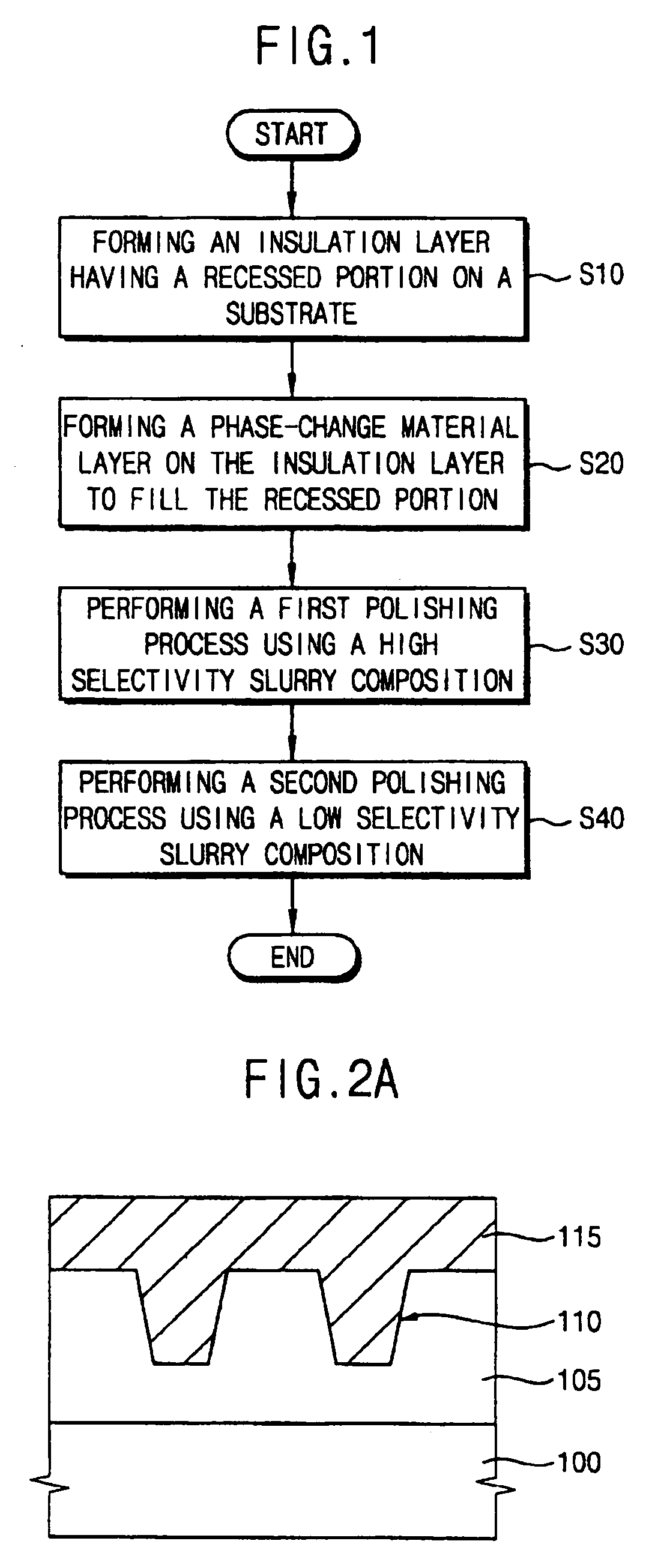
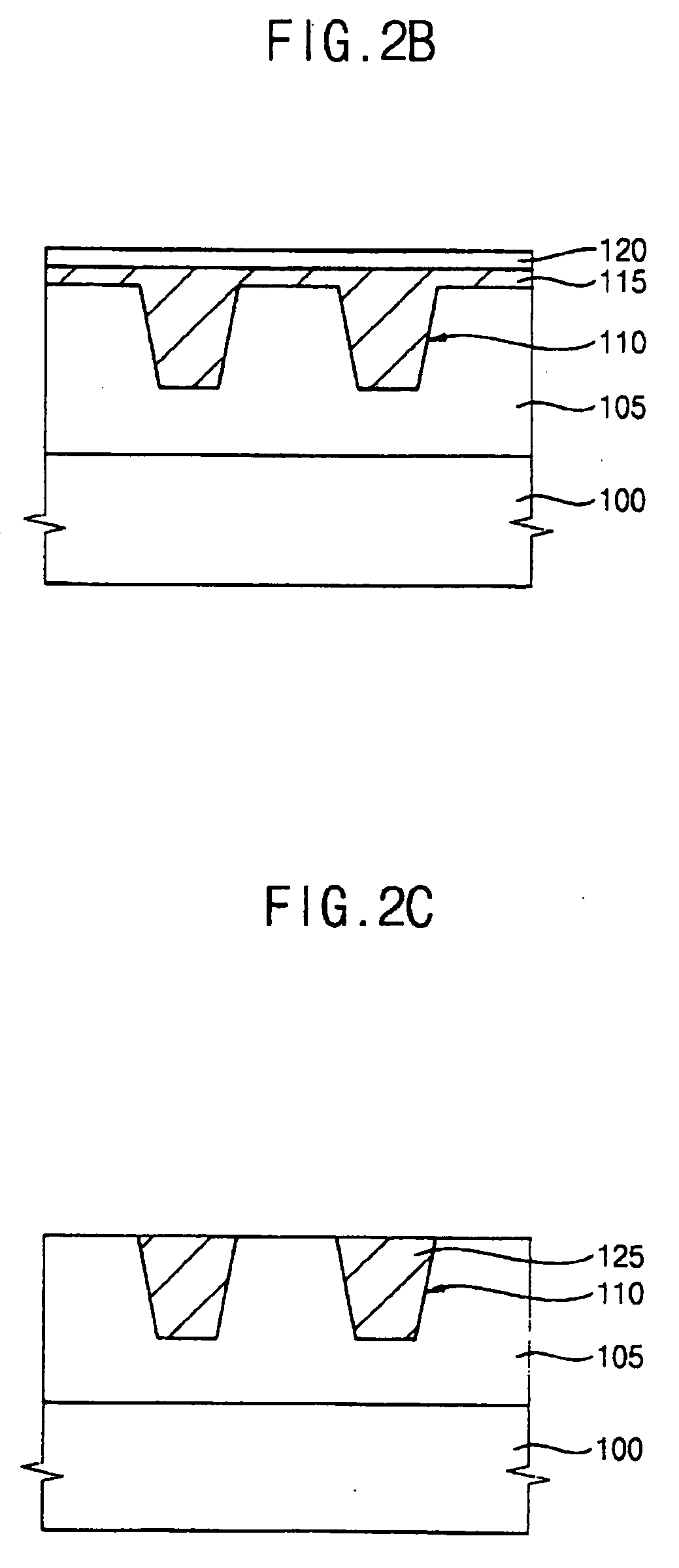
In methods of forming a phase-change material layer pattern, an insulation layer having a recessed portion may be formed on a substrate, and a phase-change material layer may be formed on the insulation layer to fill the recessed portion. A first polishing process may be performed on the phase-change material layer using a first slurry composition to partially remove the phase-change material layer, the first slurry composition having a first polishing selectivity between the insulation layer and the phase-change material layer. A second polishing process may be performed on the phase-change material layer using a second slurry composition to form a phase-change material layer pattern in the recessed portion, the second slurry composition having a second polishing selectivity substantially lower than the first polishing selectivity.

Description

BACKGROUND[0001]1. Field[0002]Example embodiments relate to methods of forming a phase-change material layer pattern, methods of manufacturing a phase-change memory device and related slurry compositions. More particularly, example embodiments relate to methods of forming a phase-change material layer pattern using a chemical mechanical polishing (CMP) process, methods of manufacturing a phase-change memory device and related slurry compositions.[0003]2. Description of the Related Art[0004]Semiconductor memory devices may be generally divided into volatile semiconductor memory devices, e.g., dynamic random access memory (DRAM) devices or static random access memory (SRAM) devices, and non-volatile semiconductor memory devices, e.g., flash memory devices or electrically erasable programmable read only memory (EEPROM) devices. The volatile semiconductor memory device loses data stored therein when the power is turned off. However, the non-volatile semiconductor memory device retains s...

Claims

the structure of the environmentally friendly knitted fabric provided by the present invention; figure 2 Flow chart of the yarn wrapping machine for environmentally friendly knitted fabrics and storage devices; image 3 Is the parameter map of the yarn covering machine
Login to View More

Application Information

Patent Timeline
11 Jun 2009
Publication
US20090149006A1
IPC
H01L21/20; B24B37/00; H01L21/304; H01L27/105; H01L45/00
CPC
H01L27/2409; H01L27/2436; H01L45/1683; H01L45/144; H01L45/06; H10B63/20; H10B63/30; H10N70/231
Inventors
KIM, JONG-YOUNG