Unlock instant, AI-driven research and patent intelligence for your innovation.

Method and apparatus for fluorogenic determination of lead concentrations

Inactive Publication Date: 2009-08-20
SAINT LOUIS UNIVERSITY
View PDF6 Cites 21 Cited by
  • Summary
  • Abstract
  • Description
  • Claims
  • Application Information

AI Technical Summary

Benefits of technology

[0023]The present invention is related to chemical sensing, particularly through fluorescence, which demonstrates the utility of fluorogenic probes for specific quantification of lead in biological cells. The invention more specifically is a method and apparatus for the use of fluorogenic and luminescent probes for development of a rapid, and cost-effective determination of lead clearance following lead hazard control activities. The invention involves the use of chemifluorescent probes and in the alternative chemiluminescent probes for efficient detection of lead in dust on hard surfaces at regulatory levels. The use of methods for lead visualization based on one or more of the fluorogenic or luminescent type compounds would be highly beneficial to lead abatement projects. The identification of areas of high lead concentration (hotspots) can allow work to be focused on areas that have the greatest impact on clearance. Also, a rapid, portable and cost-effective means of determining if lead clearance has been met can improve compliance with lead abatement activities. This would decrease the amount of time and materials spent in general surface cleaning and allow the elimination of isolated areas of lead concentration that may otherwise have been missed.
[0030]An example of a potential application of CL technology is the incorporation of a fluorogenic compound in lead abatement detergents can allow a real-time evaluation of cleaning efficacy. Essentially, a surface can be cleaned using a wipe and detergent spray to the point of low or no fluorescence. To accomplish this fluorogenic compounds can be used on environmental surfaces in a home. The fluorogenic probe compounds can “turn-on” at critical lead concentrations that represent clearance values. New technology using fluorogenic probes to detect lead in house dust could speed up the process of declaring clearance or vastly improve lead detection after repair and renovation activities that currently rely on comparison of a wiped cloth to a photomicrograph standard that EPA developed to correlate to a level of contamination that is below the dust lead hazard in 40 CFR 745.65b. However this potential application is not the primary focus or embodiment of the present invention.
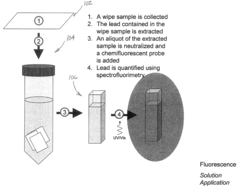
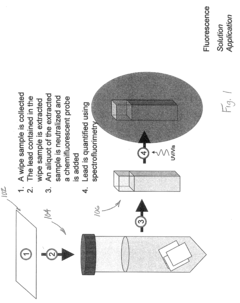
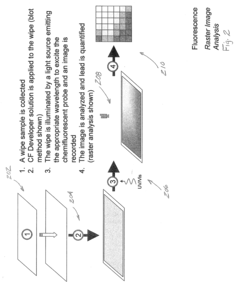
[0033]A probe that has turn on ability but is easily dissolved in a non-toxic solvent, such as water, would enhance the ability to increase extraction efficiency of lead from a dust-wipe . This would accommodate lead on wipes, where a lead gradient or hot spots exists, yet fully solvate lead with a probe that would turn on at a critical level, such as one that is near the clearance level for lead on floors, 40 ug / ft2. After swiping a wipe, the wipe can be placed in a developer solution with probe and the fluorescence emission can be measured. The solution can be shaken vigorously prior taking the measurement. It is also important that a probe be found that has an absorption spectra that can make use of an inexpensive source of light, such as a black lamp.
[0036]The use of various types of black or LW lamps and bulbs on chemosensor fluorescence can enhance the measurement technique. After the surfaces are sprayed and allowed to develop, and they can then be illuminated with various types of commercially available black lights. The distance from the bulb to surface can be predefined, and emission intensity can be measured using specially designed software. A digital picture of the surface can be taken and screened to measure average fluorescence intensity as described previously. Average fluorescence intensity can be compared against light intensity and against light type.
[0039]Current work in lead abatement has been reliant on wipe samples taken from a surface to verify the extent of lead contamination, usually through laboratory testing and it is time consuming and expensive. New technology using CL or CF probes to detect lead in house dust could speed up the process of declaring clearance or vastly improve lead detection after repair and renovation activities that currently rely on comparison of a wiped cloth to a photomicrograph standard that EPA developed to correlate to a level of contamination that is below the dust lead hazard in 40 CFR 745.65b. CL or CF probes can be developed in accordance with the present invention for a rapid, and cost-effective determination of lead clearance after lead hazard control activities. The present invention can be portable and cost efficient while providing sufficient accuracy and ratio-metric fidelity. These and other advantageous features of the present invention will be in part apparent and in part pointed out herein below.

Problems solved by technology

Specificity for a particular element or agent is an important quality for the ligand functional group, but this is not always possible.

Method used

the structure of the environmentally friendly knitted fabric provided by the present invention; figure 2 Flow chart of the yarn wrapping machine for environmentally friendly knitted fabrics and storage devices; image 3 Is the parameter map of the yarn covering machine
View more

Image

Smart Image Click on the blue labels to locate them in the text.
Viewing Examples
Smart Image
  • Method and apparatus for fluorogenic determination of lead concentrations
  • Method and apparatus for fluorogenic determination of lead concentrations
  • Method and apparatus for fluorogenic determination of lead concentrations

Examples

Experimental program
Comparison scheme
Effect test

Embodiment Construction

[0053]According to the embodiment(s) of the present invention, various views are illustrated in FIG. 1-11 and like reference numerals are being used consistently throughout to refer to like and corresponding parts of the invention for all of the various views and figures of the drawing. Also, please note that the first digit(s) of the reference number for a given item or part of the invention should correspond to the Fig. number in which the item or part is first identified.

[0054]One embodiment of the present invention comprising the use of a fluorogenic or alternatively a luminescent probe compound to detect the concentration of lead on a surface teaches a novel apparatus and method for detecting the presence of lead in a residential environment. One embodiment of the method for using CL or CF chemosensor probes for detection of lead for lead abatement activities includes wiping a suspect surface with a wipe, then placing the wipe in an extraction solution to extract the lead conta...

the structure of the environmentally friendly knitted fabric provided by the present invention; figure 2 Flow chart of the yarn wrapping machine for environmentally friendly knitted fabrics and storage devices; image 3 Is the parameter map of the yarn covering machine
Login to View More

PUM

No PUM Login to View More

Abstract

A method and apparatus for the use of fluorogenic probes for development of a rapid, and cost-effective determination of lead clearance following lead hazard control activities. The invention involves the use of fluorogenic chemosensors for efficient detection of lead in dust on hard surfaces at regulatory levels. The use of methods for lead visualization based on one or more of the fluorogenic type compounds would be highly beneficial to lead abatement projects. The identification of areas of high lead concentration (hotspots) can allow work to be focused on areas that have the greatest impact on clearance. Also, a rapid and cost-effective means of determining if lead clearance has been met can improve compliance with lead abatement activities. This would decrease the amount of time and materials spent in general surface cleaning and allow the elimination of isolated areas of lead concentration that may otherwise have been missed.

Description

CROSS REFERENCE TO RELATED APPLICATION[0001]This application is a non-provisional of and claims priority to U.S. Provisional Patent Application Ser. No. 61 / 028,095, filed Feb. 12, 2008, which document is hereby incorporated by reference herein to the extent permitted by law.BACKGROUND OF INVENTION[0002]1. Field of Invention[0003]This invention relates generally to lead abatement detection techniques and, more particularly, to portable detection techniques for lead abatement in a residence.[0004]2. Background Art[0005]People have used lead for different purposes for many years. Lead has been used for soldering pipes, in crystal glassware, in paint mixtures, and many other applications. The hazards of lead poisoning have been known, but only in relatively recent times has the extent of the threat to children moved to the forefront. The ingestion of lead is harmful to people of all ages, but is more damaging to children under six, and unborn fetuses because the developing nervous syste...

Claims

the structure of the environmentally friendly knitted fabric provided by the present invention; figure 2 Flow chart of the yarn wrapping machine for environmentally friendly knitted fabrics and storage devices; image 3 Is the parameter map of the yarn covering machine
Login to View More

Application Information

Patent Timeline
no application Login to View More
IPC IPC(8): G06K9/00G01T1/00G01N33/20
CPCG01N21/76G01N31/22G01N21/8806
Inventor EMO, BRETT M.LEWIS, ROGER D.ONG, KEE-HEANKENNEDY, JASON N.
Owner SAINT LOUIS UNIVERSITY