This helps you quickly interpret patents by identifying the three key elements:
Problems solved by technology
Method used
Benefits of technology
Benefits of technology
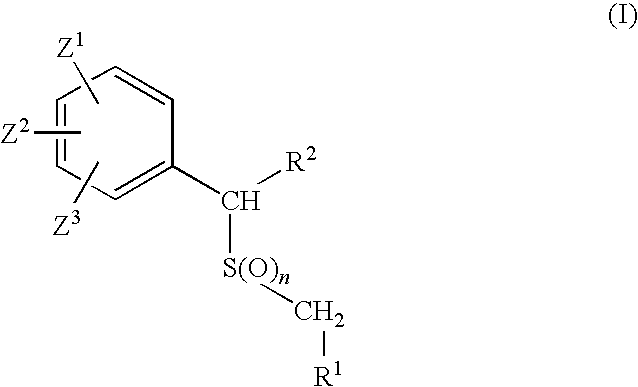
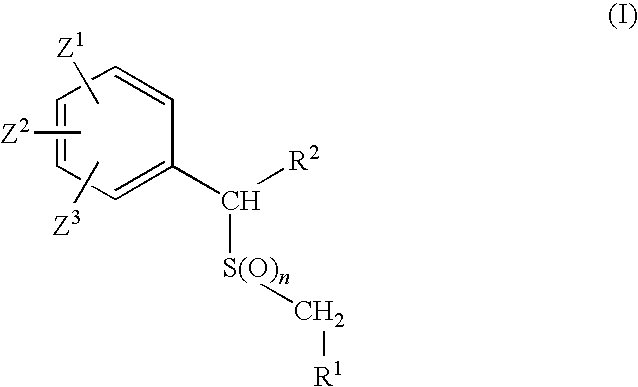
[0026]The inventors of the present invention have conducted various studies and found that a sulfide compound, a sulfoxide compound and a sulfone compound that are represented by the following general formula (I), strongly inhibit γ-secretase and thus suppress production and / or secretion of β-amyloid protein. Accordingly, the inventors have found out that the compounds are useful as a therapeutic agent for various diseases associated with abnormal production and / or secretion of β-amyloid protein, thereby leading to completion of the present invention. In addition, the inventors of the present invention have found that the sulfide compound, the sulfoxide compound and the sulfone compound that are represented by the following general formula (I) show sufficient solubility in water and realize sufficient drugefficacy when administered to an animal or to a human, thereby leading to completion of the present invention.
[0035]According to the present invention, a means for medically preventing and treating various diseases such as Alzheimer's disease, Down's syndrome or other diseases associated with amyloid deposition can be provided.
Problems solved by technology
Alzheimer's disease induces dementia symptoms, which is accompanied by progressive loss of memory, recognition, thinking, decisiveness or the like, and eventually leads to death.
Until now, no useful method for preventing or treating the disease is known.
Method used
the structure of the environmentally friendly knitted fabric provided by the present invention; figure 2 Flow chart of the yarn wrapping machine for environmentally friendly knitted fabrics and storage devices; image 3 Is the parameter map of the yarn covering machine
View more
Image
Smart Image Click on the blue labels to locate them in the text.
Viewing Examples
Smart Image
Click on the blue label to locate the original text in one second.
Reading with bidirectional positioning of images and text.
[0146]A suspension of 2-bromo-5-[chloro(2,3,6-trifluorophenyl)methyl]-4-methylpyridine (4.91 g, 14.0 mmol), 4-methoxytoluenethiol (2.59 g, 16.8 mmol) and potassiumcarbonate (2.32 g, 16.8 mmol) in N,N-dimethylformamide (10 ml) was stirred at room temperature for 29 hours. 4-Methoxytoluenethiol (1.08 mmol, 7.0 mmol) and potassiumcarbonate (967 mg, 7.0 mmol) were added to the reaction suspension, and the suspension was stirred at room temperature for 4 hours. Water was added to the reaction suspension, followed by extraction with ethyl acetate. The organic layer was washed with saturated saline, dried over anhydroussodiumsulfate, then filtered, and the filtrates were concentrated under reduced pressure. The concentrated residue obtained was subjected to filtering column eluting with hexane:ethyl acetate=1:1, and the eluent was concentrated under reduced pressure. The concentrated residue obtained...
[0152]A trifluoroacetic acid (30 ml) solution of 2-bromo-5-[[(4-methoxybenzyl)thio](2,3,6-trifluorophenyl)methyl]-4-methylpyridine (3.27 g, 6.98 mmol) was stirred at 60° C. for 2 days. The reaction solution was allowed to cool to room temperature, and then concentrated under reduced pressure. A methanol (30 ml) solution of the concentrated residue obtained was heated at reflux for 2.5 hours. The reaction solution was allowed to cool to room temperature, and then concentrated under reduced pressure. Methylenechloride was added to the concentrated residue obtained, and the resulting mixture was washed with saturated aqueous sodiumhydrogencarbonate. The organic layer was dried over anhydrousmagnesiumsulfate, then filtered, and the filtrates were concentrated under reduced pressure. The concentrated residue obtained was subjected to flash silica gelcolumn chromatography using 15% ethyl acetate / hexane as eluent....
[0155]Sodiumhydride (60 mg, 1.38 mmol) and 1,1,1-trifluoro-3-iodopropane (165 μl, 1.38 mmol) were added to a N,N-dimethylformamide (5 ml) solution of (6-bromo-4-methylpyridin-3-yl)(2,3,6-trifluorophenyl)methanethiol (400 mg, 1.15 mmol) at 0° C., and the solution was stirred at room temperature for 2 hours. Water was added to the reaction solution, followed by extraction with ethyl acetate. The organic layer was washed sequentially with water and saturated saline. The resulting organic layer was dried over anhydrousmagnesiumsulfate, and then concentrated under reduced pressure. The resulting residue was subjected to flash silica gelcolumn chromatography (hexane / ethyl acetate) to give the title compound (390 mg, 0.878 mmol, 76%) as a yellow oil.
[0156]1H-NMR (400 MHz, CDCl3) δ: 2.23 (3H, s), 2.29-2.46 (2H, m), 2.65-2.77 (2H, m), 5.48 (1H, s), 6.84-6.90 (1H, m), 7.08-7.16 (1H, m), 7.28 (1H, ...
the structure of the environmentally friendly knitted fabric provided by the present invention; figure 2 Flow chart of the yarn wrapping machine for environmentally friendly knitted fabrics and storage devices; image 3 Is the parameter map of the yarn covering machine
Login to View More
PUM
Login to View More
Abstract
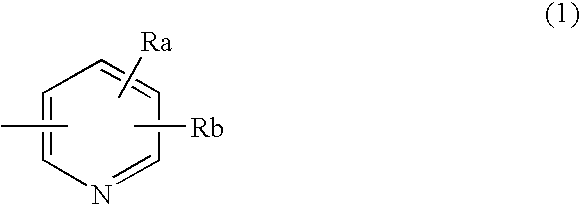
A compound having activity to inhibit production and / or secretion of β-amyloidprotein, and is useful for prevention and / or treatment of various diseases associated with abnormal production and / or secretion of β-amyloidprotein, the compound represented by the general formula (I):[wherein, R1 represents a C1-C6 alkyl group which may have 1 to 6 halogen atoms as substituent groups, a C2-C6 alkenyl group which may have 1 to 6 halogen atoms as substituent groups, or a C3-C7 cycloalkyl group which may have 1 to 6 halogen atoms as substituent groups; R2 represents a 6-membered nitrogen-containing monocyclic aromatic heterocyclic group having 1 to 3 substituent groups, or a 9- or 10-membered nitrogen-containing bicyclic heterocyclic group having 1 to 4 substituent groups; Z1, Z2 and Z3 each independently represent a hydrogen atom, a halogen atom or a cyano group; and n represents 0, 1 or 2], salts thereof, or solvates thereof.
Description
CROSS-REFERENCES TO RELATED APPLICATIONS[0001]This application is a continuation of International Application No. PCT / JP2008 / 066279, filed Sep. 10, 2008, which claims priority from Japanese Application No. 2007-235580, filed Sep. 11, 2007. Each application is incorporated herein in its entirety.TECHNICAL FIELD[0002]The present invention relates to a novel compound having activity to inhibit production and / or secretion of β-amyloidprotein, and to a therapeutic agent for various diseases associated with abnormal production and / or secretion of β-myloid protein, such as Alzheimer's disease, Down's syndrome and other diseases associated with amyloid deposition.BACKGROUND ART[0003]Alzheimer's disease is a neurodegenerative disease having pathological characteristics in which degeneration and loss of neuronal cells, as well as formation of senile plaques and changes in neurofibrillary tangles are observed. Alzheimer's disease induces dementia symptoms, which is accompanied by progressive ...
Claims
the structure of the environmentally friendly knitted fabric provided by the present invention; figure 2 Flow chart of the yarn wrapping machine for environmentally friendly knitted fabrics and storage devices; image 3 Is the parameter map of the yarn covering machine
Login to View More
Application Information
Patent Timeline
Application Date:The date an application was filed.
Publication Date:The date a patent or application was officially published.
First Publication Date:The earliest publication date of a patent with the same application number.
Issue Date:Publication date of the patent grant document.
PCT Entry Date:The Entry date of PCT National Phase.
Estimated Expiry Date:The statutory expiry date of a patent right according to the Patent Law, and it is the longest term of protection that the patent right can achieve without the termination of the patent right due to other reasons(Term extension factor has been taken into account ).
Invalid Date:Actual expiry date is based on effective date or publication date of legal transaction data of invalid patent.


 Login to View More
  Login to View More