Cordierite-based ceramic honeycomb filter and its production method

a technology of cordierite and ceramics, applied in the direction of combination devices, machines/engines, domestic applications, etc., can solve the problems of large pressure loss, short capture time, and high production cost, and achieve the effect of improving strength and low pressure loss

a technology of cordierite and ceramics, applied in the direction of combination devices, machines/engines, domestic applications, etc., can solve the problems of large pressure loss, short capture time, and high production cost, and achieve the effect of improving strength and low pressure loss

US20100205921A1Active Publication Date: 2010-08-19HITACHI METALS LTD

Image

Smart Image Click on the blue labels to locate them in the text.
Viewing Examples
Smart Image
  • Cordierite-based ceramic honeycomb filter and its production method
  • Cordierite-based ceramic honeycomb filter and its production method
  • Cordierite-based ceramic honeycomb filter and its production method

Examples

Experimental program
Comparison scheme
Effect test

example 1

[0062]Starting material powders comprising pulverized amorphous silica (particle size distribution deviation SD1=0.45, mode diameter M50=30.5 μm, the percentage of particles of 200 μm or more=0.9%, the percentage of particles of 100 μm or more=4.0%, the percentage of particles of 20 μm or less=8.5%, roundness=0.4, and containing 0.005% by mass of CaO+Na2O+K2O as impurities), kaolin (average particle size=3.0 μm, and containing 0.32% by mass of CaO+Na2O+K2O as impurities), talc (average particle size=12 μm, and containing 0.5% by mass of CaO+Na2O+K2O as impurities), alumina (average particle size=4.2 μm, and containing 0.3% by mass of CaO+Na2O+K2O as impurities), aluminum hydroxide (average particle size=1.8 μm, and containing 0.05% by mass of CaO+Na2O+K2O as impurities) were mixed in the amounts shown in Table 1, to form a cordierite-forming material powder. This cordierite-forming material powder was dry-mixed with a pore-forming material of a foamed resin having a particle size di...

examples 8-17

, and Comparative Examples 1-4 and 8

[0065]Using spherical, amorphous silica powder obtained by ejecting finely pulverized, high-purity, natural silica stones into high-temperature flame, whose particle characteristics are shown in Table 1, in the amount shown in Table 1, two ceramic honeycomb structures of 267 mm in outer diameter, 304 mm in length, 1.57 mm in cell wall pitch and 0.3 mm in cell wall thickness were produced in each of Examples 8-17 and Comparative Examples 1-4 and 8, in the same manner as in Example 1 except for changing the amounts of talc powder, silica powder, kaolin powder, alumina powder and aluminum hydroxide powder, and the particle characteristics and amount of the pore-forming material as shown in Table 1. The particle size distribution of silica used in Example 11 is shown in FIG. 4.

[0066]The flow path ends of each ceramic honeycomb structure were alternately plugged with a plugging slurry comprising a cordierite-forming material, dried and sintered to prod...

the structure of the environmentally friendly knitted fabric provided by the present invention; figure 2 Flow chart of the yarn wrapping machine for environmentally friendly knitted fabrics and storage devices; image 3 Is the parameter map of the yarn covering machine
Login to View More

PUM

PropertyMeasurementUnit
pore size distributionaaaaaaaaaa
pore sizeaaaaaaaaaa
porosityaaaaaaaaaa
Login to View More

Abstract

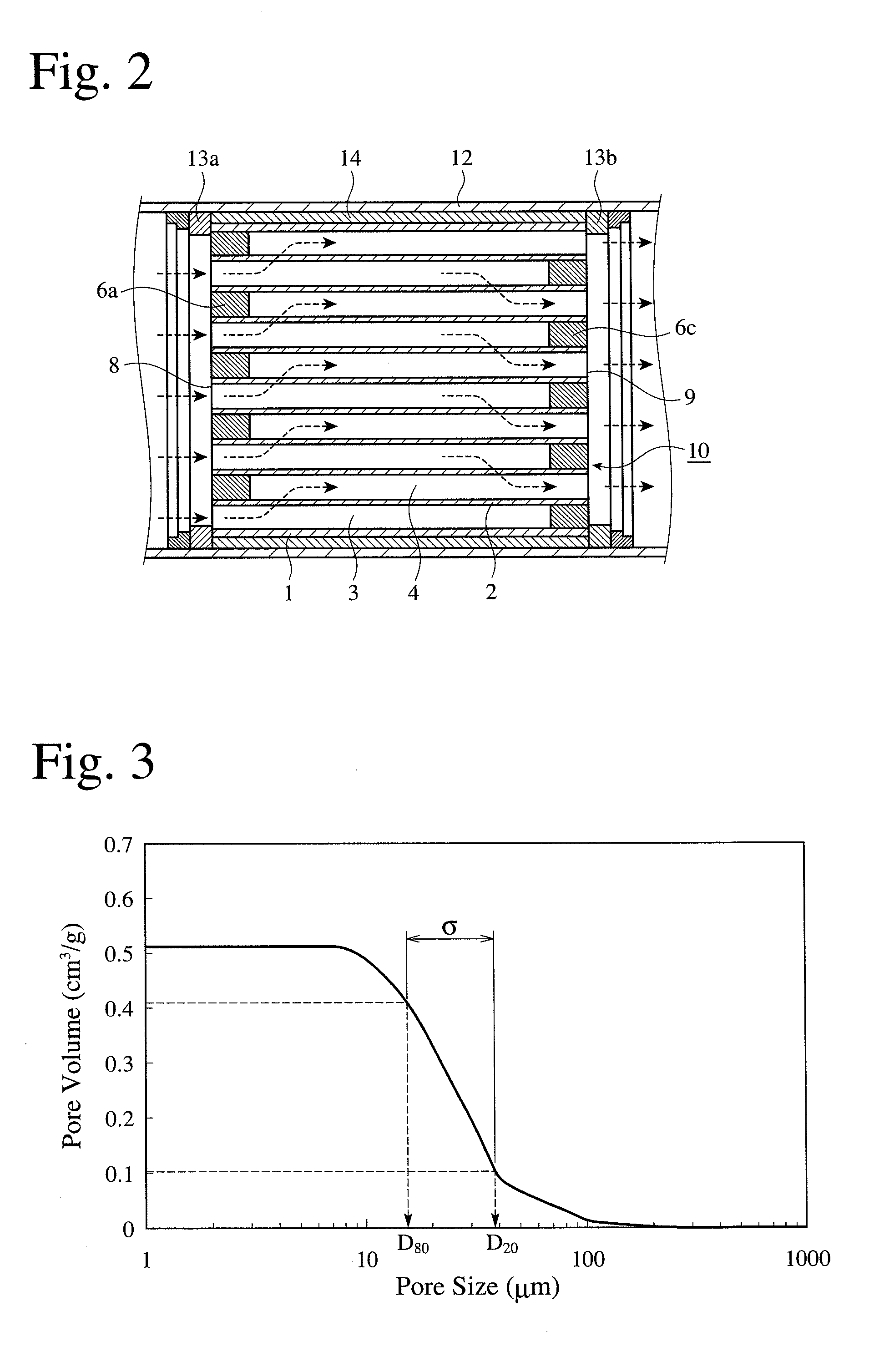
A cordierite-based ceramic honeycomb filter comprising a honeycomb structure having a large number of flow paths partitioned by porous cell walls, and plugs alternately formed in said flow paths on the exhaust-gas-inlet side or the exhaust-gas-outlet side for permitting an exhaust gas to pass through said porous cell walls to remove particulate matter from the exhaust gas, said porous cell walls having porosity of 45-58%, an average pore size of 15-30 μm, the volume of pores having pore sizes exceeding 50 μm being more than 10% and 25% or less of the total pore volume, the volume of pores having pore sizes of 100 μm or more being 1-8% of the total pore volume, the volume of pores having pore sizes of less than 10 μm being 3-10% of the total pore volume, and said pores having a pore size distribution deviation σ [=log(D20)−log(D80)] of 0.6 or less, wherein D20 represents a pore size (μm) at a pore volume corresponding to 20% of the total pore volume, and D80 represents a pore size (μm) at a pore volume corresponding to 80% of the total pore volume, both in a curve representing the relation between the pore size and the cumulative pore volume, and D80<D20.

Description

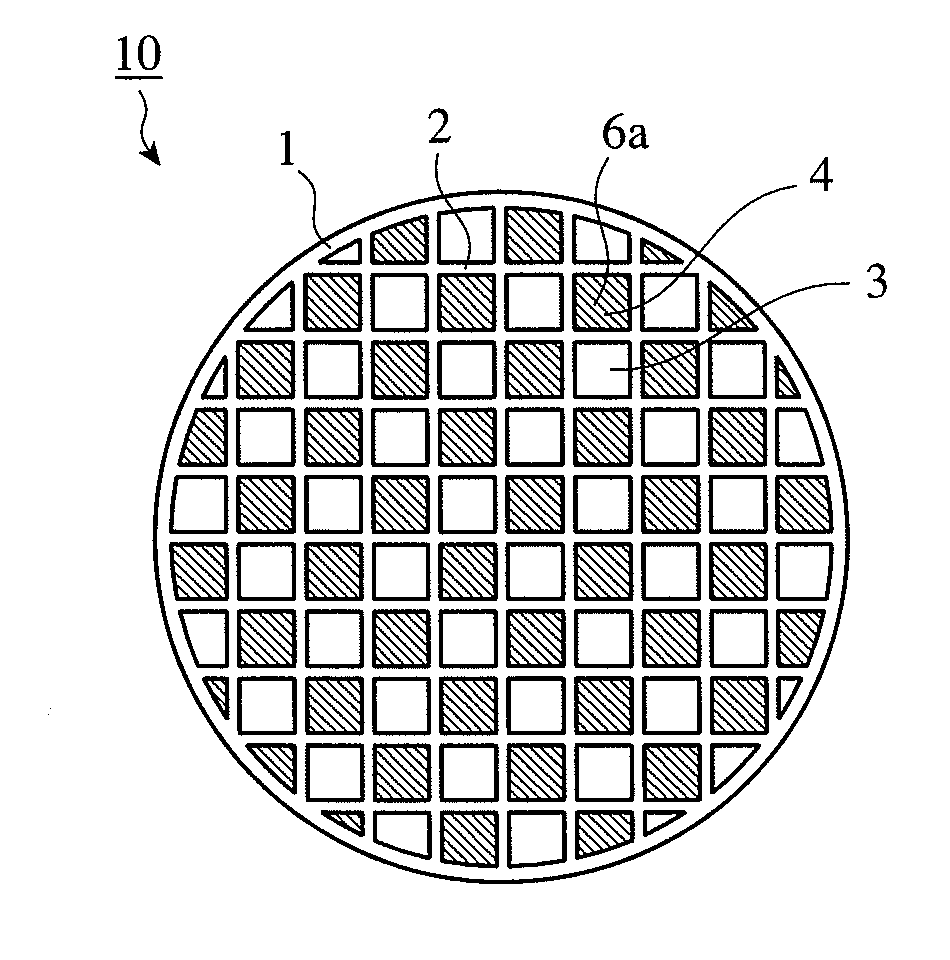
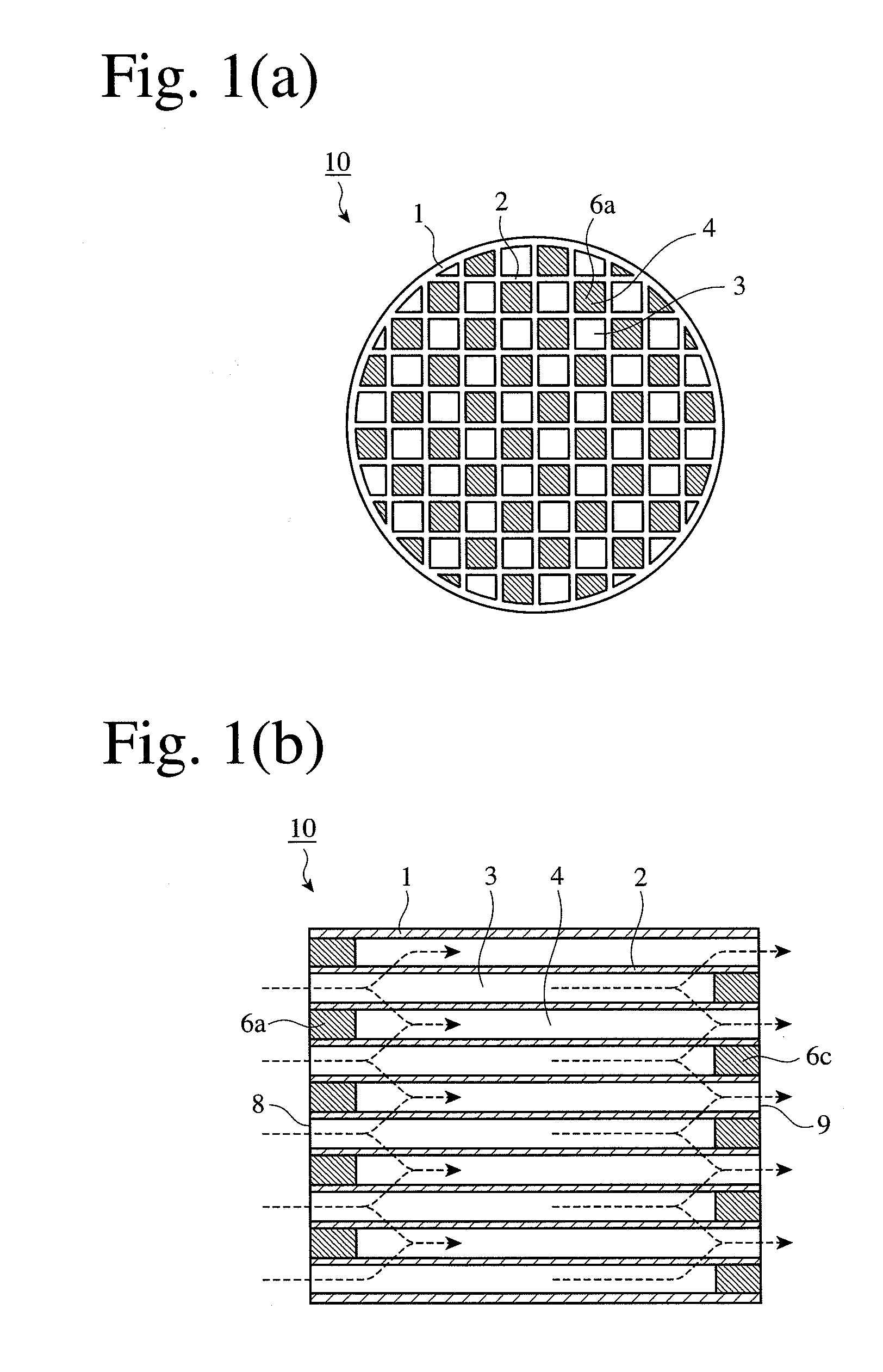
FIELD OF THE INVENTION[0001]The present invention relates to a cordierite-based ceramic honeycomb filter for removing particulate matter from exhaust gases discharged from diesel engines.BACKGROUND OF THE INVENTION[0002]Exhaust gases from diesel engines contain particulate matter (PM) based on carbonaceous soot and SOFs (soluble organic fractions) of high-boiling-point hydrocarbons, and the release of PM into the atmosphere is likely to exert adverse effects on humans and environment. Exhaust pipes connected to diesel engines are thus conventionally provided with ceramic honeycomb filters (simply called “honeycomb filters” below) for capturing PM.[0003]FIGS. 1(a) and 1(b) show one example of honeycomb filters for capturing PM to clean the exhaust gas. A honeycomb filter 10 comprises a ceramic honeycomb structure having porous cell walls 2 for constituting large numbers of outlet-side-sealed flow paths 3 and inlet-side-sealed flow paths 4 and a peripheral wall 1, and upstream-side pl...

Claims

the structure of the environmentally friendly knitted fabric provided by the present invention; figure 2 Flow chart of the yarn wrapping machine for environmentally friendly knitted fabrics and storage devices; image 3 Is the parameter map of the yarn covering machine
Login to View More

Application Information

Patent Timeline
19 Aug 2010
Publication
US20100205921A1
IPC
B01D46/24; B01D39/20
CPC
B01D46/2425; B01D46/2429; F01N3/0222; C04B2235/72; C04B2235/5481; C04B2235/5436; B01D2046/2433; B01D2046/2437
Inventors
OKAZAKI, SHUNJI; ISHIZAWA, TOSHITAKA