
Circuit for voltage stabilization in an onboard power supply
a technology of voltage stabilization and power supply, which is applied in the direction of electric/fluid circuit, electric devices, transportation and packaging, etc., can solve the problems of too large power loss at the diode, and achieve the effects of high storage density, high efficiency, and rapid reaction
- Summary
- Abstract
- Description
- Claims
- Application Information
AI Technical Summary
Benefits of technology
Problems solved by technology
Method used
Image

Examples
first embodiment
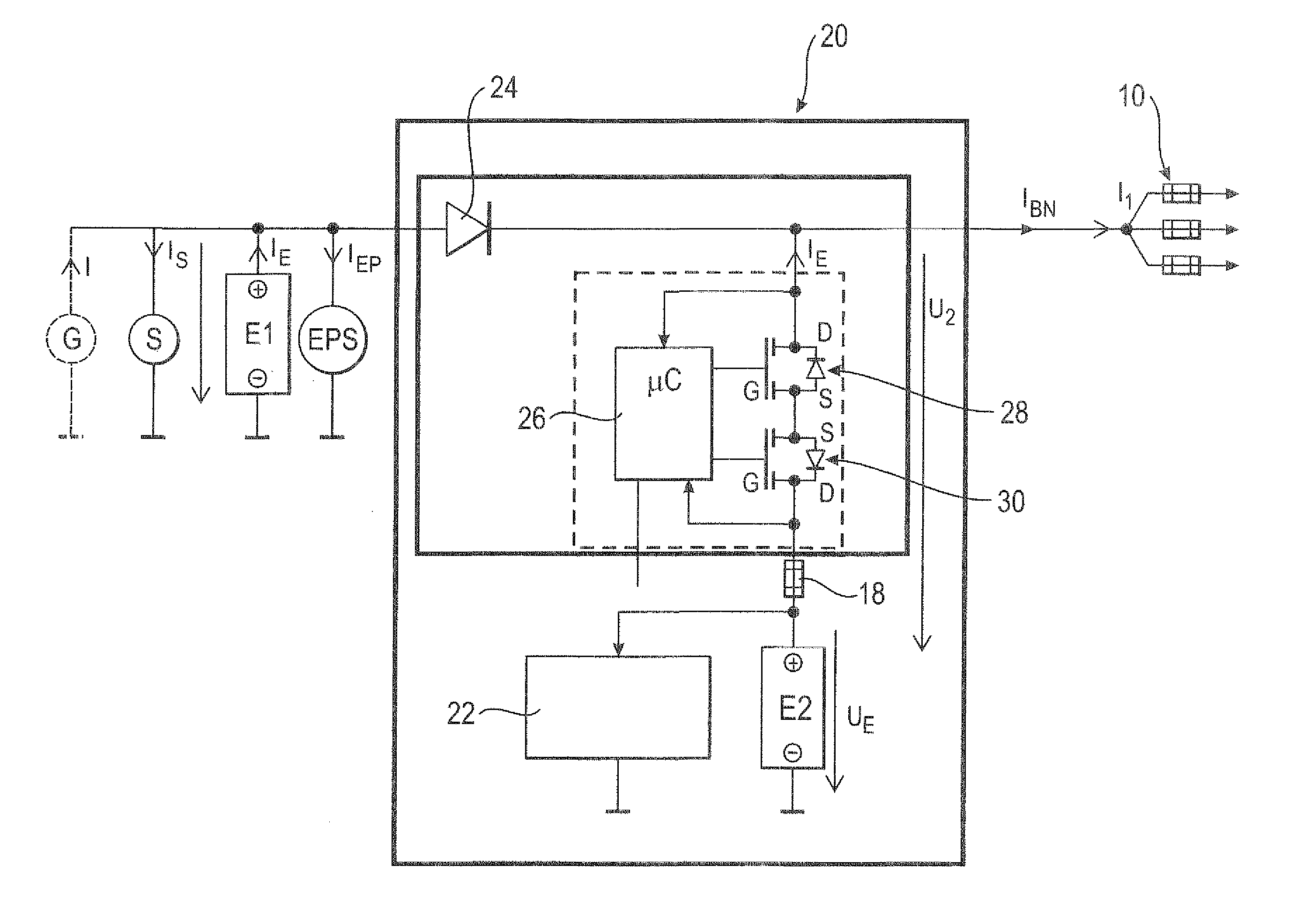
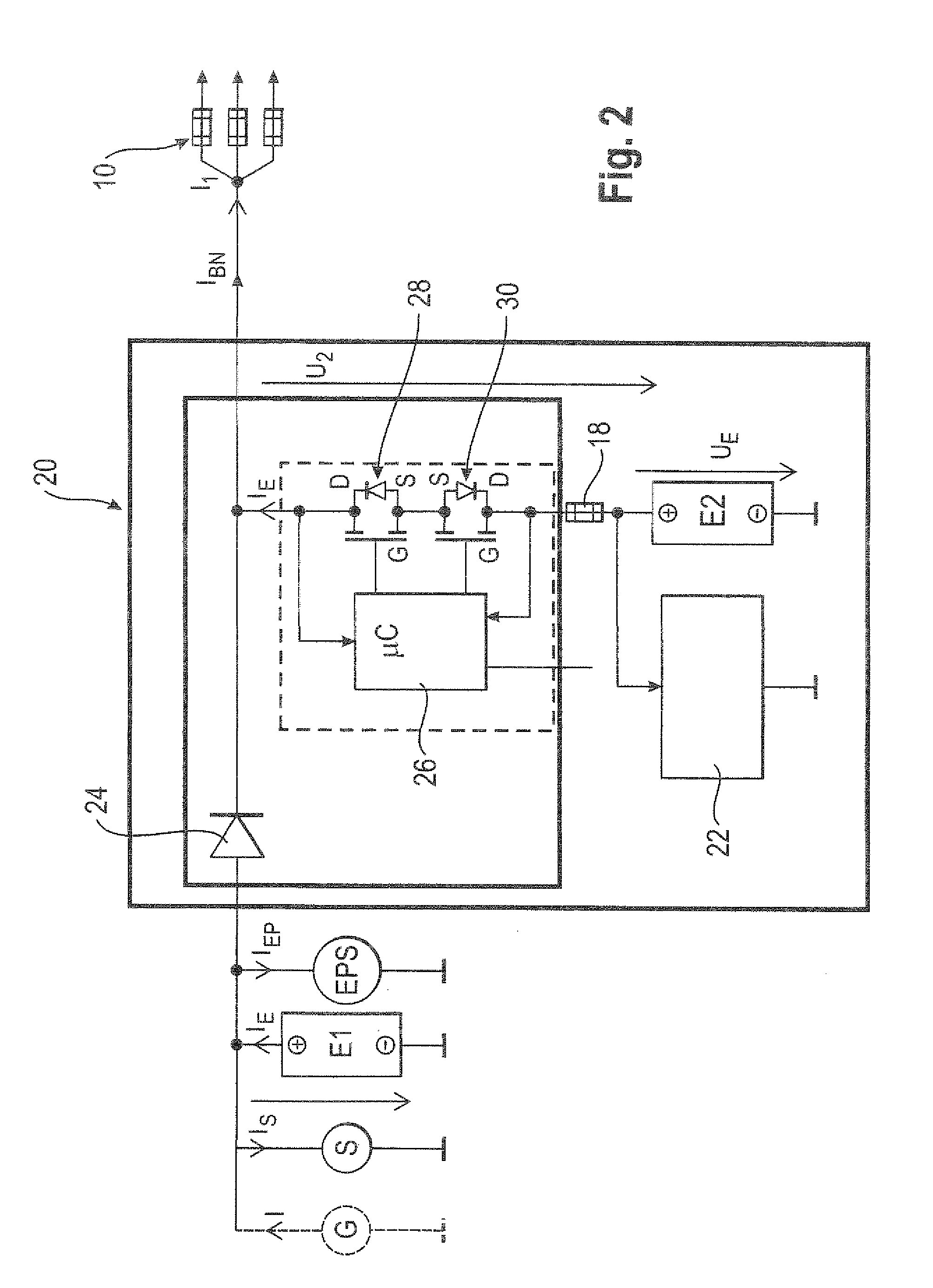
[0030]FIG. 2 shows a circuit 20 for voltage stabilization of an on-board electrical system 10 according to the invention, which is electrically connected between two high-current consumer loads (starter S and EPS system of a motor vehicle) connected with a first energy storage E1 (in this embodiment a battery) and the electrical system 10 to be stabilized. The circuit 20 comprises a diode element 24, a micro-controller 26, two inversely arranged power MOSFETs 28, connected in series, a cutout 18 and a second energy storage E2 (in this embodiment a battery) connected to the on-board electrical system 10 through the cutout 18 and the two power MOSFETs 28, 30. The charging state of the second battery E2 is monitored by an impedance measurement device 22. The micro-controller 26 has the purpose to control the voltages applied at the gate G of the power MOSFETs 28, 30 and, thus, to switch the MOSFETs 28, 30 as desired. Further, the micro-controller 26 measures the voltage and the tempora...
second embodiment
[0032]FIG. 4 shows a circuit diagram of a circuit 50 for voltage stabilization of an on-board electrical system 10 according to the invention. The circuit 50 comprises a diode element 24 constructed as shown in FIG. 3 and a super capacitor 40 (super cap) having a capacity of 110 F.
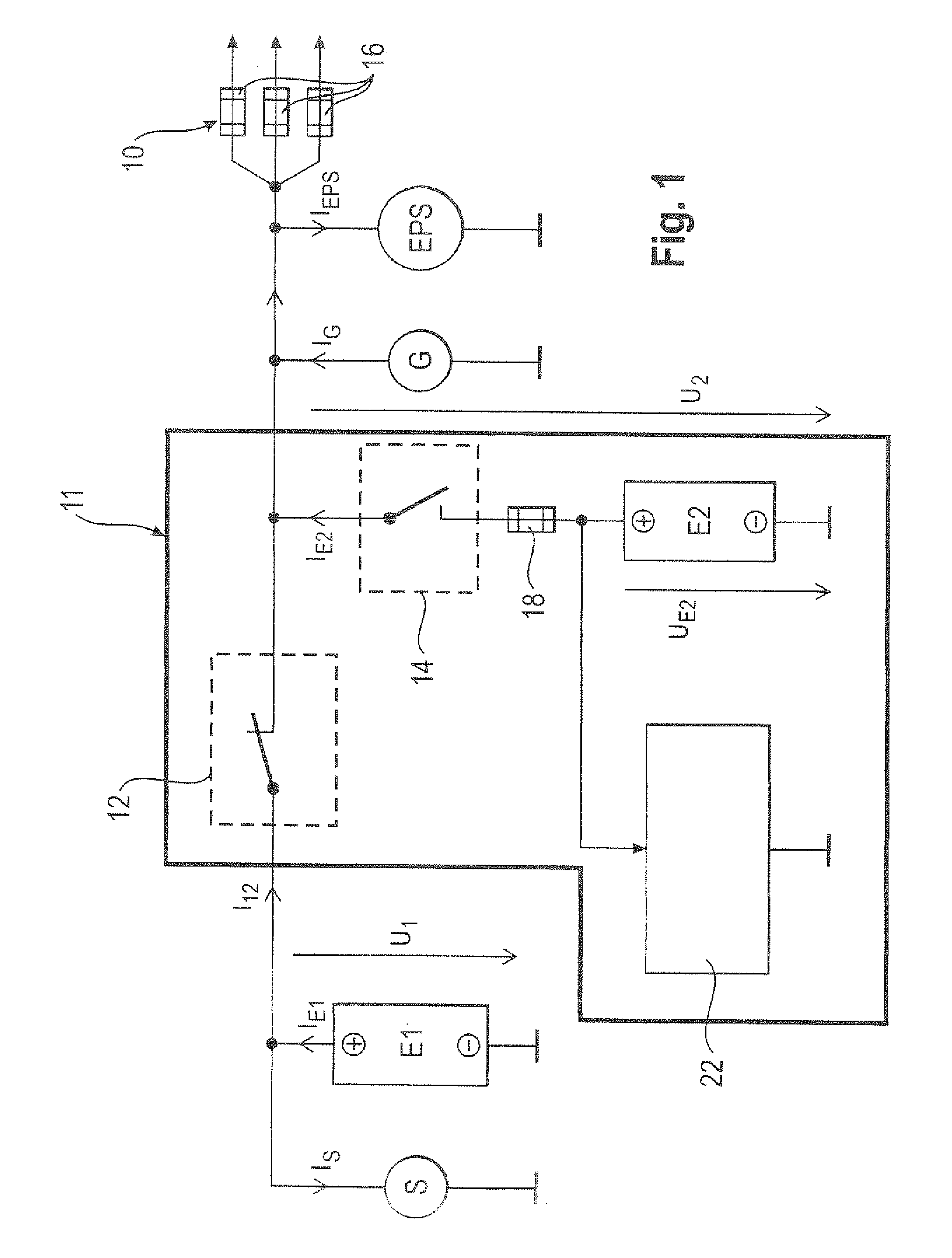
[0033]As explained above, in the circuit 20, 50 of the invention an arrangement of current generator G in front of the diode element 24 (left of the diode element 24 in FIGS. 2 and 4) is possible since an accidental interruption of current flow from the generator G to the on-board electrical system 10 through the diode element 24 is not possible (contrary to the circuit 11 having the cut-off relay 12 shown in FIG. 1). Therefore, the present circuit 20, 50 may also be used in motor vehicles in which the starter S and the generator G are designed as an integrated unit.
[0034]In the following, the mode of operation of the circuit known from the prior art and of the circuit of the invention are explained with t...
PUM
 Login to View More
 Abstract
Description
Claims
Application Information
 Login to View More