Unlock instant, AI-driven research and patent intelligence for your innovation.

Inorganic Solid Electrolyte Glass Phase Composite and a Battery Containing an Inorganic Solid Electrolyte Glass Phase Composite

Active Publication Date: 2011-12-29
WEST VIRGINIA UNIVERSITY
View PDF6 Cites 68 Cited by
  • Summary
  • Abstract
  • Description
  • Claims
  • Application Information

AI Technical Summary

Benefits of technology

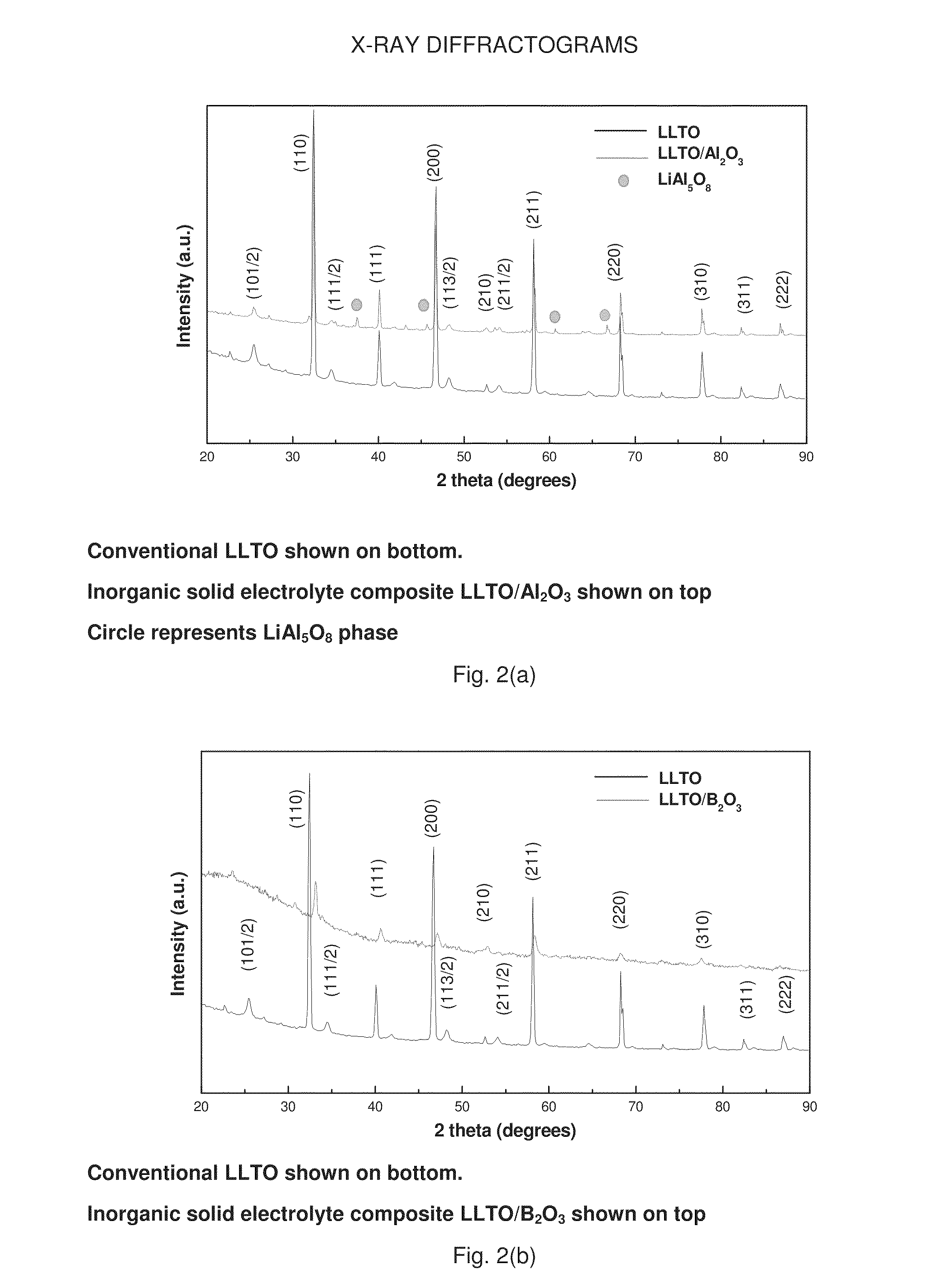
[0012]The inorganic solid electrolyte composite of the present invention wherein Al2O3 is the glass material provides a bulk boundary conductivity σb of about 9.33×10⁻⁴ S cm−1 and a grain boundary conductivity σgb of about 2.38×10⁻⁵ Scm−1. The inorganic solid electrolyte composite of the present invention wherein B2O3 is the glass material provides a grain boundary conductivity σgb of about 4.58×10⁻⁵ S cm−1. Those persons skilled in the art clearly recognize the inorganic solid electrolyte composite of the present invention provides a substantial improvement in both bulk boundary conductivity and grain boundary conductivity over the background art's conventional LLTO's σb of 1.65×10⁻⁴ S cm−1 and σgb of 9.03×10⁻⁶ S cm−1.
[0013]In another embodiment of this invention, a lithium-ion conducting solid electrolyte composite is provided that comprises a lithium-ion conductive substance of the general formula La2/3-xLi3xTiO3—Z wherein x ranges from about 0.04 to 0.17, and wherein “Z” is one or more of a glass material selected from the group consisting of Li2O, Li2S, Li2SO4, Li3PO4, B2O3, P2O5, P2O3, Al2O3, SiO2, CaO, MgO, BaO, TiO2, GeO2, SiS2, Sb2O3, SnS, TaS2, P2S5, B2S3, and a combination of two or more thereof.
[0014]In yet another embodiment of the present invention, a battery comprising a cathode; an anode; and an inorganic solid electrolyte composite disposed on or between the cathode and the anode, wherein the inorganic solid electrolyte composite comprising a substance having the general formula La2/3-xLi3xTiO3 wherein x ranges from about 0.04 to about 0.17, and a glass material. The battery includes wherein the inorganic solid electr

Problems solved by technology

While the sulfide based Li-CSEs to date have been preferred over the oxide based LiCSEs, the sulfide based Li-CSEs are difficult to synthesize.
Prior to the present invention, the oxide based Li-CSEs of the perovskite-type lithium lanthanum titanium oxide have achieved a bulk conductivity σb of 2.95×10⁻³ S cm−1 at 295 Kelvin (K), however, they have significant obstacles to their utilization, including for example, poor ionic conduction of its grain boundary leading to a low total ionic conductivity, chemical instability in direct contact with elemental lithium, and a very narrow electrochemical window (1.7 volts), among others.
This Li-CSE LGPS coating procedure however adds to the manufacturing expense of producing an oxide based Li-CSEs of the perovskite-type lithium lanthanum titanium oxide.
As a solid electrolyte for Li-ion batteries, La2 / 3-xLi3xTiO3 (hereinafter “LLTO”) has not been commercialized mainly due to the following problems: (i) low ionic conductivity at the grain boundaries, and (ii) low chemical stability in contact with the anode of Li-ion batteries.

Method used

the structure of the environmentally friendly knitted fabric provided by the present invention; figure 2 Flow chart of the yarn wrapping machine for environmentally friendly knitted fabrics and storage devices; image 3 Is the parameter map of the yarn covering machine
View more

Image

Smart Image Click on the blue labels to locate them in the text.
Viewing Examples
Smart Image
  • Inorganic Solid Electrolyte Glass Phase Composite and a Battery Containing an Inorganic Solid Electrolyte Glass Phase Composite
  • Inorganic Solid Electrolyte Glass Phase Composite and a Battery Containing an Inorganic Solid Electrolyte Glass Phase Composite
  • Inorganic Solid Electrolyte Glass Phase Composite and a Battery Containing an Inorganic Solid Electrolyte Glass Phase Composite

Examples

Experimental program
Comparison scheme
Effect test

example 1

Preparation of La0.56Li0.33TiO3 Powder

[0055]9.128 g La2O3, 1.233 g Li2CO3 and 8 g TiO2 (molar ratio is 0.56:0.33:2, respectively) were initially mixed with 50 ml (milliliters) ethanol by ball milling for 24 h to obtain a LLTO slurry. After drying the LLTO slurry for a sufficient time, the LLTO dried mixture was heated in air at 800° C. for 4 h to decarbonate and then it was sintered at 1150° C. for 36 h with intermittent grinding every 12 h to obtain a LLTO powder.

Preparation of La0.56Li0.33TiO3 Electrolytes

[0056]Two methods are used herein to form the LLTO electrolyte. One method employs a tape casting to obtain thin film LLTO electrolyte. Fifteen grams (g) of the above as-prepared La0.56Li0.33TiO3 powder was mixed with 0.75 g butyl benzyl phthalate, 0.75 g polyalkylene glycol, 0.5 g fish oil, and 1.5 g polyvinyl butyral with 12 g ethanol and 12 g xylene by ball milling for 24 h. A DCX plus DC control tape casting machine (commercially available) was used to produce the LLTO electr...

example 2

Preparation of LLTO / Al2O3 Composite Electrolytes

[0057]Ball milling was used to completely mix 13.5 g of the as-prepared LLTO powder of Example 1, 1.5 g Al2O3 powder, 0.75 g butyl benzyl phthalate, 0.75 g polyalkylene glycol, 0.5 g fish oil, and 1.5 g polyvinyl butyral with 12 g ethanol and 12 g xylene for 24 h. Then, tape casting, as described above, was used to produce the LLTO / Al2O3 electrolyte tape. In order to conveniently perform various tests, we stacked 20 small sheets (having dimensions of from about 12 inches in length, about one inch wide [diameter], and about 27 microns thickness) of the LLTO / Al2O3 electrolyte tape and then pressed them into pellets. The pellets were finally sintered at 1200° C. for 12 h to obtain LLTO / Al2O3 composite electrolytes of the present invention.

example 3

Preparation of LLTO / B2O3 Composite Electrolytes

[0058]9.5 g of the above as-prepared La0.56Li0.33TiO3 powder of Example 1 was mixed with 0.5 g B2O3 in 30 ml ethanol through ball milling for 24 h to obtain the LLTO / B2O3 composite slurry. The LLTO / B2O3 slurry was dried in an oven at 100° C. and then the obtained LLTO / B2O3 composite powder was ground in a mortar. Thereafter, the LLTO / B2O3 composite powder and polyvinyldene difluoride (PVDF) were mixed using a mass ratio of 300:1 and then the mixture was pressed into pellets under 20,000 lb of pressure. The pellets were sintered at 1250° C. for 12 h to obtain LLTO / B2O3 composite electrolyte of the present invention. The molar ratio of LLTO:B2O3 is 7.6:1.

the structure of the environmentally friendly knitted fabric provided by the present invention; figure 2 Flow chart of the yarn wrapping machine for environmentally friendly knitted fabrics and storage devices; image 3 Is the parameter map of the yarn covering machine
Login to View More

PUM

No PUM Login to View More

Abstract

An inorganic solid electrolyte glass phase composite is provided comprising a substance of the general formula La2 / 3-xLi3xTiO3 wherein x ranges from about 0.04 to about 0.17, and a glass material. The glass material is one or more compounds selected from Li2O, Li2S, Li2SO4, Li3PO4, B2O3, P2O5, P2O3, Al2O3, SiO2, CaO, MgO, BaO, TiO2, GeO2, SiS2, Sb2O3, SnS, TaS2, P2S5, B2S3, and a combination of two or more thereof. A lithium-ion conducting solid electrolyte composite is disclosed comprising a lithium-ion conductive substance of the general formula La2 / 3-xLi3xTiO3—Z wherein x ranges form about 0.04 to 0.17, and wherein “Z” is the glass material identified above. A battery is disclosed having at least one cathode and anode and an inorganic solid electrolyte glass phase composite as described above disposed on or between at least one of the cathode and the anode.

Description

CROSS REFERENCE TO RELATED APPLICATION[0001]This utility patent application claims the benefit of priority to co-pending U.S. Provisional Patent Application Ser. No. 61 / 341,322, filed Mar. 30, 2010, entitled “Inorganic solid electrolyte for lithium-ion batteries.” The entire contents of U.S. Provisional Patent Application Ser. No. 61 / 341,322 is incorporated by reference into this utility patent application as if fully rewritten herein.BACKGROUND OF THE INVENTION[0002]1. Field of the Invention[0003]This invention relates to an inorganic solid electrolyte glass phase composite and a battery having an inorganic solid electrolyte glass phase composite. Specifically, this invention relates to a lanthanum lithium titanium oxide glass phase composite. The glass phase is preferably an aluminum oxide or a boron oxide. The inorganic solid electrolyte glass phase composite may be used in lithium-ion batteries, thin film batteries, pH sensors, and separation devices. A battery having a lanthanu...

Claims

the structure of the environmentally friendly knitted fabric provided by the present invention; figure 2 Flow chart of the yarn wrapping machine for environmentally friendly knitted fabrics and storage devices; image 3 Is the parameter map of the yarn covering machine
Login to View More

Application Information

Patent Timeline
no application Login to View More
IPC IPC(8): H01M10/0562H01G9/032
CPCH01M10/0562H01M2300/0071Y02E60/12Y02E60/10H01M10/0525H01M2300/0068
Inventor ZHANG, HUIJIANG, YINGLULIU, XINGBO
Owner WEST VIRGINIA UNIVERSITY
Features
  • R&D
  • Intellectual Property
  • Life Sciences
  • Materials
  • Tech Scout
Why Patsnap Eureka
  • Unparalleled Data Quality
  • Higher Quality Content
  • 60% Fewer Hallucinations
Social media
Patsnap Eureka Blog
Learn More