[0009]The present invention improves on existing technologies for DNA fragmenting and tagging using transposases. In embodiments, the invention provides new
reaction conditions, which include
manganese ions instead of
magnesium ions, for transposase-mediated cleavage of target nucleic acids with concomitant tagging of the resulting DNA fragments. The invention thus broadens transposase
reaction conditions to include
magnesium ions,
manganese ions, or both. Preferably, the
reaction conditions also include relatively low
alkali metal ion, such as
potassium ion, concentrations. The resulting tagged DNA fragments find use in many
molecular biology applications, including, but not limited to, next generation sequencing,
Polymerase Chain Reaction (PCR) techniques, and
gene cloning and
genome analysis. Using the reaction conditions disclosed herein, native transposases (i.e., transposases having
amino acid sequences not differing from
amino acid sequence found in nature; e.g., non-recombinant), as well as modified transposases (i.e., transposases having
amino acid sequences differing from the amino acid sequence found in nature; e.g., recombinant) can be used for
in vitro DNA fragmentation and tagging at relatively low concentrations and relatively short reaction times. Native transposases can be obtained either from native or recombinant hosts, whereas modified transposases can be obtained only from recombinant hosts. The reaction conditions thus provide an improvement over the current art.
[0010]The present invention also improves on existing technologies for preparing DNA substrates for next generation sequencing. The present invention provides a new method for preparing such DNA substrates that incorporates two different transposase recognition sequences per DNA fragment created, coupled with independently tagged primers for amplification of the DNA fragments. The method allows for preparation of tagged products using only two primers.
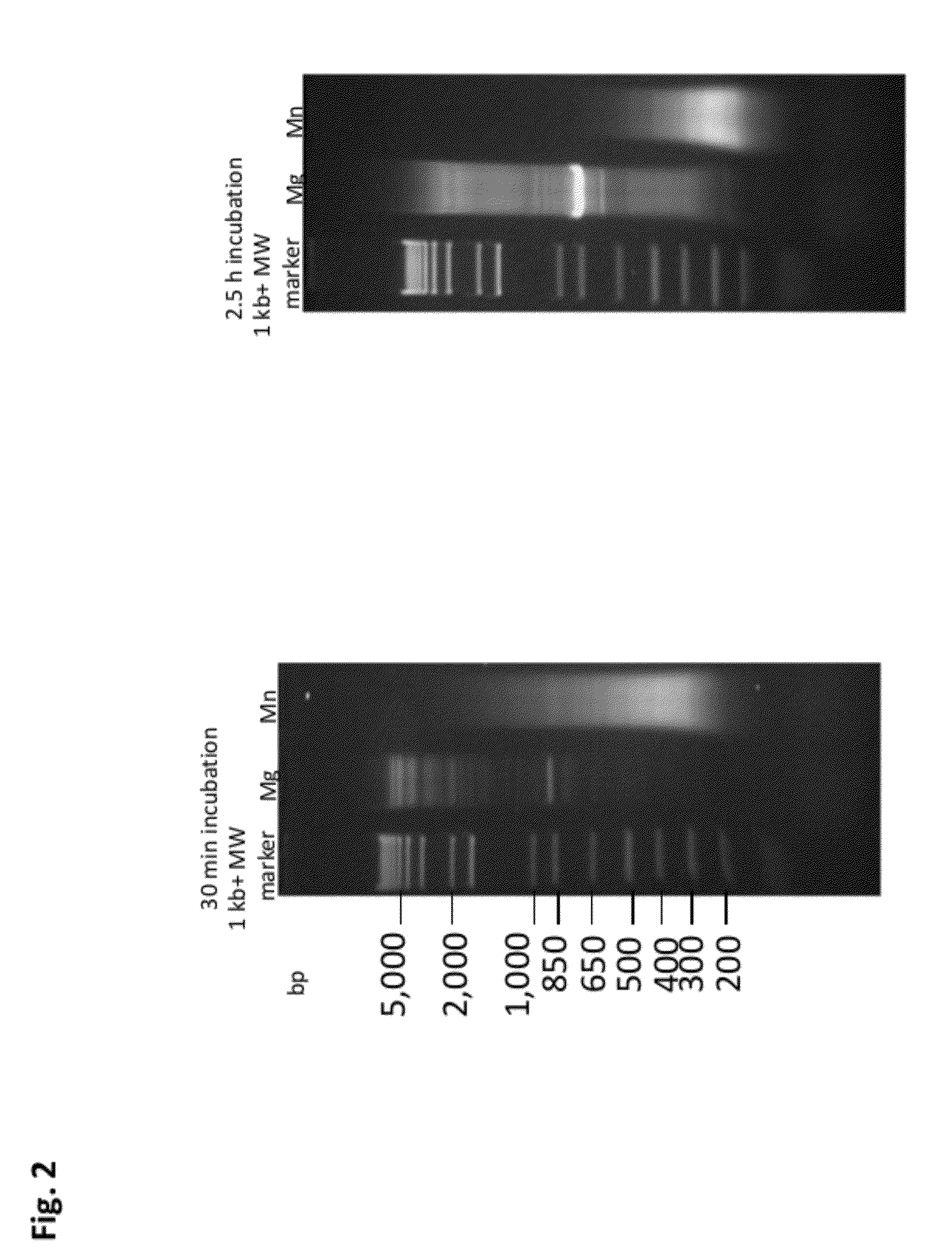
[0011]In a first aspect, the invention provides compositions, preferably aqueous compositions, comprising a transposase and manganese ions (Mn(II)) at a concentration of from about 1 mM to about 100 mM or even higher. It has surprisingly been found that use of Mn(II) ions at these concentrations provides superior transposase-mediated cleavage activity as compared to use of
magnesium ions (Mg(II)), which are typically used in Tn5 transposase reactions. However, under conditions used in the present invention magnesium ions can be used, alone or in combination with manganese ions, to provide superior results as compared to prior art disclosures relating to the use of MG(II)-containing reaction compositions. Indeed, the finding is contrary to the prevailing belief in the art that optimal activity for transposases is found in compositions containing Mg+2 (see, for example, www dot epibio dot com slash item.asp?id+292, which indicates that Tn5 transposase complexes are inactive in the absence of Mg+2, but active in the presence of that
ion, but at relatively low levels).
[0013]Interestingly, and further surprisingly, it has been found that the relatively wide range of Mn+2 and Mg+2 concentrations, or combinations of the two, such as from about 1 mM to about 100 mM each or total, reduce the sequence specificity of the transposase. Reduced sequence specificity is an important characteristic for a transposase used to create DNA fragments for next generation sequencing.
[0030]The method can be practiced with any naturally occurring (i.e., wild-type) transposase or with an engineered transposase. The use of a wild-type transposase within the context of the present invention provides an
advantage over prior art disclosures. Further, and independently, in embodiments, the reaction conditions for the present invention provide superior results as compared to prior art methods. In exemplary embodiments, the transposase is an IS4 family transposase, such as one naturally found in
Vibrio species, including, but not limited to
Vibrio harveyi. As such, the
recognition sequence for the transposase can be a naturally occurring sequence. It may also be a sequence that is engineered to have properties other than those exhibited by the naturally occurring sequence, such as stronger (or weaker) binding for the naturally occurring transposase or for an engineered transposase.



 Login to View More
  Login to View More