
Oriented Sorghum Strand Boards made with Sorghum Stalks and Processes for Making Same
Inactive Publication Date: 2013-04-11
WASHINGTON STATE UNIVERSITY +1
View PDF7 Cites 2 Cited by
- Summary
- Abstract
- Description
- Claims
- Application Information
AI Technical Summary
Benefits of technology
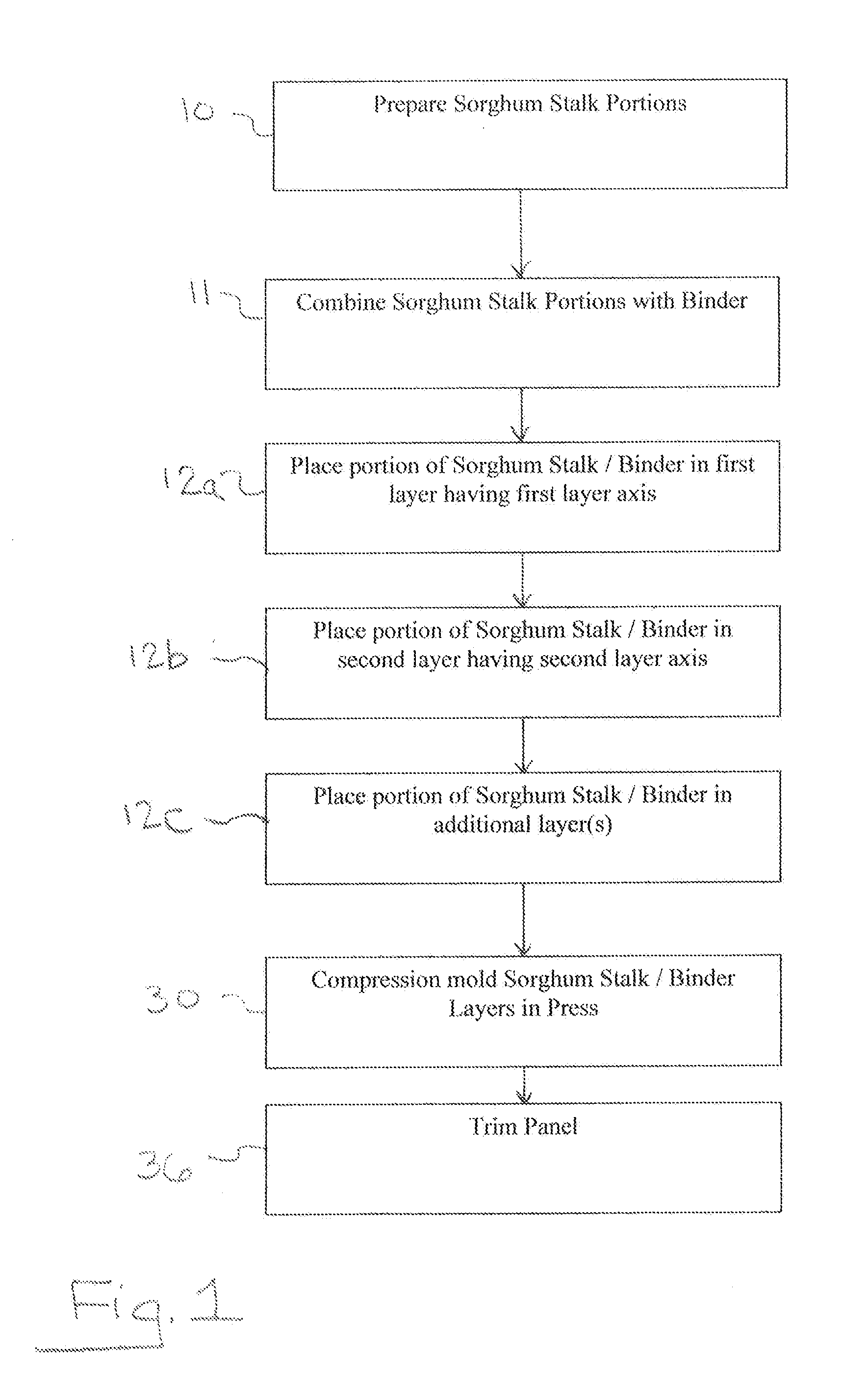
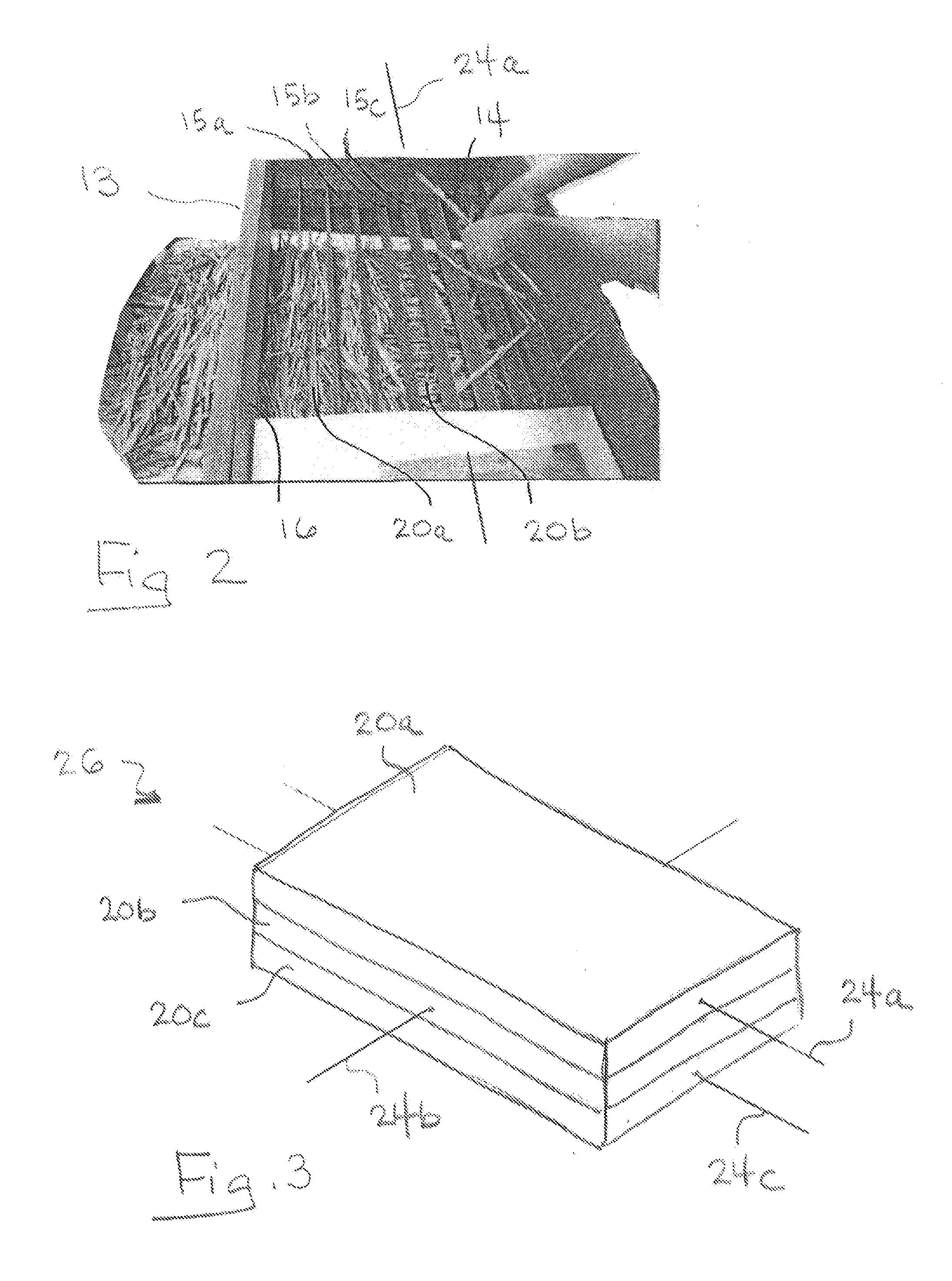
The patent describes a method for coating and layering sorghum stalk material using a binder. The stalk material can be oriented and layered with a typical depth of 4 to 5 inches of pre-compressing. Layers can be stacked directly onto a press platen or placed onto a platen after stacking. Multiple layers can be used, and they can be aligned in different directions. The stalk material is oriented with at least 90% of it aligned within 45 degrees of the layer axis. The stalk material can be combined with binder after orientation and layering. The surface layers of the boards can also include sorghum fines to improve surface finish.
Problems solved by technology
Similar wood growth can take many years.
However, the supply of Sorghum stalks and sorghum stalk bagasse greatly exceeds demand, and as a consequence, a large amount of this material is either plowed under or burned.
It not only pollutes the air, but emits greenhouse gases (GHGs) linked to the current climate crisis.
Products such as traditional wood-based OSB made with resins such as UF and PF which release formaldehyde and other volatile organic compounds (VOC's) over the life of the product may be hazardous as formaldehyde is a known carcinogen and formaldehyde emissions have been linked to respiratory illness, asthma and premature death, especially for children and the elderly.
Their high vapor pressure results from a low boiling point, which causes large numbers of molecules to evaporate from the liquid or solid form of the compound and enter the surrounding air.
Method used
the structure of the environmentally friendly knitted fabric provided by the present invention; figure 2 Flow chart of the yarn wrapping machine for environmentally friendly knitted fabrics and storage devices; image 3 Is the parameter map of the yarn covering machine
View moreImage
Smart Image Click on the blue labels to locate them in the text.
Smart ImageViewing Examples

Examples
Experimental program
Comparison scheme
Effect test
example
[0059]Single layer and three layer OSSB boards containing sorghum stalk material were prepared using stalks from energy Sorghum plants: 96% by weight, MIDI; 4% by weight and a final Density: 43.2 lb / ft3. Processing parameters for the three layers composites were:[0060]Hot-pressing temperature: 350 F[0061]Duration: 6 min[0062]Closing time: 4 min[0063]Moisture content: 6%
Processing parameters for the one layer composites were:[0064]Hot-pressing temperature: 350 F[0065]Duration: 5 min[0066]Closing time: 3 min[0067]Moisture content: 8%
[0068]FIGS. 8-13 show density modified properties of the one layer and three layer boards. MOR, MOE and IP properties are influenced by density, and the data shown has been normalized by density.
the structure of the environmentally friendly knitted fabric provided by the present invention; figure 2 Flow chart of the yarn wrapping machine for environmentally friendly knitted fabrics and storage devices; image 3 Is the parameter map of the yarn covering machine
Login to View More PUM
| Property | Measurement | Unit |
|---|---|---|
| Temperature | aaaaa | aaaaa |
| Fraction | aaaaa | aaaaa |
| Fraction | aaaaa | aaaaa |
Login to View More
Abstract
A composite board having a sorghum stalk material component and a binder component is disclosed together with a corresponding method of manufacture. To prepare the composite board, the sorghum stalk material is harvested, dried and refined into fibers. The fibers are then combined with a binder such as a thermosetting resin. The resin coated fibers are then arranged into a stack having several layers. Within each layer, the resin coated fibers are aligned along a predetermined layer axis. Next, the stack is thermocompressed in a press at a preselected temperature to compress the resin coated fibers to a preselected board thickness.
Description
[0001]This application claims priority to provisional U.S. patent application No. 61 / 544,856 filed Oct. 7, 2011 titled “Oriented Strand Boards made with Sorghum Stalks and Processes for Making Same.” This application is related to provisional U.S. patent application No. 61 / 544,884 filed Oct. 7, 2011 titled “Composite Boards made with Sorghum Stalks and a Thermoplastic Binder and Processes for making same.” The entire contents of provisional application 61 / 544,856 and provisional application 61 / 544,884 are hereby incorporated by reference herein.FIELD OF THE INVENTION[0002]The present invention pertains generally to composite boards. More particularly, the present invention pertains to composite boards having oriented agrifiber strands. The present invention is particularly, but not exclusively, useful as an oriented sorghum strand board (OSSB) made from sorghum stalk material and a binder.BACKGROUND OF THE INVENTION[0003]Sorghum is a genus of numerous species of coarse, upright grow...
Claims
the structure of the environmentally friendly knitted fabric provided by the present invention; figure 2 Flow chart of the yarn wrapping machine for environmentally friendly knitted fabrics and storage devices; image 3 Is the parameter map of the yarn covering machine
Login to View More Application Information
Patent Timeline
 Login to View More
 IPC IPC(8): B32B5/12B32B37/02
CPCB32B5/12B32B37/02B27N1/003B27N3/04B32B5/26Y10T428/24116B32B2260/04B32B2260/046B32B2262/06B32B2419/00Y10T156/10B32B2260/023
InventorHURST, MICHAEL WARRENQI, CHUSHENGYADAMA, VIKRAM
OwnerWASHINGTON STATE UNIVERSITY