
Compositions and Methods for the Treatment of Parkinson Disease by the Selective Delivery of Oligonucleotide Molecules to Specific Neuron Types
a technology of oligonucleotide molecules and parkinson disease, which is applied in the field of compositions and methods for drug compositions, can solve the problems of specificity conferred by rnai-based brain pathology therapy approaches, the silencing of genes, and the blood-brain barrier (bbb) as the therapeutic approach to brain pathologies, so as to avoid side effects
- Summary
- Abstract
- Description
- Claims
- Application Information
AI Technical Summary
Benefits of technology
Problems solved by technology
Method used
Image

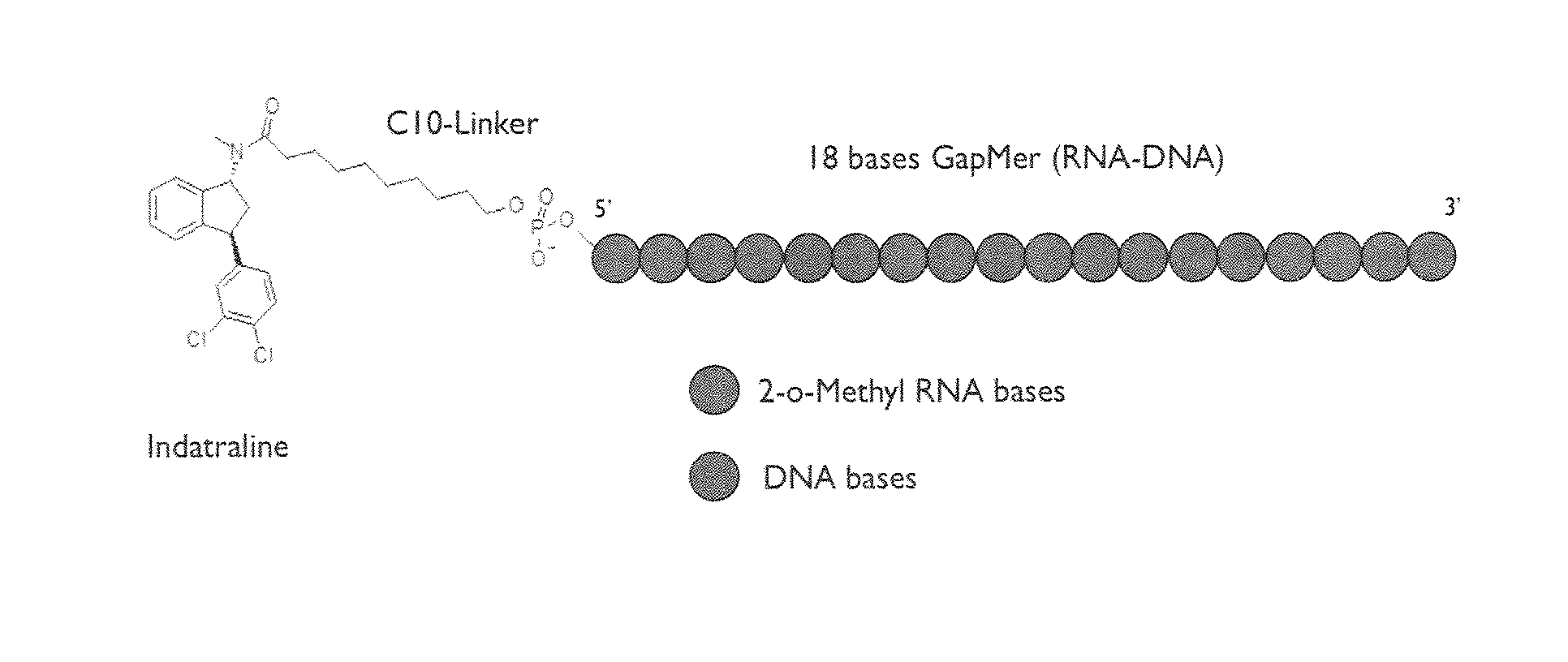
Examples
example 1
Targeting Validation: Function
[0429]Experimental Design
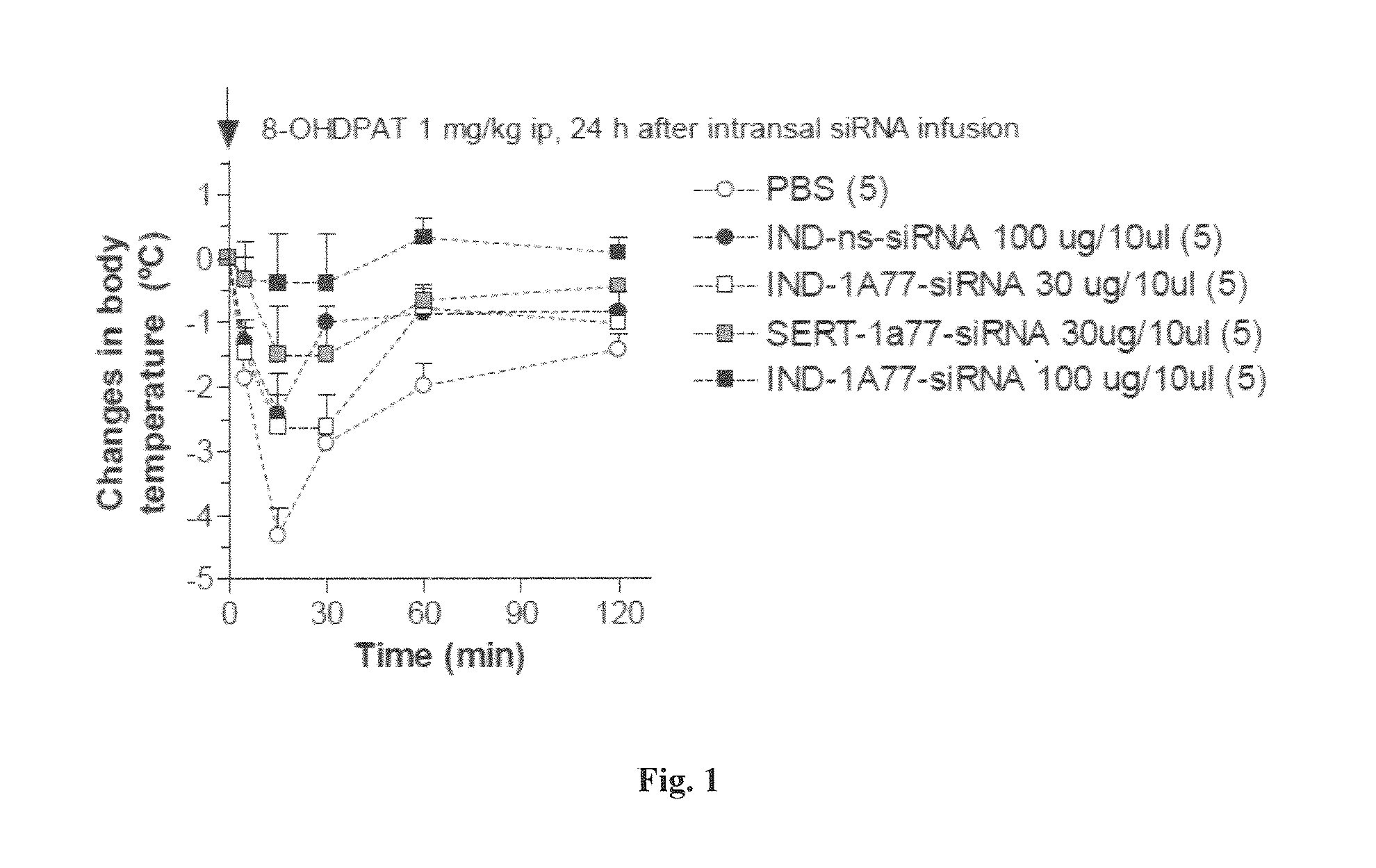
[0430]To determine functionally the targeting of the molecules according to the invention, an oligo anti-5HT1A with indatraline was used. The molecule was intranasally administrated to validate that indatraline targets raphe nuclei. Two different concentrations were tested (30 and 100 μg / mouse) and hypothermia after 8-OH-DPAT administration was assessed to determine functionally that 5-HT1A receptors in raphe were targeted. Basal temperature was determined 24 hours after intra-nasal administration of the molecule.
[0431]8-Hydroxy-2-(di-n-propylamino)tetralin (8-OH-DPAT) is a selective 5-HT 1A agonist that induces hypothermia in mice by activating somatodendritic 5-HT1A autoreceptors in median raphe. By this assay, it was determined if the hypothermia induced by 8-OH-DPAT can be blocked by indatraline, if able to target raphe, and the oligo that blocks down 5-HT1A.
[0432]30 and 100 μg / mouse of molecule according to the invention wa...
example 2
Targeting Validation: Localization
[0435]Experimental Design
[0436]To visualize whether substantia nigra, locus coeruleus and raphe were targeted, an intra-ventricular administration of indatraline-antisense labelled with the fluorophore Alexa488 was used. Indatraline is a non-selective monoamine transporter inhibitor that blocks the reuptake of dopamine, norepinephrine, and serotonin.
[0437]Dopamine transporter (DAT) expression is localized in dopaminergic neurons of the substantia nigra pars compacta (SNC).
[0438]Norepinephrine transporter (NET also known as solute carrier family 6 member 2, SLC6A2) expression is restricted to noradrenergic neurons in locus coeruleous (LC) and are not present on neurons that release dopamine or epinephrine.
[0439]Serotonin transporter (SERT) expression is primarily located in serotonergic neurons localized in raphe nuclei with high levels in dorsal raphe (DR).
[0440]For co-localization purposes tyrosine hydroxylase (TH) and tryptophan hydroxylase (TPH) ...
example 3
Candidate Selection
[0445]Experimental Design
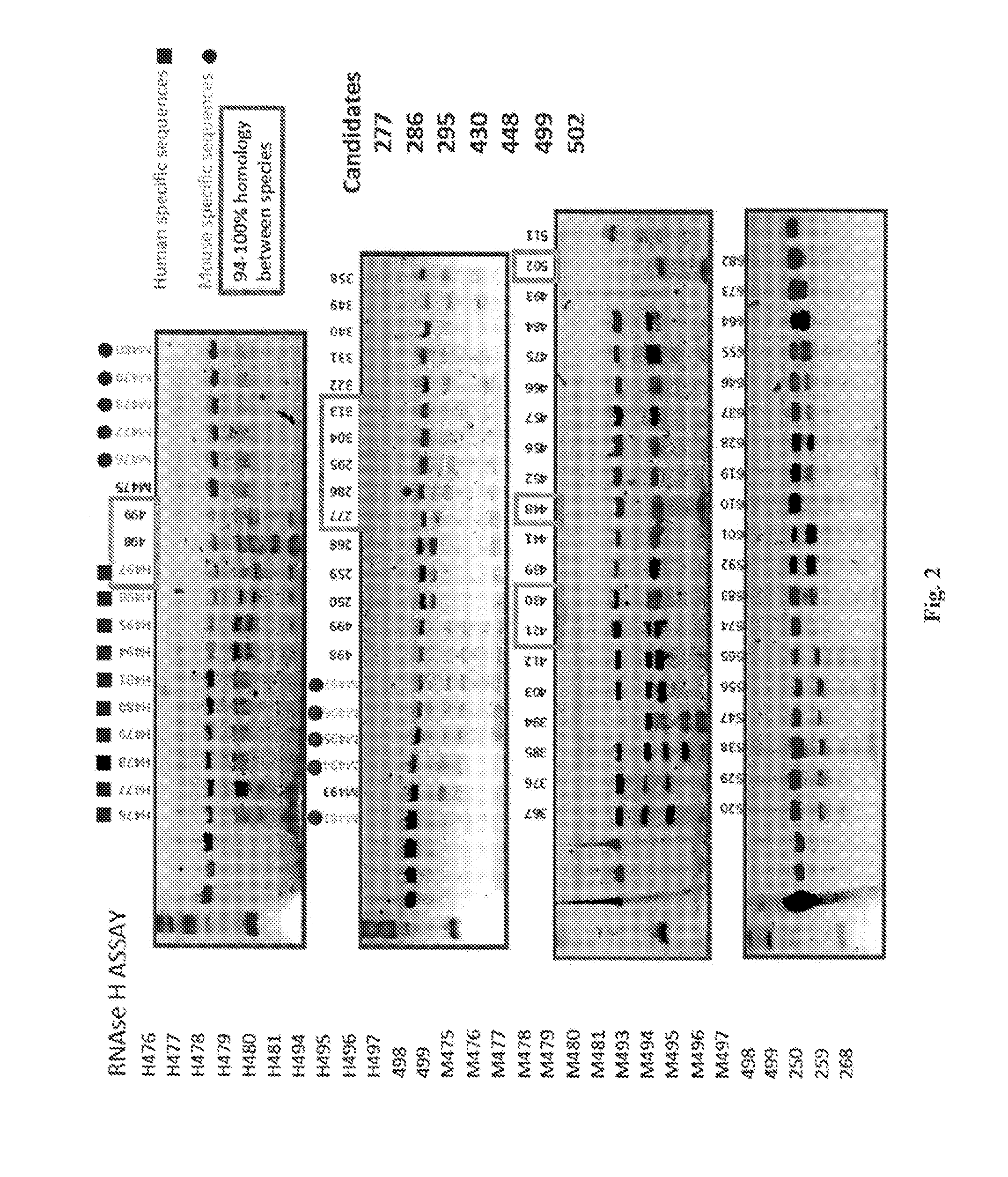
[0446]A total of 7 pre-candidates molecules were selected by RNase H assay. The objective of this assay was to determine which of the seven oligonucleotides promotes the activity of this non-specific endonuclease that catalyzes the cleavage of mRNA.
[0447]To determine the knockdown of mRNA in vivo, in situ hybridization was performed in a total of five animals per analyzed molecule. The seven pre-candidates molecules were divided in two groups administrated in consecutive weeks. A total of 30 μg / mouse / day was administered during 4 consecutive days. Animals were sacrificed 24 hours after the last administration.
[0448]Results
[0449]FIG. 2 shows the results of the RNase H assay.
[0450]The following criteria were used during selection: selected candidates as shown in FIG. 2, a 94-100% homology between 5 species (mouse, rat, dog, monkey and human), no homology with other synucleins (gamma and beta) and induce of RNase H activity.
[0451]To perform t...
PUM
| Property | Measurement | Unit |
|---|---|---|
| Structure | aaaaa | aaaaa |
| Selectivity | aaaaa | aaaaa |
Abstract
Description
Claims
Application Information
 Login to View More