[0010]It is the inventors' finding that simultaneous use of tert-
butyl acetate (CAS#540885) and 4-Chlorobenzotrifluoride (CAS#98566) as dispersants enables even dispersion of nano-particles with particle size less than 1 inn in the water-soluble
solvent such as water so as to afford an
emulsion which has particularly excellent performance in heat conduction and heat dissipation.
[0011]Based on the above finding, the present invention proposes a new process for preparation of a heat-conducting and heat-dissipating nano-material. The
resultant heat-conducting and heat-dissipating nano-material has the ability of effectively and quickly dissipating the heat generated inside the LED lighting device. Due to its excellent heat dissipation effect, the size of heat dissipation structure can be very small, the heat dissipation fins commonly used in the art can even be removed. As a result, the whole lighting device becomes smaller and lighter.
[0022]In order to ensure that the surfaces are sufficiently clean for the application of the heat-conducting and heat-dissipating material for enhanced attachment and prolonged lifespan of the material, the heat conduction panel and the
heat sink are pre-treated by sand blast before the application of the material.
[0025]Depending on which type of substance having properties of heat conduction and heat dissipation is used, the heat-conducting and heat-dissipating nano-material of the invention varies in its heat conduction performance and heat dissipation performance. For example, the heat-conducting and heat-dissipating material made from the complex formed by high molecular material and
ceramic would have better heat
conductivity, which is more suitable to be coated between the heat conduction panel and the
heat sink to transfer the heat generated by the LED
light source to the heat sink by heat conduction and also by heat
radiation as a supplementary means. The heat-conducting and heat-dissipating material made from the complex formed by high molecular material and silica would have better performance in heat dissipation, which is more suitable to be coated on the external surface of the heat sink so as to transfer the heat to the ambient by the way of
radiation.
[0027]The heat-conducting and heat-dissipating material of the present invention is of nano-particles, particularly nano-particles with sizes less than 1 nm, they can be easily and evenly dispersed in the water-soluble
solvent in the presence of both tert-
butyl acetate and 4-Chlorobenzotrifluoride used as the dispersing agents to give a homogenous
emulsion. The present invention has not only solved the problems of even dispersion of the nano-particles in the
solvent, but also acquired the
emulsion with excellent performance in heat conduction and heat dissipation. It is found that
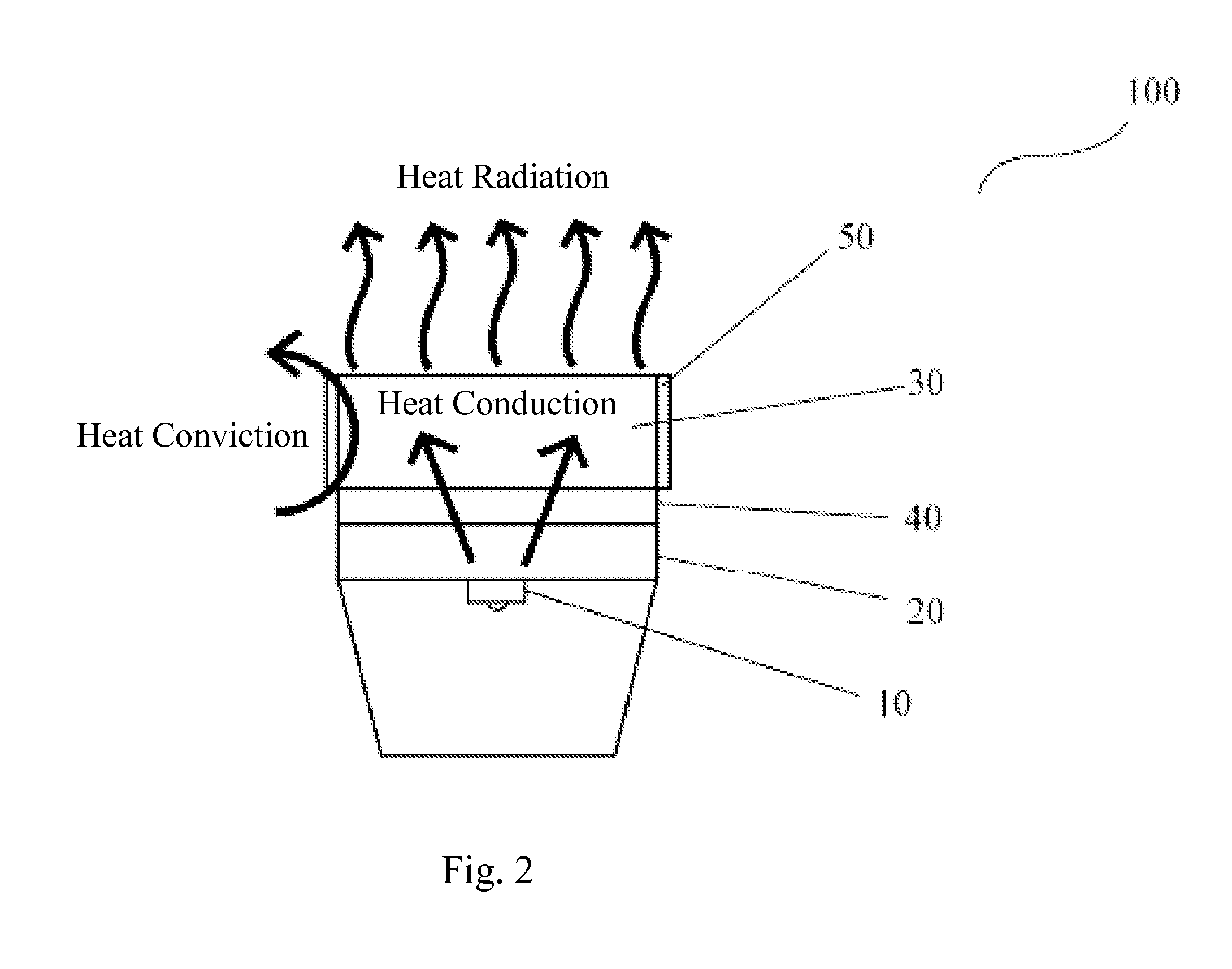
coating of this emulsion between the heat conduction panel and the heat sink as well as on the external surface of the heat sink can transfer quickly the heat generated by the LED
light source to the surface of the heat sink through heat conduction or heat
convection, and the heat is then dissipated from the heat sink to the ambient by heat
radiation, thereby conferring the active heat dissipation ability on the heat sink. Since the nano-material of the present invention has greatly increased the heat dissipation efficiency of the LED light, in some cases the fins may be removed from the heat sink. Such a heat sink thus has simple structure with light weight and small size, and the cost on raw materials can be reduced significantly.
[0028]As stated above, depending on which type of substance having properties of heat conduction and heat dissipation is used, the heat-conducting and heat-dissipating nano-material of the invention varies in its heat conduction performance and heat dissipation performance. The material selected for the
coating between the heat conduction panel and the heat sink preferably has better heat
conductivity and therefore the heat-conducting and heat-dissipating material made from the complex formed by high molecular material and
ceramic may be used. The material selected for the
coating on the surface of the heat sink preferably has better performance in heat dissipation, and therefore the heat-conducting and heat-dissipating material made from the complexes formed by high molecular material and silica may be used.



 Login to View More
  Login to View More