Check patentability & draft patents in minutes with Patsnap Eureka AI!

Anions and Derived Salts with High Dissociation in Non-Protogenic Solvents

a non-protogenic solvent and high dissociation technology, applied in the direction of electrochemical generators, non-aqueous electrolyte accumulator electrodes, non-aqueous electrolyte cells, etc., can solve the problems of large-scale applications, destroying solvents undergoing carbocationic chemistry, and releasing highly toxic h

Active Publication Date: 2014-09-18
JONSSON ERLENDUR +2
View PDF0 Cites 5 Cited by
  • Summary
  • Abstract
  • Description
  • Claims
  • Application Information

AI Technical Summary

Benefits of technology

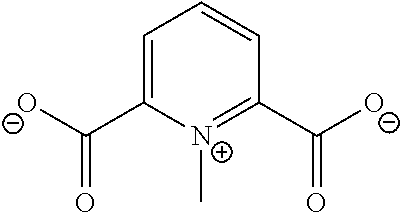
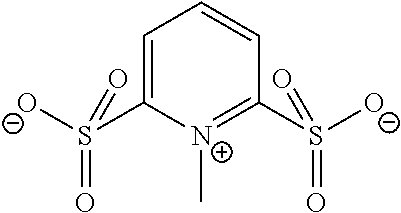
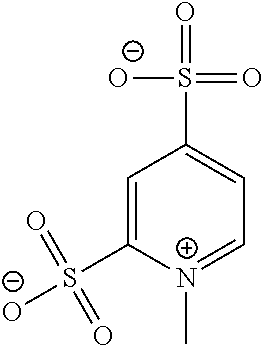
The present invention is related to a new type of salt that consists of a positive onium-type core with a negative component attached to it. The negative component can be an anion formed from the coupling of two negative moieties. This invention is also related to electrolytes made with these salts, and batteries that use these electrolytes. The technical effect of this invention is the creation of a new salt structure that can be utilized in various applications.

Problems solved by technology

[(RfSO2)2N]− or its higher homologues {CF3SO2N[S(O)(CF3)N]nSO2CF3}− are resistant to oxidation, but they do not passivate aluminum which is the only affordable positive electrode current collector.
Most lithium batteries use LiPF6as a solute, which is far from satisfactory mainly since the salt has a propensity to equilibrate as LiPF6⇄LiF+PF5, the latter being a highly reactive Lewis acid, progressively destroying the solvent undergoing carbocationic chemistry.
Another problem with all the salts containing fluorine is the release of highly toxic HF in the case of fire, an incident that occurs presently at a rate of a few ppm / cell, unacceptable for large scale applications, like electric road transportations.
Presently, it has been impossible to avoid using fluorine, the most electronegative element, to impart resistance to oxidation to the anions.

Method used

the structure of the environmentally friendly knitted fabric provided by the present invention; figure 2 Flow chart of the yarn wrapping machine for environmentally friendly knitted fabrics and storage devices; image 3 Is the parameter map of the yarn covering machine
View more

Image

Smart Image Click on the blue labels to locate them in the text.
Viewing Examples
Smart Image
  • Anions and Derived Salts with High Dissociation in Non-Protogenic Solvents
  • Anions and Derived Salts with High Dissociation in Non-Protogenic Solvents
  • Anions and Derived Salts with High Dissociation in Non-Protogenic Solvents

Examples

Experimental program
Comparison scheme
Effect test

example 1

[0016]To 1.34 g of imidazole in suspension in heptane is added 1 ml of 2M butyllithium in hexane and the mixture is stirred at room temperature for 24 hours. To this suspension, are added 3.2 g of sulfur trioxide in dichloromethane. The slurry is stirred further for 24 hours and the solids are separated by centrifugation to yield lithium [1,3 disulfonatoimidazolium].

example 2

[0017]Pyridine-3,5-disulfonic acid is made from 3,5-dichloro-pyridine which is transformed into 3,5-dichloro-pyridine-N-oxide with H2O2. This compound is treated at 135° C. in an autoclave with an excess of Na2SO3, resulting in the sodium salt of pyridine-3,5-disulfonic acid-N-oxide which is reduced by NaBH4 to yield the sodium salt of pyridine-3,5-disulfonic acid. The disalt is alkylated with methyl methanesulfonate to yield sodium [3,5-disulfonato-1-methyl-pyridinium].

example 3

[0018]3,5-pyridine-dicarboxamide is made from the action of NH3 on dimethyl-pyridine-3,5-dicarboxylate. This diamide is quaternarized with dimethyl sulfate and treated with a solution of cyanogen bromide in acetonitile in the presence of imidazole. The result is the imidazolium salt of N,N′-dicyano-1-methyl-pyridinium-3,5 dicarboxamide.

the structure of the environmentally friendly knitted fabric provided by the present invention; figure 2 Flow chart of the yarn wrapping machine for environmentally friendly knitted fabrics and storage devices; image 3 Is the parameter map of the yarn covering machine
Login to View More

PUM

PropertyMeasurementUnit
polaraaaaaaaaaa
metallicaaaaaaaaaa
ion conductionaaaaaaaaaa
Login to View More

Abstract

Salts with formula X−M+ wherein M+ is Li, Na, K, an ammonium, a phosphonium, an imidazolium, a pyridinium, or a pyrazolium and X− is an anion formed from covalent linking of two negative moieties to a positive onium-type core are provided. Also provided are electrolytes and batteries produced from these salts.

Description

BACKGROUND OF THE INVENTION[0001]In solvents, either a non-protogenic, often referred to as “aprotic”, liquid or polymers bearing polar groups such as ethers, esters or nitriles, there is no solvation of the negative X− charge when attempting to induce ion conduction, i.e. forming an electrolyte, by dissolving a salt X−M+ in such media. Solubility then dissociation of the ion pair X−M+ is thus only effective when the anion X− does not require stabilization by forming hydrogen bonds, as in water, alcohols or amides RCONHR′ where R or R′═H, an organic radical. Thus the main anions used in practice are ClO4−, BF4−, PF6−, AsF6−, SbF6−, RfSO3−, [(RfSO2)2N]−, and (RfBF3)− where Rf═CnF2n+1, (0≧n≧8). Another family of anions are the so-called “Hückel anions”, such as 2-trifluoromethyl-4,5-dicyano-imidazole.[0002]A main driving force for designing new anions is in the field of lithium batteries, in particular for highly conductive electrolytes where the polarizing lithium M+=Li is the counte...

Claims

the structure of the environmentally friendly knitted fabric provided by the present invention; figure 2 Flow chart of the yarn wrapping machine for environmentally friendly knitted fabrics and storage devices; image 3 Is the parameter map of the yarn covering machine
Login to View More

Application Information

Patent Timeline
no application Login to View More
Patent Type & Authority Applications(United States)
IPC IPC(8): H01M10/0568H01M10/0565H01M4/36H01M10/0569
CPCH01M10/0568H01M4/36H01M10/0565H01M10/0569C07D213/02C07D233/84H01M4/13H01M4/485H01M4/505H01M4/525H01M6/166Y02E60/10
Inventor JÓNSSON, ERLENDURARMAND, MICHEL BERNARDJOHANSSON, JENS PATRIK
Owner JONSSON ERLENDUR
Features
  • R&D
  • Intellectual Property
  • Life Sciences
  • Materials
  • Tech Scout
Why Patsnap Eureka
  • Unparalleled Data Quality
  • Higher Quality Content
  • 60% Fewer Hallucinations
Social media
Patsnap Eureka Blog
Learn More