Steel products are easily corroded and sessile marine lives easily inhabit thereat.
However, such a concrete structure is limitedly used in the North Sea or polar regions since it is not easily fabricated and also limited to seabed
topography conditions.
A
drill ship has a self-propulsive function to ensure mobility, but its fixedness is ensured by means of mooring or dynamic positioning, which causes rolling or pitching under a
bad weather to cause hardship on its operation.
The jack-up rig ensures better fixedness in comparison to a
drill ship, but it cannot operate at a deep area and does not ensure good mobility.
In addition, under a
bad weather, the jack-up operation may be temporarily interrupted.
The semisubmersible
oil drilling ship is structurally stable but may come into an unstable state at a
bad weather since it has a great upper
deck area and is likely to contain a lot of equipment thereon.
The semisubmersible
oil drilling ship also requires great fabrication and operation costs since it does not have a self-propulsive function.
If any unusual structure in a fault or sedimentary stratum, an abrupt change of the seabed
topography, abnormal
erosion, a
stream of sediments or the like is found in the seas around the structure, a serious problem may occur on the stability of the structure.
However, ascending and descending of the
sea level is not caused only by celestial bodies, but the phenomenon locally caused by wind, wave, or difference in pressures should not be ignored.
Therefore, if this effect is not suitably considered in designing, a serious problem may be caused.
In addition, the external surface of each component becomes rougher to increase a drag effect, and in case of a steel material,
corrosion may be locally promoted.
Meanwhile, as sessile marine lives cover the surface of the structure, it becomes more difficult to maintain and manage the marine structure, and thus it is required to partially remove the marine bodies.
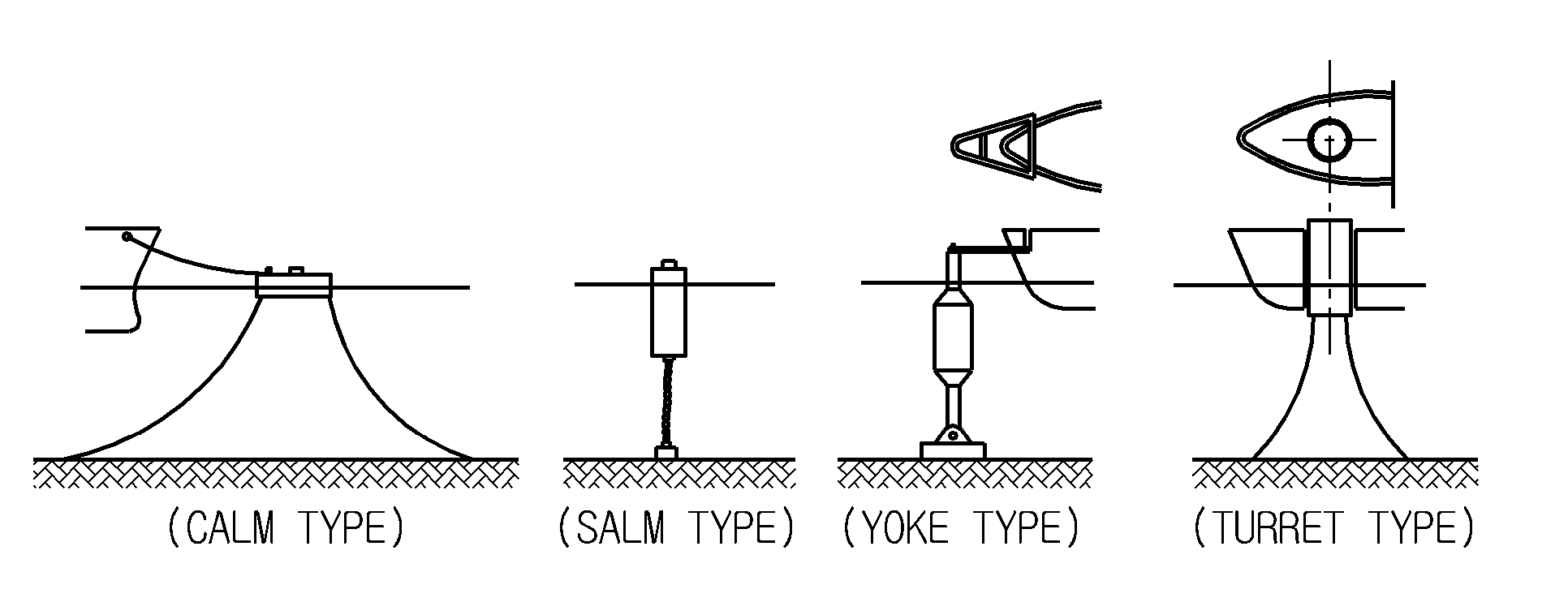
The fixed structure needs a small maintenance cost and has a high operation rate in the oil unloading work, while the single-point
mooring system needs more maintenance cost but has a low early stage investment.
In particular, in a marine structure having a riser, the ratio has a limit of about 5%, and if the ratio becomes 10%, the riser may be bent or broken.
Here, if the mooring line and the anchor are broken beyond an allowable level of the system, a flexible riser connecting the
single point mooring (SPM) and the
pipe line end manifold (PLEM) is damaged, which results in
spillage of high-pressure and high-temperature
crude oil.
Such an oil
spillage accident causes huge economical, life and environmental losses.
In fact, a mooring device is not designed suitably for an environment of an installation region, and an interpretation program for mooring devices is imported from foreign countries, which consumes enormous foreign currency.
In addition, a tension applied to each mooring line of a marine structure is not regular but changes continuously due to a loading amount, a change of tide, or a difference between the
ebb and flow.


 Login to View More
  Login to View More