Unlock instant, AI-driven research and patent intelligence for your innovation.

Method for adjusting light emitting device

Active Publication Date: 2016-02-25
KK TOPCON
View PDF2 Cites 0 Cited by
  • Summary
  • Abstract
  • Description
  • Claims
  • Application Information

AI Technical Summary

Benefits of technology

The present invention provides a technique to emit light with a short pulse width using a simple structure. This can be achieved by increasing the capacitance of the capacitive reactance circuit and decreasing the resistance value of the resistance circuit to increase or decrease the peak value of the emitted light. The technique does not require complex or expensive equipment and can be implemented in various applications such as lighting systems or optical communication devices.

Problems solved by technology

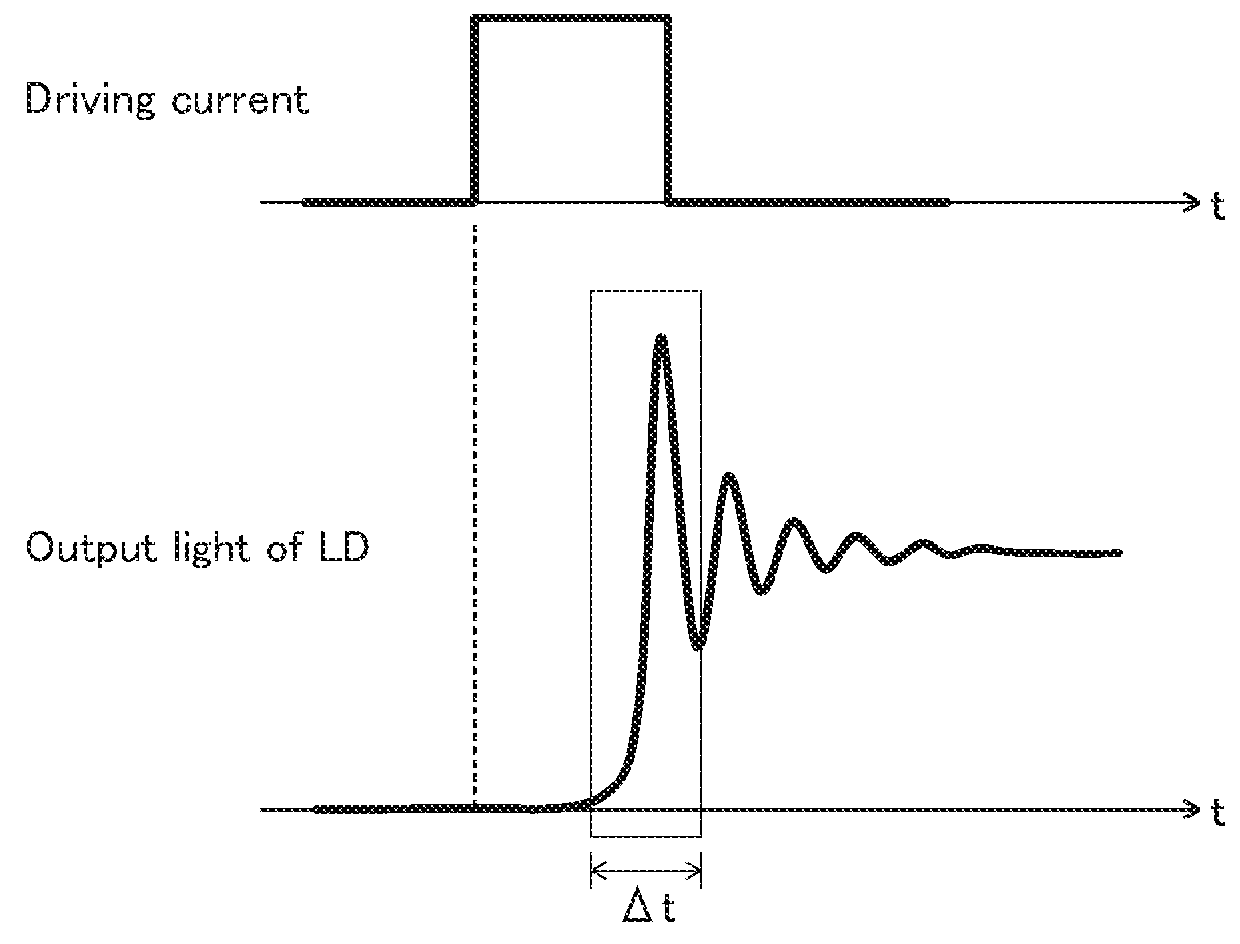
However, it is difficult to generate a driving current having a time length on the order of several tens to several hundreds of picoseconds using a simple circuit.
However, for example, considering that the cycle of a high frequency of 100 MHz is 10−8 seconds (10 nanoseconds=10,000 picoseconds), it is not easy to obtain pulse-like driving current having a time length on the order of several tens to several hundreds of picoseconds.
Nevertheless, the high frequency technique in the microwave band may not be suitable for use for, for example, outdoor measuring devices and the like, in view of circuit scale, production cost, need for complicated adjustment, and large consumption of electric power.

Method used

the structure of the environmentally friendly knitted fabric provided by the present invention; figure 2 Flow chart of the yarn wrapping machine for environmentally friendly knitted fabrics and storage devices; image 3 Is the parameter map of the yarn covering machine
View more

Image

Smart Image Click on the blue labels to locate them in the text.
Viewing Examples
Smart Image
  • Method for adjusting light emitting device
  • Method for adjusting light emitting device
  • Method for adjusting light emitting device

Examples

Experimental program
Comparison scheme
Effect test

first embodiment

1. First Embodiment

Structure

[0035]FIG. 3 shows a block diagram and a circuit diagram of a light emitting device 100 of an embodiment. The light emitting device 100 includes a light source 101, a differentiation circuit 102, and a switch 103, which are connected in series, and power-supply voltage V is applied between both ends of this serial connection. In this example, the light source 101 is a laser diode (LD), the differentiation circuit 102 is a circuit formed by connecting a resistor R (102a) and a capacitor C (102b) in parallel, and the switch 103 is an FET.

[0036]Regarding circuit constants, for example, the power-supply voltage is 5V, the resistance value of the resistor 102a is 200 ohm, the capacitance of the capacitor 102b is 20 pF, and a square wave with a frequency of approximately several tens of MHz at most is used as a control signal.

Operation

[0037]When the FET is switched off (there is no electric conduction between source and drain), the voltage V is not applied to t...

second embodiment

2. Second Embodiment

[0079]The intensity of light emitted by the laser diode (LD) is temperature-dependent. Here, an example of a structure for decreasing variation of the intensity of emitted light of the light source due to temperature change will be described. FIG. 11 shows a block diagram of this embodiment. FIG. 11 shows a light emitting device 200 including a variable voltage power supply 105, a temperature sensor 106, a light source 101, a differentiation circuit 102, and a switch 103. Here, the light source 101, the differentiation circuit 102, and the switch 103 are the same as in the First Embodiment shown in FIG. 3.

[0080]The variable voltage power supply 105 is a negative power supply and varies the value of output voltage according to the temperature detected by the temperature sensor 106. The negative voltage set and generated by the variable voltage power supply 105 is applied to the circuit in which the light source 101, the differentiation circuit 102, and the switch ...

third embodiment

3. Third Embodiment

[0084]FIG. 15A shows a light emitting device 300 having a switch 103 at a position different from the case shown in FIG. 3. In the light emitting device 300, the switch 103 is arranged between a light source 101 and a differentiation circuit 102. The light emitting device 300 is an example in which the light source and the differentiation circuit are connected in series. The light source 101, the differentiation circuit 102, and the switch 103 of the light emitting device 300 are the same as those described relating to the structure shown in FIG. 3.

[0085]The operation of the light emitting device 300 is the same as that of the light emitting device 100 shown in FIG. 3. The operation of the light emitting device 300 will be simply described hereinafter. When the switch 103 is switched off, no voltage is applied to the capacitor (the reference numeral 102b in FIG. 3) of the differentiation circuit and also, no voltage is applied to the light source 101, whereby the ...

the structure of the environmentally friendly knitted fabric provided by the present invention; figure 2 Flow chart of the yarn wrapping machine for environmentally friendly knitted fabrics and storage devices; image 3 Is the parameter map of the yarn covering machine
Login to View More

PUM

No PUM Login to View More

Abstract

Light with a short pulse width is emitted using a simple structure. A light source 101, a differentiation circuit 102, and a switch 103 are connected in series. When the switch 103 is switched on, inrush current flows in a capacitor 102b forming the differentiation circuit 102, and accordingly the light source 101 is supplied with electric current and thereby emits light. When the capacitor 102b is charged, electric current flows in a resistor 102a, and voltage drops at the resistor 102a. Then, the voltage applied to the light source 101 is decreased, whereby the light source 101 stops emitting light. The values of the resistor 102a and the capacitor 102b are adjusted so that the above phenomenon occurs.

Description

BACKGROUND OF THE INVENTION[0001]1. Technical Field[0002]The present invention relates to a method for adjusting a light emitting device that can perform emission of pulsed light.[0003]2. Background Art[0004]In technology using laser light for measuring distances, various types of machining, etc., a short pulsed laser light with a pulse width of several tens to not more than several hundreds of picoseconds is desired. For example, in distance measurements using pulsed laser light, the precision of measuring distances can be improved by using pulsed light with a narrow pulse width. As a technique for generating laser light with a narrow pulse width, techniques disclosed in, for example, Japanese Examined Patent Application Publication No. 7-109911, Japanese Unexamined Patent Application Laid-Open No. 55-107282, and Japanese Unexamined Patent Application Laid-Open No. 2002-368329 are publicly known.[0005]FIG. 1 shows a relationship between driving current and output light of a laser d...

Claims

the structure of the environmentally friendly knitted fabric provided by the present invention; figure 2 Flow chart of the yarn wrapping machine for environmentally friendly knitted fabrics and storage devices; image 3 Is the parameter map of the yarn covering machine
Login to View More

Application Information

Patent Timeline
no application Login to View More
IPC IPC(8): H01S5/065H01S5/062
CPCH01S5/062H01S5/065H01S5/0428H01S5/06216
Inventor GOTO, YOSHIAKITOKUDA, YOSHIKATSU
Owner KK TOPCON