

Polymerization of diene monomers
a diene monomer and polymer technology, applied in the field of diene monomer polymerization, can solve the problems of high polydispersity, high overall rate of monomer conversion, and still carried out thermoplastic elastomer block copolymerization, and achieves high initiator efficiency, control and predictability, and greater degree of uniformity.
- Summary
- Abstract
- Description
- Claims
- Application Information
AI Technical Summary
Benefits of technology
Problems solved by technology
Method used
Image

Examples
examples
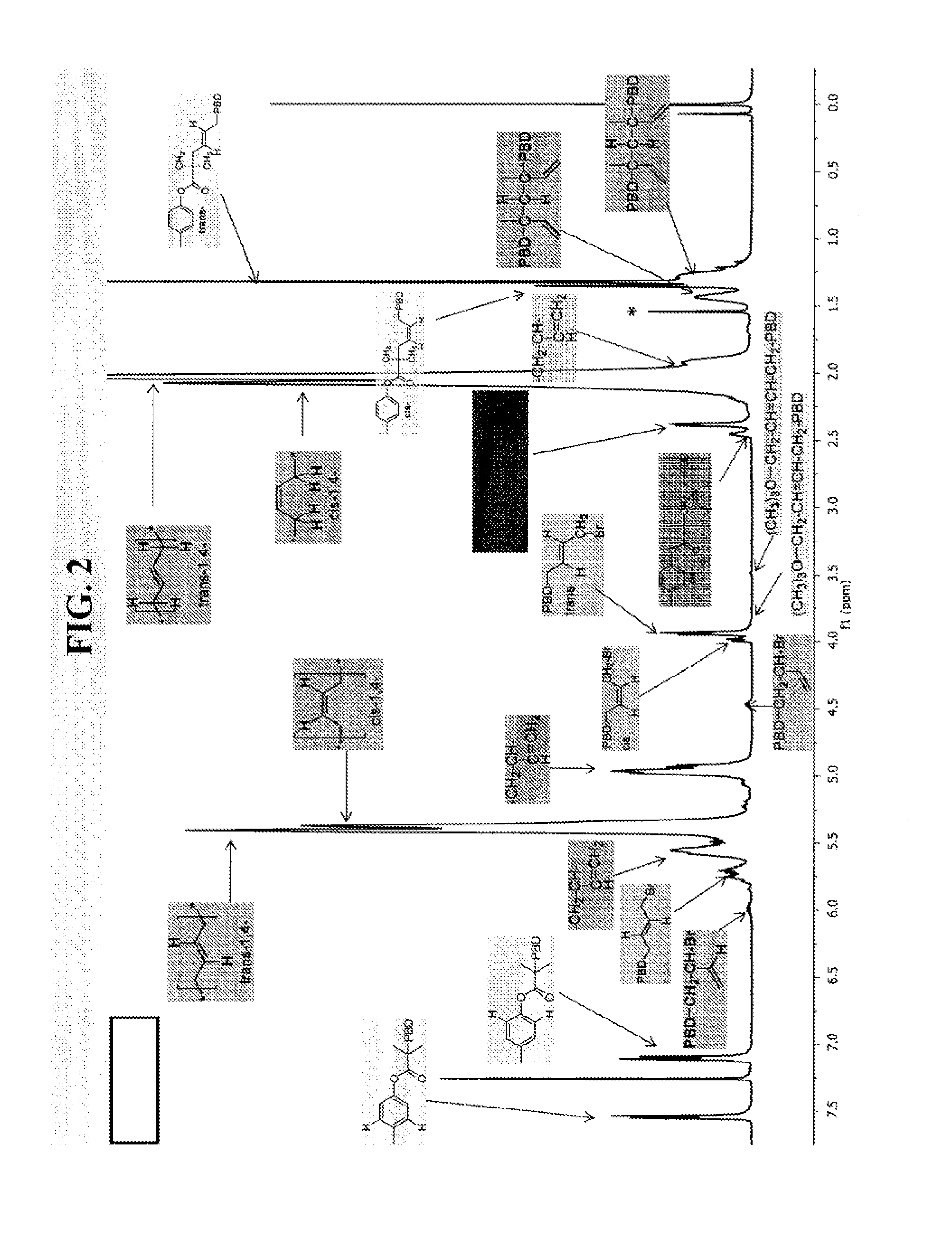
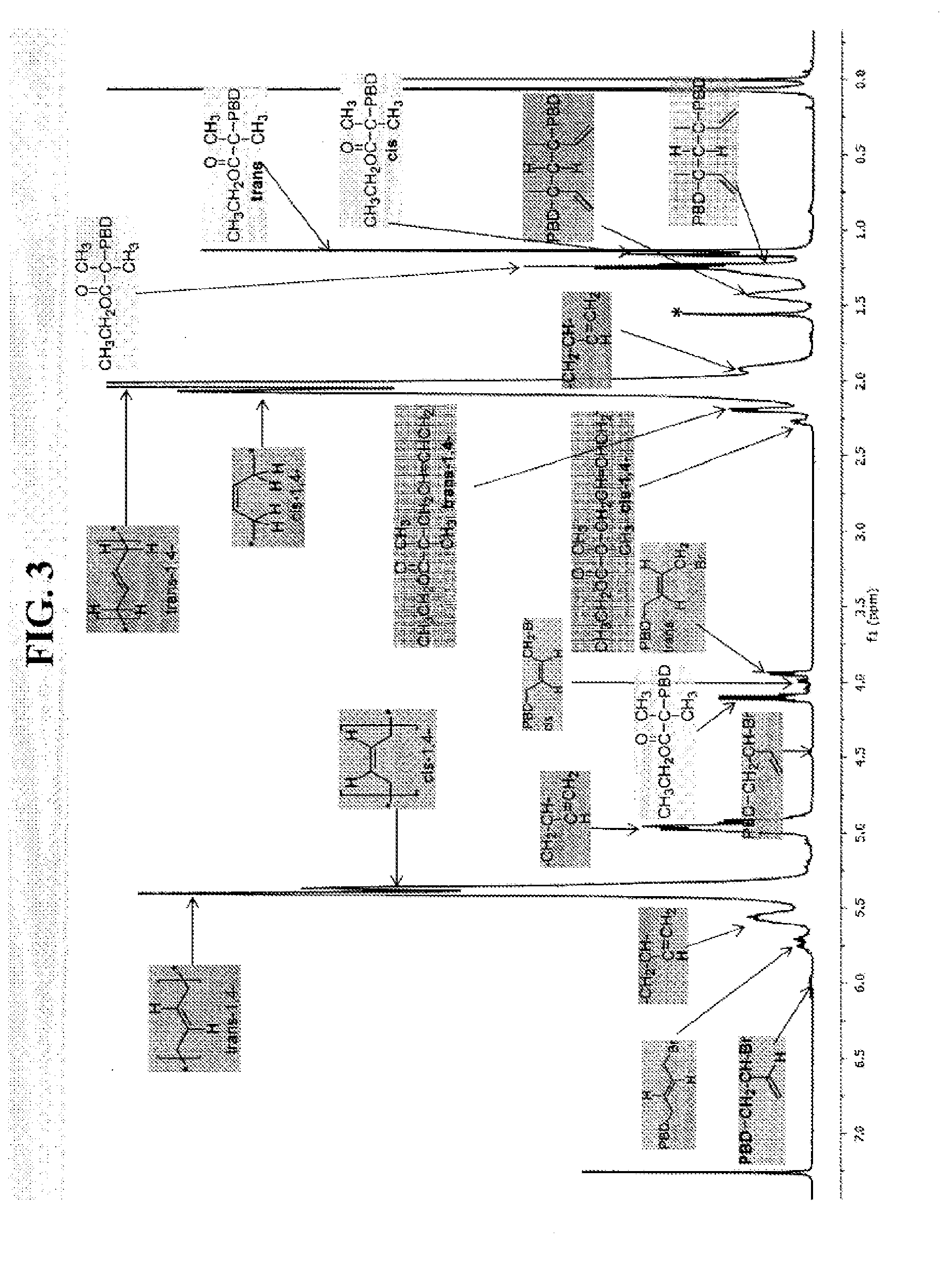
[0303]Polybutadiene (PBD) and polyisoprene (PI) were prepared in accordance with the ATRP process of this disclosure. FIG. 2 shows chain-end nuclear magnetic resonance (NMR) of (A) initiator fragment and first unit of butadiene bonded to an initiator and (B) halide-capped and eliminated end units. FIG. 3 shows 1H NMR spectra of polybutadiene (PBD) initiated from alkyl and sulfonyl initiators. FIG. 4 lists chain end characterizations for butadiene prepared in accordance with the ATRP process of this disclosure.
[0304]FIG. 8 graphically depicts the effect of initiators in the CuBr-mediated butadiene polymerization in toluene. Part (a) shows the dependence of Mn and Mw / Mn on conversion. Part (b) shows pseudofirst-order kinetics. [BD] / [Initiator] / [CuBr] / [bpy]=100 / 1 / 1 / 3, T=110° C. FIG. 10 lists data showing the effect of initiators in the CuBr-mediated butadiene polymerization in toluene at 110° C.
[0305]FIG. 9 graphically depicts the effect of CuX / RY (X, Y═Cl, Br) halide combinations in t...
PUM
| Property | Measurement | Unit |
|---|---|---|
| polydispersity | aaaaa | aaaaa |
| PDI | aaaaa | aaaaa |
| temperature | aaaaa | aaaaa |
Abstract
Description
Claims
Application Information
 Login to View More