Here, deviation in day-to-day placement of electrodes can result in measurement errors, particularly when trends of the measured parameters are extracted.
This, in turn, can lead to
misinformation, nullify the value of such measurements, and thus negatively
impact treatment.
Unfortunately, during a measurement, the lead wires can pull on the electrodes if the device is moved relative to the patient's body, or if the patient ambulates and snags the lead wires on various objects.
Such pulling can be uncomfortable or even painful, particularly where the electrodes are attached to hirsute parts of the body, which can inhibit
patient compliance with long-term monitoring.
Moreover, such pulling can degrade or even completely eliminate adhesion of the electrodes to the patient's
skin, thereby degrading or completely destroying the ability of the electrodes to sense the physiolectrical signals at various
electrode locations.
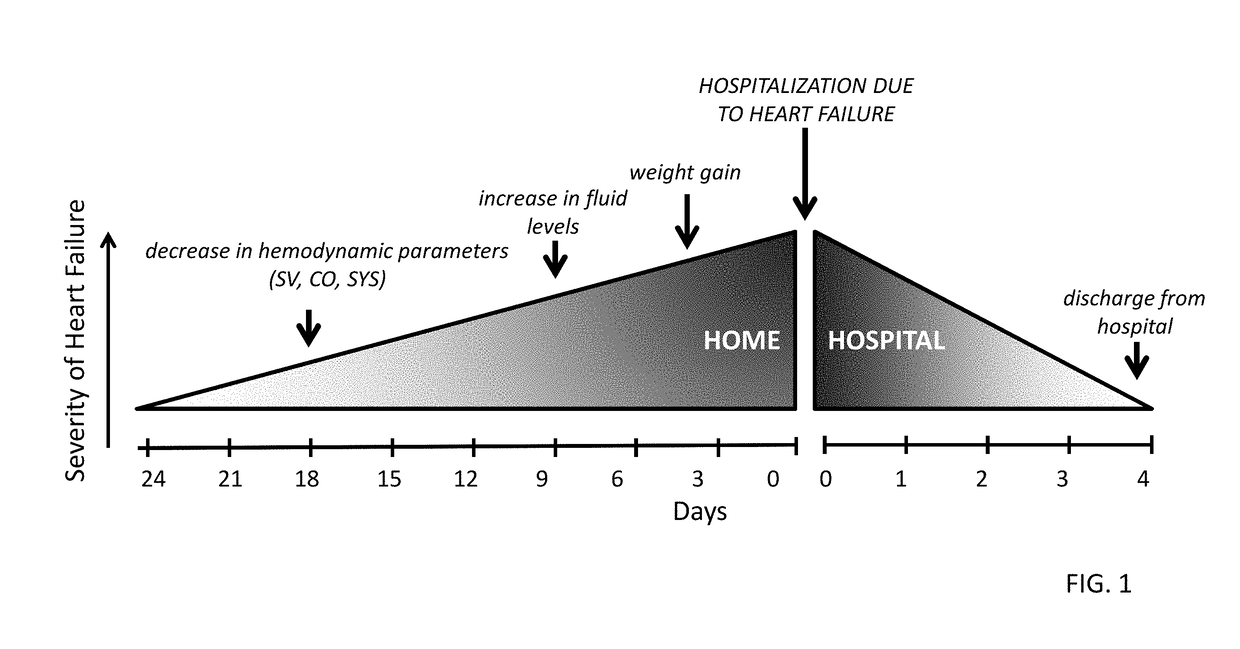
In general terms, this condition occurs when SV and CO are insufficient in adequately perfusing the kidneys and lungs.
Chronic elevation of LVEDP causes transudation of fluid from the pulmonary veins into the lungs, resulting in shortness of breath (dyspnea), rapid
breathing (
tachypnea), and fatigue with
exertion due to the mismatch of
oxygen delivery and
oxygen demand throughout the body.
As CO is compromised, the kidneys respond with decreased
filtration capabilities, thus driving retention of
sodium and water, and leading to an increase in intravascular volume.
However, an extremely delicate balance between these two biological treatment modalities needs to be maintained, since an increase in blood pressure (which relates to
afterload) or fluid retention (which relates to preload), or a significant change in heart rate due to a tachyarrhythmia, can lead to decompensated HF.
Unfortunately, this condition is often unresponsive to oral medications.
However, this parameter is typically not sensitive enough to detect the
early onset of CHF—a particularly important time when the condition may be ameliorated by a change in medication or diet.
As described above, these organs then respond with a decrease in their filtering capacity, thus causing the patient to retain
sodium and water and leading to an increase in intravascular volume.
This, in turn, leads to congestion, which is manifested to some extent by a build-up of fluids in the patient's
thoracic cavity (e.g. TFC).
CHF is also the leading cause of mortality for patients with ESRD, and this demographic costs Medicare nearly $90,000 / patient annually.
Typically, the patient wears the entire
system on their body, but such systems can be awkward, cumbersome, and / or uncomfortable, e.g., due to the electrodes pulling the patient's
skin / hair.
Less-than-satisfactory consistency with the use of any
medical device (in terms of duration and / or methodology) may be particularly likely in an environment such as the patient's home or a
nursing home, where direct supervision may be less than optimal.


 Login to View More
  Login to View More