This helps you quickly interpret patents by identifying the three key elements:
Problems solved by technology
Method used
Benefits of technology
Benefits of technology
The present invention provides an adhesive sheet with high flexibility and fast-curing properties that is suitable for use in the production of automobiles. The adhesive sheet has good balance of properties such as fast-curability, heat resistance, and adhesiveness, and also exhibits excellent properties such as thermal conductivity due to good filling properties. The adhesive sheet can be easily shaped and worked with, and can be used in various production processes. The technical effects of the invention include improved efficiency and productivity in the production process of automobiles.
Problems solved by technology
However, since the clearance between a conductor coil and a stator core is very narrow and an adhesive is hard to enter the clearance, a void space is formed.
When the clearance is enlarged to avoid this, heat dissipation of a motor decreases, leading to a lowering in the performance, because of low heat dissipation of the adhesive, and for complete filling, a large amount of an adhesive is required.
Further, correct control of the coating amount and the coating position of a liquid adhesive is generally difficult.
Furthermore, a heat-curable adhesive such as an epoxy resin shows a lowering in viscosity and drips readily when heated, possibly polluting an adherend and the working periphery, thus, it is required to prevent liquid-drip to parts other than the adhesion part by using fixtures such as a fence and a wall.
As described above, a liquid epoxy resin adhesive has a lot of problems of workability in use.
Further, irregularity of an adherend such as a coil composed of bundled conductive wire should be filled.
Patent documents 2 and 3 describe an adhesive sheet inferior in a filling property onto an irregular adherend and thermal conductivity since an intermediate layer of the adhesive sheet is a foaming layer and an adhesive layer not foaming is disposed on the outside thereof, and do not consider fast curability and heat resistance (for example, suppression of a lowering in adhesion strength under high temperatures).
Method used
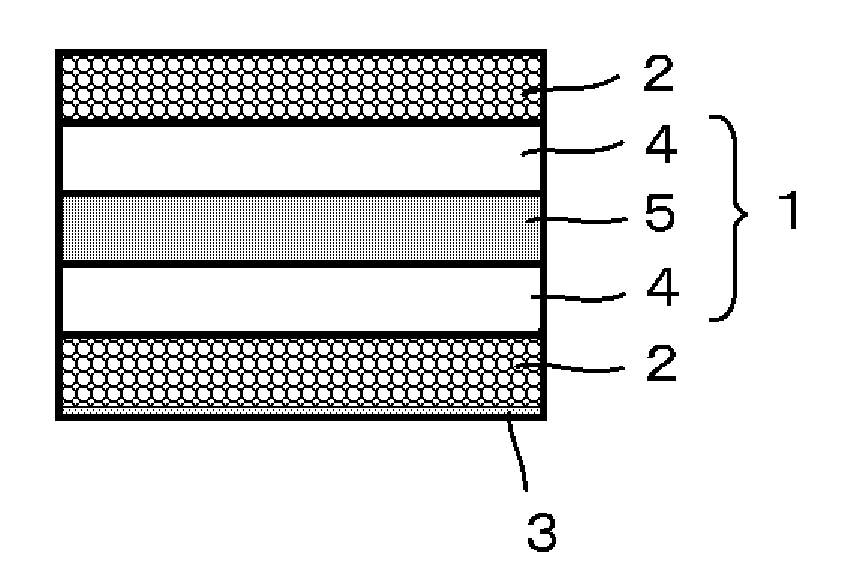
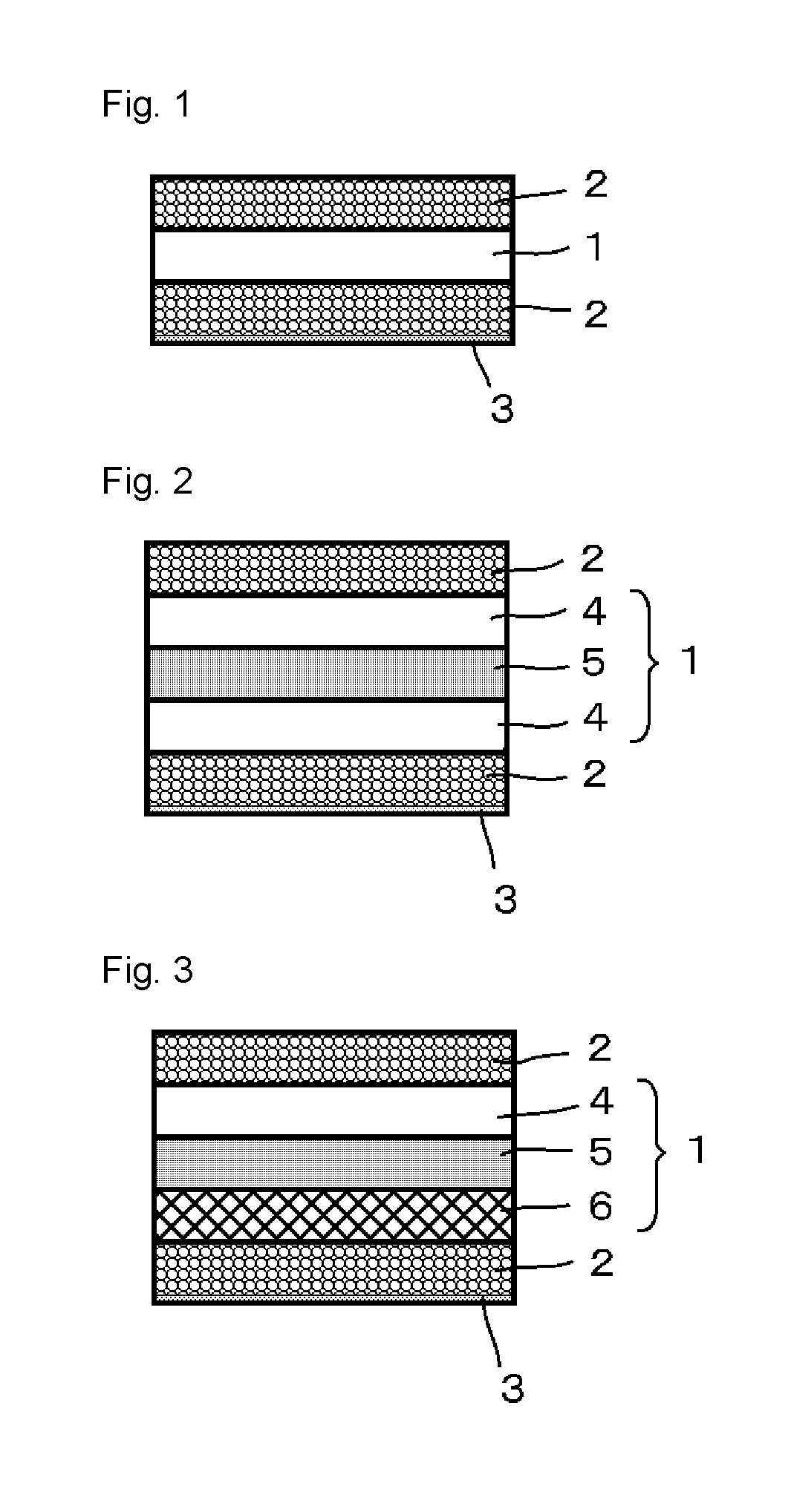
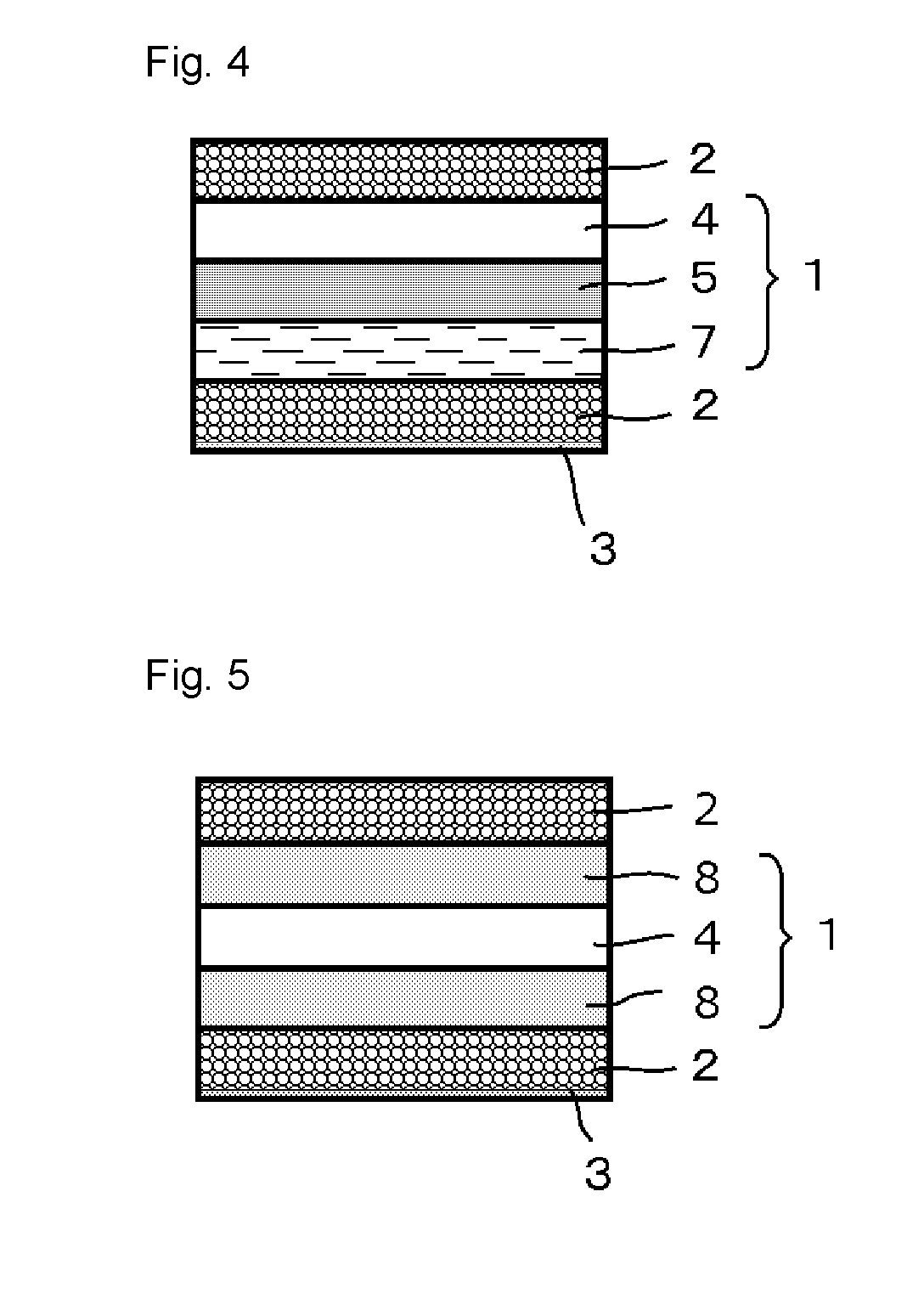
the structure of the environmentally friendly knitted fabric provided by the present invention; figure 2 Flow chart of the yarn wrapping machine for environmentally friendly knitted fabrics and storage devices; image 3 Is the parameter map of the yarn covering machine
View more
Image
Smart Image Click on the blue labels to locate them in the text.
Viewing Examples
Smart Image
Click on the blue label to locate the original text in one second.
Reading with bidirectional positioning of images and text.
Smart Image
Examples
Experimental program
Comparison scheme
Effect test
examples
[0087]The present invention will be further illustrated by examples below, but the present invention is not limited to them.
[0088]
[0089]The following components were mixed in amounts shown in Table 1 (parts by mass), to obtain adhesives for base fabrication (Compounds 1 to 5).
[0090]“EP1”: epoxy resin (liquid, viscosity 13,500 mPa·s (25° C.), epoxy equivalent 189 g / eq, BPA type, standard liquid product)
[0092]“EP3”: epoxy resin (softening temperature 70° C., epoxy equivalent 210 g / eq, special novolac type, heat resistant type)
[0093]“EP4”: epoxy resin (softening temperature 92° C., epoxy equivalent 200 g / eq, special polyfunctional type, highly heat resistant type)
[0094]“EP5”: epoxy resin (softening temperature 86° C., epoxy equivalent 230 g / eq, naphthalenering type, heat resistant / tough type)
[0095]“EP6”: epoxy resin (softening temperature 92° C., epoxy equivalent 395...
examples 1 to 10
, Reference Examples 1 to 3 and Comparative Examples 1 to 2
[0148]Expandable adhesives (Compounds 2 to 3 and 6 to 7) were coated on one side of bases K1a to K10 so that the thickness after drying was about 35 μm (about 25 μm in Example 8, about 30 μm in Examples 9 and 10), thereafter, the solvent was removed by drying at 90° C. for 5 minutes, to form expandable adhesive layers. Onto the surface of this expandable adhesive layer, a 38 μm thick polyester film having undergone a silicone releasing treatment on one side was pressed with hot rolls heated at 100° C., to obtain a first step product. On another surface of this first step product, the same kind of expandable adhesive composition was coated so that the thickness after drying was about 35 μm (about 25 μm in Example 8, about 30 μm in Examples 9 and 10), thereafter, the solvent was removed by drying at 90° C. for 5 minutes, to form an expandable adhesive layer. Onto the surface of this expandable adhesive layer, a 38 μm thick pol...
example 11
[0149]On a 38 μm thick polyester film having undergone a silicone heavy peeling / releasing treatment on one side, an expandable adhesive (Compound 8) was coated so that the thickness after drying was 25 μm, thereafter, the solvent was removed by drying at 90° C. for 5 minutes, to form an expandable adhesive layer. On the surface of this expandable adhesive layer, a 38 μm thick polyester film having undergone a silicone light peeling / releasing treatment on one surface was laminated and the laminate was wound, to obtain an adhesive sheet of Example 11. In use of this adhesive sheet, the polyester films having undergone a releasing treatment on both sides were peeled, and a base-less type adhesive sheet composed only of the expandable adhesive layer is used.
[0150]The adhesive sheets of Examples 1 to 11, Reference Examples 1 to 3 and Comparative Examples 1 to 2 described above were evaluated according to the following methods. The results are shown in Tables 3 to 5.
[0151][Thickness of Ad...
the structure of the environmentally friendly knitted fabric provided by the present invention; figure 2 Flow chart of the yarn wrapping machine for environmentally friendly knitted fabrics and storage devices; image 3 Is the parameter map of the yarn covering machine
Login to View More
PUM
Property
Measurement
Unit
Temperature
aaaaa
aaaaa
Temperature
aaaaa
aaaaa
Fraction
aaaaa
aaaaa
Login to View More
Abstract
In an embodiment, an adhesive sheet has an expandable adhesive layer 2 on one side or both sides of a base 1, wherein the expandable adhesive layer 2 contains an epoxy resin including a polyfunctional epoxy resin, a phenol resin as a curing agent, an imidazole-based compound as a curing catalyst, and a temperature-sensitive foaming agent. The adhesive sheet has properties in good balance, such as fast curability, heat resistance, and adhesiveness, and also excellent properties such as thermal conductivity attributed to a good filling property.
Description
TECHNICAL FIELD[0001]The present invention relates to an adhesive sheet having an expandable adhesive layer containing an epoxy resin and a temperature-sensitive foaming agent. The adhesive sheet of the present invention is useful, for example, for an application in which the sheet is used between two members such as a stator and a coil in a motor generator, expanded, foamed and cured by heating, and filled in its interspace, thereby mutually adhering the members.BACKGROUND ART[0002]An epoxy resin adhesive is widely used for adhesion of members and structural bonding because of excellent heat resistance and strong adhesiveness.[0003]For example, in motors of electric vehicles and hybrid automobiles having rapidly spread recently, a coil composed of wound and bundled enamel wire is fixed to a stator core with an epoxy resin. In conventional methods, an insulating paper is inserted between a conductor coil and a stator core, a liquid epoxy resin adhesive is injected into an interspace...
Claims
the structure of the environmentally friendly knitted fabric provided by the present invention; figure 2 Flow chart of the yarn wrapping machine for environmentally friendly knitted fabrics and storage devices; image 3 Is the parameter map of the yarn covering machine
Login to View More
Application Information
Patent Timeline
Application Date:The date an application was filed.
Publication Date:The date a patent or application was officially published.
First Publication Date:The earliest publication date of a patent with the same application number.
Issue Date:Publication date of the patent grant document.
PCT Entry Date:The Entry date of PCT National Phase.
Estimated Expiry Date:The statutory expiry date of a patent right according to the Patent Law, and it is the longest term of protection that the patent right can achieve without the termination of the patent right due to other reasons(Term extension factor has been taken into account ).
Invalid Date:Actual expiry date is based on effective date or publication date of legal transaction data of invalid patent.


 Login to View More