Check patentability & draft patents in minutes with Patsnap Eureka AI!

Fast-dissolving co-crystalline lactose

a co-crystalline, fast-dissolving technology, applied in the field of fast-dissolving co-crystalline lactose, can solve the problems of limited use or applicability of lactose for the above-mentioned purposes, inability to add pure lactose to certain food products, and inability to achieve full homogeneous solution, etc., to achieve efficient fortification of food or beverage, low flowability, good flowability

Inactive Publication Date: 2018-06-28
SOC DES PROD NESTLE SA
View PDF0 Cites 0 Cited by
  • Summary
  • Abstract
  • Description
  • Claims
  • Application Information

AI Technical Summary

Benefits of technology

The invention provides a new way to effectively fortify food or beverages with calcium. By using lactose.calcium salt co-crystals, the flowability and processability of the calcium salt is improved, making it easier to handle and dose. Additionally, the co-crystals are more efficient at supporting calcium absorption, meaning less calcium is needed in the nutritional or pharmaceutical compositions. The co-crystals can be made with either α-lactose or β-lactose and can be hydrated or anhydrous. Overall, this invention provides a more effective and streamlined way to add calcium to food and beverages.

Problems solved by technology

Due to these inherent properties, the use or applicability of lactose for the above-mentioned purposes is limited and sometimes restricted; e.g. addition of pure lactose to certain food products is not possible in the desired amounts.
Thus, complete dissolution of lactose without lump formation resulting in a fully homogeneous solution, requires a considerable amount of time or, alternatively, heat or mechanical treatment, e.g. stirring or shaking.
Yet, high temperatures might result in browning reactions (Maillard reaction), which may adversely impact nutritional and organoleptic properties of a composition.
Furthermore, in contemporary automated dispensing systems utilizing individual capsules for portioned preparation of liquid food formulations, e.g. instant soups, beverages or infant formulas, preparation time is very short (commonly less than a minute) and the amount of liquid available for complete dissolution is limited.
In this respect, however, selection of an appropriate form of calcium, which supplements the desired level of the mineral without affecting flavor, solubility, bioavailability, processability and organoleptic properties of the product is challenging.
Addition of calcium to milk, for example, is associated with significant difficulties.
In addition, various calcium salts commonly used for fortification purposes (e.g. calcium citrate malate, tricalcium phosphate or calcium lactate) are characterized by poor flowability rendering their handling and dosage impractical.
Caking can block dosing systems and result in loss of entire production batches.
However, none of these documents suggests the inclusion of lactose calcium complexes or compounds into nutritional or pharmaceutical compositions or describes their dissolution kinetics.

Method used

the structure of the environmentally friendly knitted fabric provided by the present invention; figure 2 Flow chart of the yarn wrapping machine for environmentally friendly knitted fabrics and storage devices; image 3 Is the parameter map of the yarn covering machine
View more

Image

Smart Image Click on the blue labels to locate them in the text.
Viewing Examples
Smart Image
  • Fast-dissolving co-crystalline lactose
  • Fast-dissolving co-crystalline lactose
  • Fast-dissolving co-crystalline lactose

Examples

Experimental program
Comparison scheme
Effect test

example 1

[0151]Preparation of seeding crystals (lactose.calcium chloride heptahydrate co-crystals) for use in Example 2:

[0152]50.0 g of lactose monohydrate, followed by 50.0 g of calcium chloride dihydrate were added to 75.0 g of water over a period of 20 minutes at 40-65° C. at 300 rpm. The solution was cooled to 15-35° C. and stirring was continued until crystals started to precipitate.

[0153]The suspension was filtered and the isolated crystals were washed with cold (8-10° C.) ethanol at room temperature. The isolated product was dried at 15-45° C. under vacuum for 1-3 hours and at 15-25° C. without vacuum for 36-60 hours.

[0154]Results:

[0155]Co-crystalline lactose.calcium chloride.7 H2O was obtained as white powder.

example 2

[0156]Preparation of Lactose.Calcium Chloride Co-Crystals Using Seeding Crystals:

[0157]100.0 g of calcium chloride dihydrate and 100.0 g of lactose monohydrate were added stepwise to 166.0 g of water. The dissolution is exothermic, so the solution heated up to a temperature of around 60° C. The solution was stirred until all solids had dissolved. The solution was cooled to 30-35° C. 10.0 mg of seeding crystals obtained by the process according to example 1 were added to the solution. After crystal precipitation, the suspension was filtered and the isolated crystals were washed with cold ethanol (8-10° C.) at room temperature. The isolated product was dried at 15-45° C. under vacuum for 1-3 hours and for 36-60 hours at 15-25° C. without vacuum.

[0158]Results:

[0159]Co-crystalline lactose.calcium chloride.7 H2O was obtained as white powder.

example 3

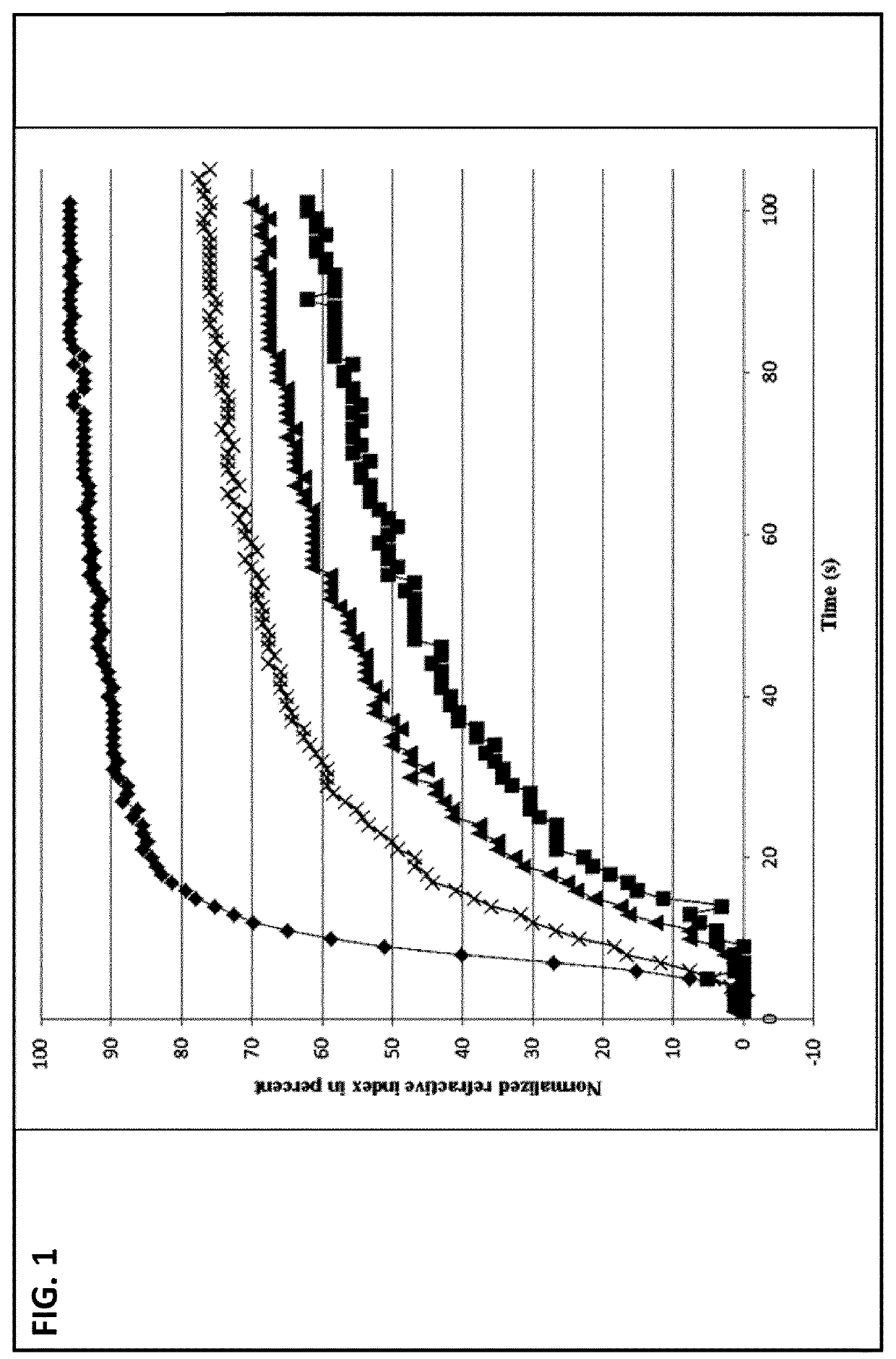
[0160]The dissolution kinetics of 2 g of lactose.CaCl2.7 H2O co-crystals in water (♦) in comparison to 1.24 g of pure lactose monohydrate in water (▪), 1.24 g of lactose monohydrate in 0.52 g calcium chloride solution (▴) and a physical mixture of 1.24 g of lactose monohydrate and 0.52 g of calcium chloride dihydrate in water (X) were measured by refractometry at room temperature over a time period of 0 to 100 seconds while stirring the solution. Particle size of the respective solids (60-90 μm) was comparable.

[0161]Results:

[0162]FIG. 1 demonstrates that within 20 seconds about 85% of the co-crystalline material, i.e. of the lactose.CaCl27 H2O co-crystals are dissolved in water, whereas at the same time only about 20% of the lactose monohydrate was dissolved in water. Similarly, a significantly lower amount of the lactose monohydrate as compared to the co-crystalline material was dissolved in the calcium chloride solution, namely about 30%. Of the physical mixture of lactose and cal...

the structure of the environmentally friendly knitted fabric provided by the present invention; figure 2 Flow chart of the yarn wrapping machine for environmentally friendly knitted fabrics and storage devices; image 3 Is the parameter map of the yarn covering machine
Login to View More

PUM

No PUM Login to View More

Abstract

The invention relates to nutritional compositions comprising lactose.calcium salt co-crystals and to the use of these co-crystals for preparing nutritional compositions, as carrier, filler or stabilizer, for accelerating lactose dissolution as well as for efficient calcium fortification of compositions. Furthermore, the present invention is directed to a process for preparing such lactose.calciumsalt co-crystals and nutritional compositions comprising such.

Description

FIELD OF THE INVENTION[0001]The invention relates to nutritional compositions comprising lactose.calcium salt co-crystals and to the use of lactose.calcium salt co-crystals for preparing nutritional compositions, for accelerating lactose dissolution and for improving calcium availability. The invention further relates to a process for preparing lactose.calcium salt co-crystals and a process for preparing nutritional compositions comprising lactose.calcium salt co-crystals.BACKGROUND OF THE INVENTION[0002]The disaccharide sugar lactose, also known as milk sugar, is built from galactose and glucose linked via a β-(1,4)-glucosidic linkage. It is the most important carbohydrate of milk.[0003]Lactose provides various nutritional benefits such as growth promotion of beneficial intestinal bacteria, for instance lactic acid bacteria (e.g. Bifidobacterium bifidum or Lactobacilli). Thereby, the consumers' resistance to intestinal infections is maintained or increased and well-being, in partic...

Claims

the structure of the environmentally friendly knitted fabric provided by the present invention; figure 2 Flow chart of the yarn wrapping machine for environmentally friendly knitted fabrics and storage devices; image 3 Is the parameter map of the yarn covering machine
Login to View More

Application Information

Patent Timeline
no application Login to View More
Patent Type & Authority Applications(United States)
IPC IPC(8): A23L33/16A23L33/125A23L33/00
CPCA23L33/16A23L33/125A23L33/40A23V2002/00A23C9/1522A61K31/7016A61K33/14A23K20/163A23K20/24A23L29/30A23K50/70A23K50/40A23K50/80A23K50/50A61K33/06A23C9/16A23L33/165A61K2300/00A23V2200/31A23V2250/0612A23V2250/1578
Inventor OERTLING, HEIKOPAS, MALTEALZIEU, THIBAUTDUPAS-LANGLET, MARINAANDRIEUX, JEAN-CHRISTOPHE
Owner SOC DES PROD NESTLE SA
Features
  • R&D
  • Intellectual Property
  • Life Sciences
  • Materials
  • Tech Scout
Why Patsnap Eureka
  • Unparalleled Data Quality
  • Higher Quality Content
  • 60% Fewer Hallucinations
Social media
Patsnap Eureka Blog
Learn More