
Silicone composition, a cured silicone rubber product and a power cable
a technology of silicone rubber and composition, applied in the field of silicone composition, can solve the problems of large corrosion depth of silicone rubber composition described in patent literature 3, and achieve the effect of improving the dispersibility of the composition, improving the tracking resistance, and improving the dispersibility
- Summary
- Abstract
- Description
- Claims
- Application Information
AI Technical Summary
Benefits of technology
Problems solved by technology
Method used
Image

Examples
preparation example 1
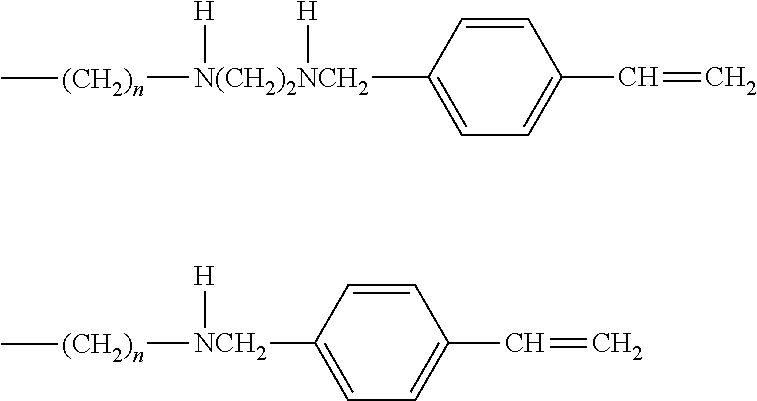
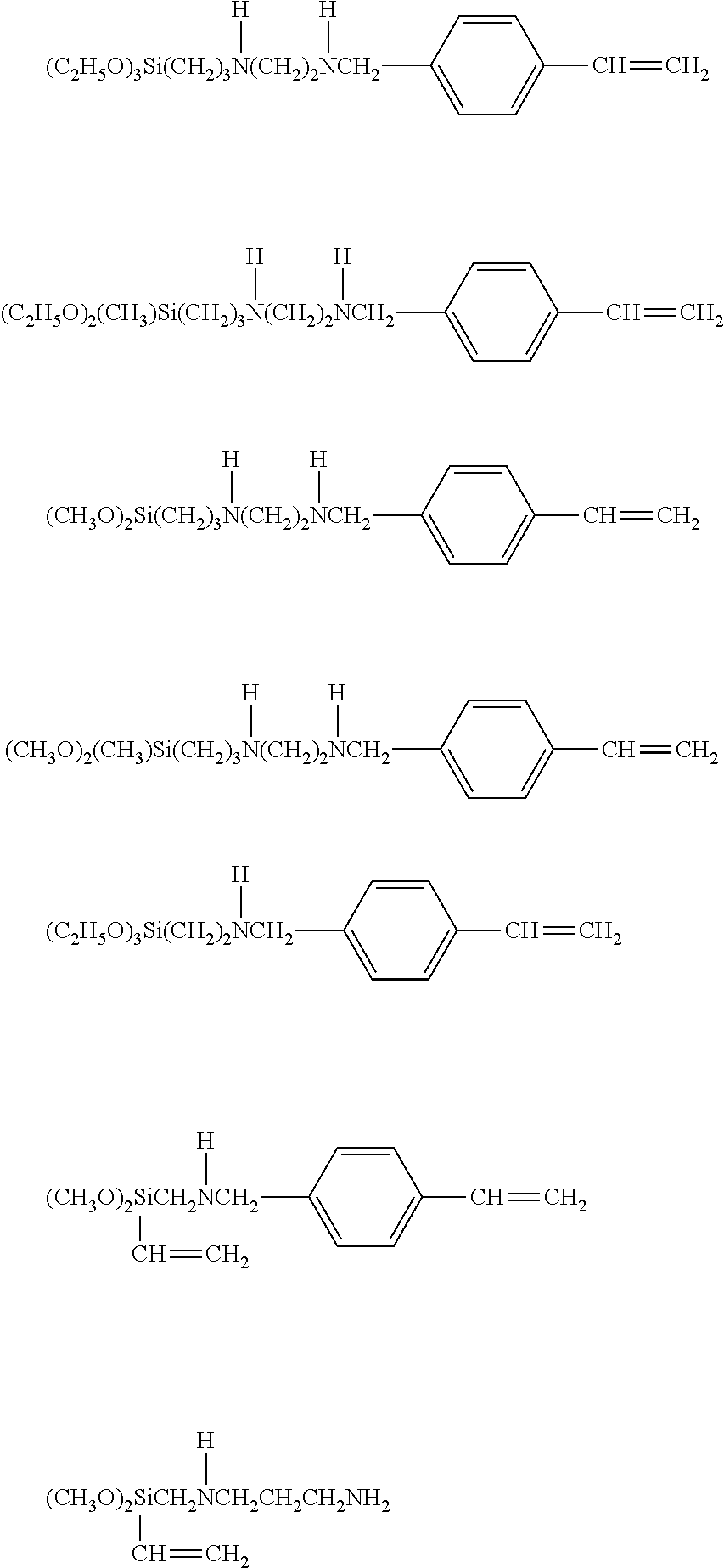
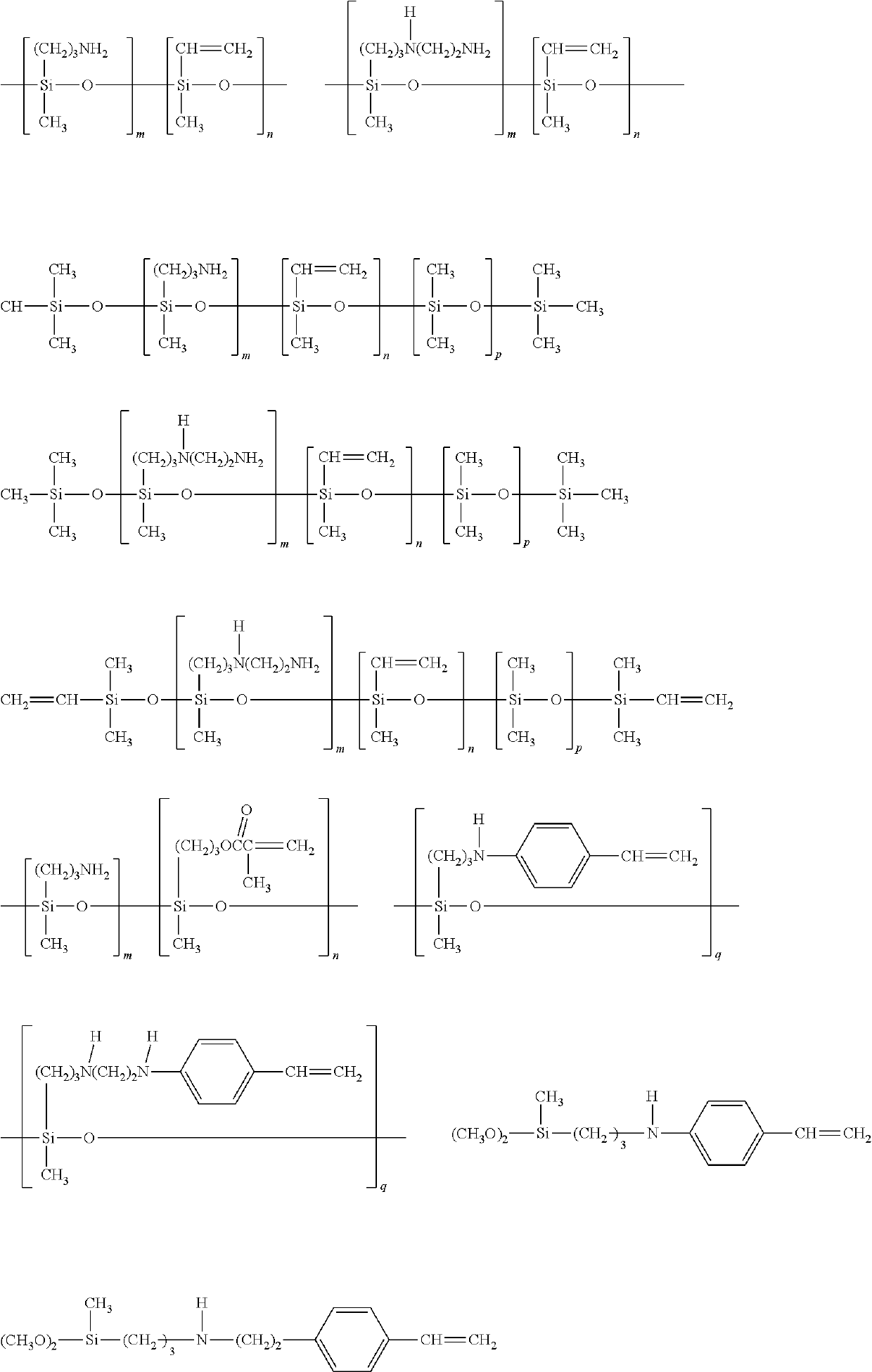
[0084]95 parts by mass of (A-1) a raw rubber-like organopolysiloxane comprising 99.975 mol % of dimethylsiloxane units and 0.025 mol % of dimethylvinylsiloxane units and having an average polymerization degree of about 8,000, 5 parts by mass of (A-2) a raw rubber-like organopolysiloxane comprising 89.993 mol % of dimethylsiloxane units and 9.982 mol % of methylvinylsiloxane units and having an average polymerization degree of about 8,000, 35 parts by mass of (B) fumed silica hydrophobilized by dichlorodimethylsilane and having a specific surface area of 300 m2 / g, and 3 parts by mass of dimethylpolysiloxane as a dispersant which had silanol groups at the both terminals, an average polymerization degree of 13, and a viscosity at 25 degrees C. of 15 mm2 / s were kneaded with a kneader. Further, 1.0 part by mass of (D) polymer A represented by the following formula (3) was added to the mixture, kneaded, and heated at 180 degrees C. for 3 hours to obtain mixture A.
preparation example 2
[0085]99 parts by mass of (A-1) a raw rubber-like organopolysiloxane comprising 99.975 mol % of dimethylsiloxane units and 0.025 mol % of dimethylvinylsiloxane units and having an average polymerization degree of about 8,000, 1 part by mass of (A-2) a raw rubber-like organopolysiloxane comprising 97.000 mol % of dimethylsiloxane units, 2.975 mol % of methylvinylsiloxane units and 0.025 mol % of dimethylvinylsiloxane units and having an average polymerization degree of about 8,000, 35 parts by mass of (B) fumed silica hydrophobilized by dichlorodimethylsilane and having a specific surface area of 300 m2 / g, and 3 parts by mass of dimethylpolysiloxane as a dispersant which had silanol groups at the both terminals, an average polymerization degree of 13, and a viscosity at 25 degrees C. of 15 mm2 / s were kneaded with a kneader. Further, 1.0 part by mass of (D) polymer A represented by the aforesaid formula (3) was added to the mixture, kneaded, and heated at 180 degrees C. for 3 hours to...
preparation example 3
[0086]90 parts by mass of (A-1) a raw rubber-like organopolysiloxane comprising 98.500 mol % of dimethylsiloxane units, 1.475 mol % of methylvinylsiloxane units and 0.025 mol % of dimethylvinylsiloxane units and having an average polymerization degree of about 8,000, 10 parts by mass of (A-2) a raw rubber-like organopolysiloxane comprising 90.000 mol % of dimethylsiloxane units, 9.975 mol % of methylvinylsiloxane units and 0.025 mol % of dimethylvinylsiloxane units and having an average polymerization degree of about 8,000, 35 parts by mass of (B) fumed silica hydrophobilized by dichlorodimethylsilane and having a specific surface area of 300 m2 / g, and 3 parts by mass of dimethylpolysiloxane as a dispersant which had silanol groups at the both terminals, an average polymerization degree of 13, and a viscosity at 25 degrees C. of 15 mm2 / s were kneaded with a kneader. Further, 1.0 part by mass of (D) polymer A represented by the aforesaid formula (3) was added to the mixture, kneaded,...
PUM
| Property | Measurement | Unit |
|---|---|---|
| Fraction | aaaaa | aaaaa |
| Fraction | aaaaa | aaaaa |
| Fraction | aaaaa | aaaaa |
Abstract
Description
Claims
Application Information
 Login to View More