
Diffraction pattern detection in a transmission charged particle microscope
a technology of transmission charge and particle microscope, which is applied in the direction of basic electric elements, electric discharge tubes, electrical apparatus, etc., can solve the problems of radiation damage to specimens, especially biological samples, and degradation of signal quality, so as to reduce the risk of detector damage, the average dose rate per pixel is reduced, and the count rate is higher
- Summary
- Abstract
- Description
- Claims
- Application Information
AI Technical Summary
Benefits of technology
Problems solved by technology
Method used
Image

Examples
embodiment 1
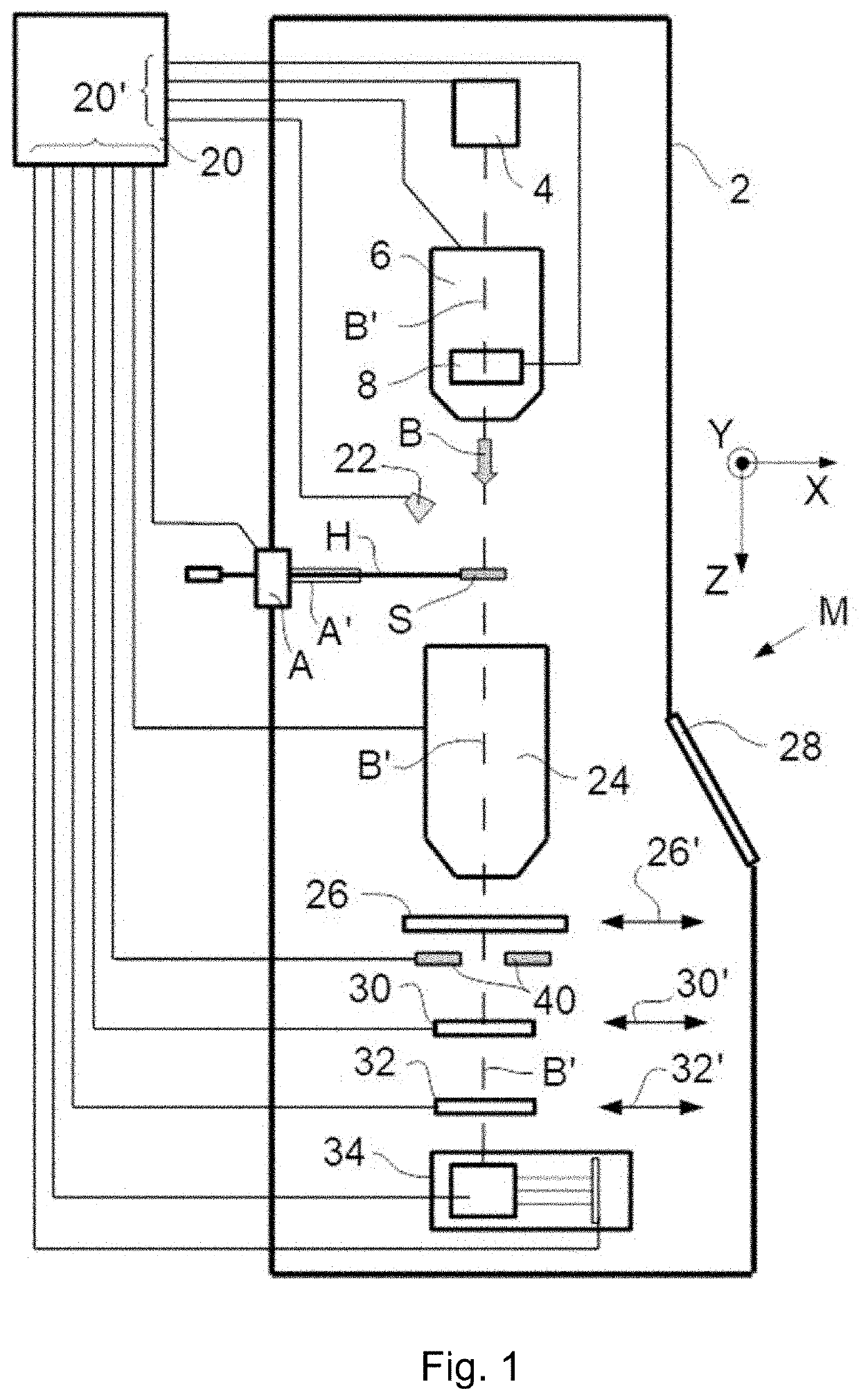
[0030]FIG. 1 (not to scale) is a highly schematic depiction of an embodiment of a TCPM M in which the present invention is implemented; more specifically, it shows an embodiment of a TEM / STEM (though, in the context of the current disclosure, it could just as validly be an ion-based microscope, for example). In the Figure, within a vacuum enclosure 2, an electron source 4 produces a beam B of electrons that propagates along an electron-optical axis B′ and traverses an electron-optical illuminator (charged particle beam column) 6, serving to direct / focus the electrons onto a chosen part of a specimen S (which may, for example, be (locally) thinned / planarized). Also depicted is a deflector 8, which (inter alia) can be used to effect scanning motion of the beam B.
[0031]The specimen S is held on a specimen holder H that can be positioned in multiple degrees of freedom by a positioning device / stage A, which moves a cradle A′ into which holder H is (removably) affixed; for example, the sp...
PUM
 Login to View More
 Abstract
Description
Claims
Application Information
 Login to View More