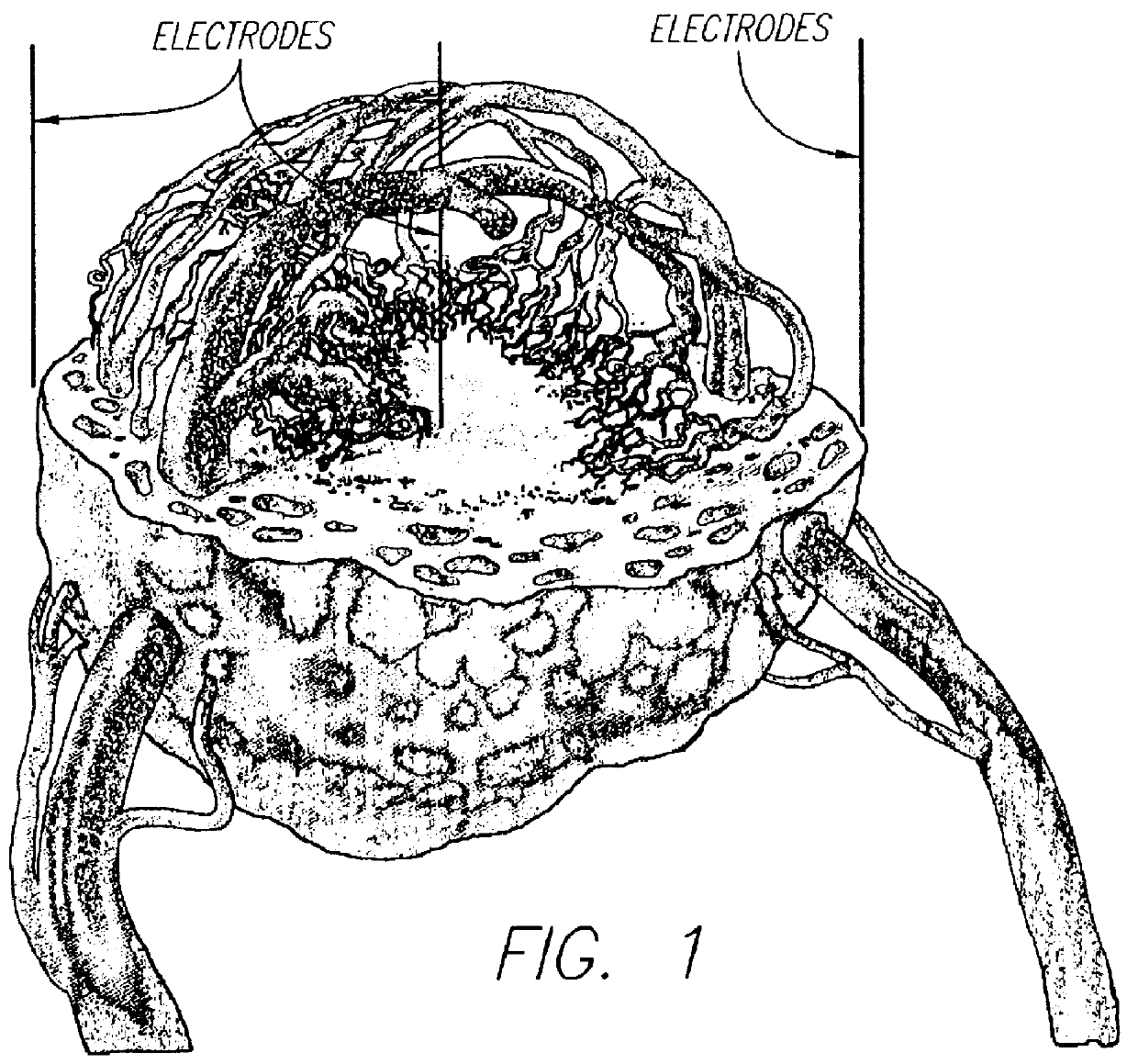
The application of an electropermeabilization pulse between these two electrodes will ordinarily provide subthreshold electrical pulses to large areas of the tumor (widely-spaced lines) thus reducing the effectiveness of the permeabilization in those areas;
However, this technique is limited in that it does not allow modulation or alteration of
drug release to achieve "
on demand"
drug delivery.
Above a certain threshold, however, the resistance rapidly decreases, with higher
voltage pulses further decreasing the tissue resistance.
Generally, for cells,
electroporation results in non-thermal, short term membrane changes, with all damage or death occurring only due to long term
osmotic pressure differences, or other physicochemical imbalances.
The presence of such
free drug may in some cases be tolerated but in many other cases is undesirable because these drugs are often toxic in their
free state.
In general, the well-permeabilized regions have low interstitial pressures, leading to increased
extravasation of fluid and macromolecules from the vasculature.
The local and vascular delivery systems described above may not be able to deliver a uniform distribution of the agent, due to regional variations in
blood supply, tumor density, necrotic zones, variations in interstitial space pressure, etc.
There are some problems with this approach however such as areas of differing pressure within the tumor and non-uniformity of the interstitial compartment within the tumor.
The rates of infusion during the experiments proved significant, as infusion rates greater than a few microliters per minute produced leakage of the
infusion solution out of the cannula tract and lowered the infusion pressure.
It is anticipated that for the purposes of the acute implementation,
electrode immobilization provided by normal frictional forces would be adequate and not require positional stabilization.
The application of low-intensity
AC field has resulted in a dielectrophoretic process resulting in the formation of pearl chains.
The
recovery process in cells versus artificial bilayers is much slower and strongly temperature dependent in cells.
(1994) noted that longer pulses were less effective than multiple pulses for maximizing transport while minimizing damage.
(1) transient electropores: Within a few msec after the cessation of the electrical field, these pores partially decrease in
diameter and adopt a stable configuration. The pores allow translocation of various molecules (influx of exogenous molecules and
efflux of cytosolic compounds) by two slightly different mechanisms. Large molecules and even macromolecules are assumed to cross only the transient electropores. They must be present in the
extracellular medium during the
electroporation pulses and efficient
electroporation requires long electroporation pulses or a large number of pulses and an E generally greater than the absolute or E.sub.C. The amount of compound electroincorporated is inversely related to the molecular weight.
(2) long-lasting electropores: Created after shorter electroporation pulses, these electropores are only efficient for ions and small or intermediate size molecules. It is possible to add the exogenous molecules to the electroporation cells after electrical field delivery as well as before. Concentrations on both sides of the
plasma membrane are roughly equilibrated.
Also, the larger the electropores formed, the longer the time necessary to recover the initial membrane impermeability.
), resealing is very slow.
There are a number of technical issues which must be considered when contemplating electroporation of a tissue as a whole, rather than tissues in suspension or culture.
non-uniformity of electrical field
Therefore, it appears that the problem of restoring integrity to a damaged
cell membrane is equivalent to the problem of achieving a high enough concentration of the correct surfactant at the site of damage.
First, even very small field intensities may cause electroporation, provided the field application is long enough.
The application of low-intensity
AC field has resulted in a dielectrophoretic process resulting in the formation of pearl chains.
Then, during the electroporation phase, more effective electroporation will result, causing increased number of cells to undergo electropermeabilization and thus be susceptible to the liposomes containing the
drug compound to be delivered.


 Login to View More
  Login to View More