As discussed above, humanized antibodies afford potential advantages over murine and also chimeric antibodies, e.g., reduced
immunogenicity in humans. This is advantageous because it should reduce and potentially eliminate the eliciting of a HAMA response when such humanized antibodies are administered
in vivo, e.g., either for treatment of cancer or for diagnosis of cancer as by
tumor imaging. Also, such antibodies may exhibit improved
plasma clearance, pharmacokinetic, and
tumor targeting properties.
Alternatively, the
amino acid sequences of the FRs of the
antibody to be humanized (e.g., COL-1) will be compared to those of known human FRs, and the human FRs to be used for CDR-
grafting will be selected based on their comprising sequences highly similar to those of the parent
antibody, e.g., a
murine antibody which binds CEA. Numerous human FRs have been isolated and their sequences reported in the literature. This enhances the likelihood that the
resultant CDR-grafted "humanized" antibody, which contains the CDRs of the parent (e.g., murine) antibody grafted onto the selected human FRs, will substantially retain the
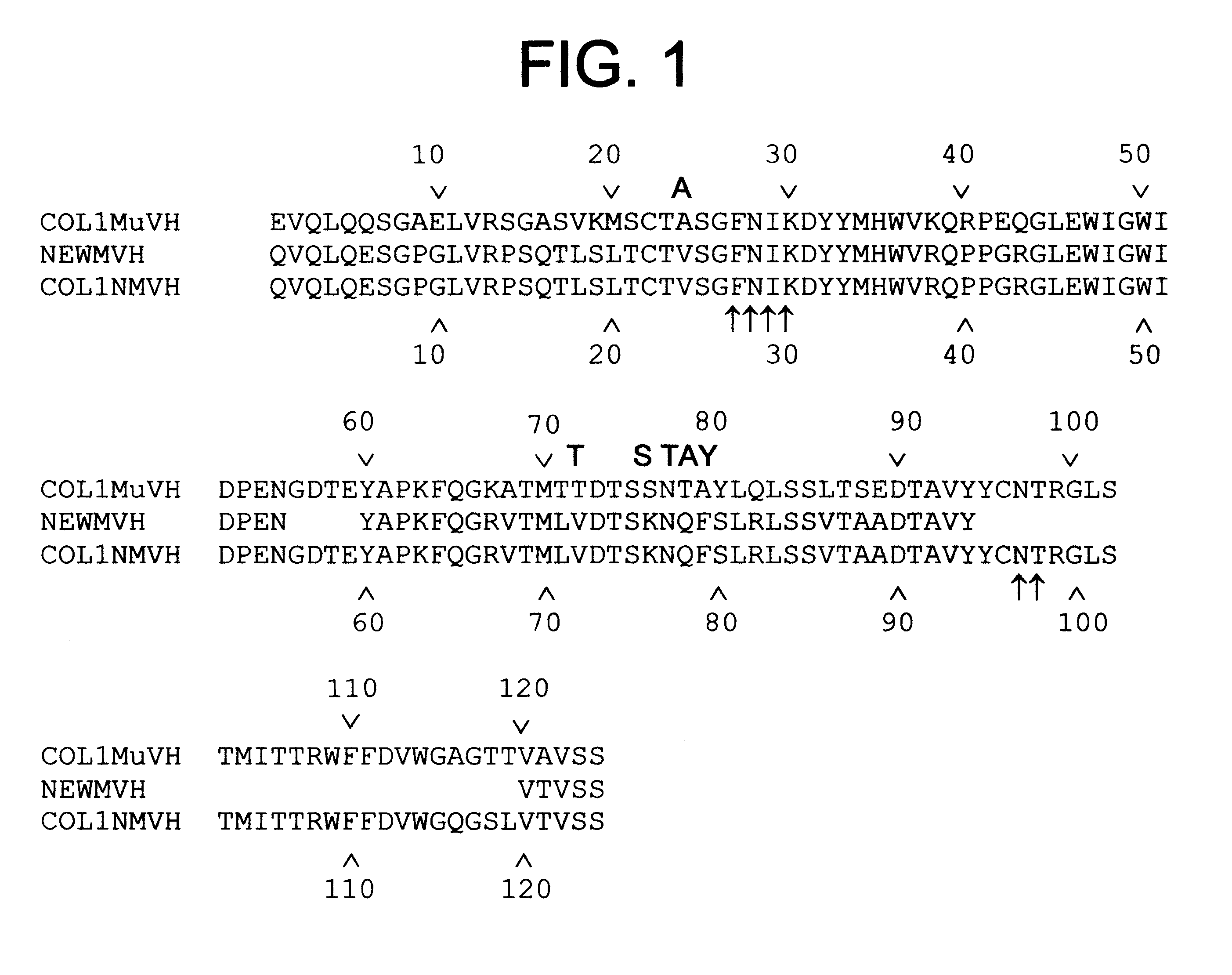
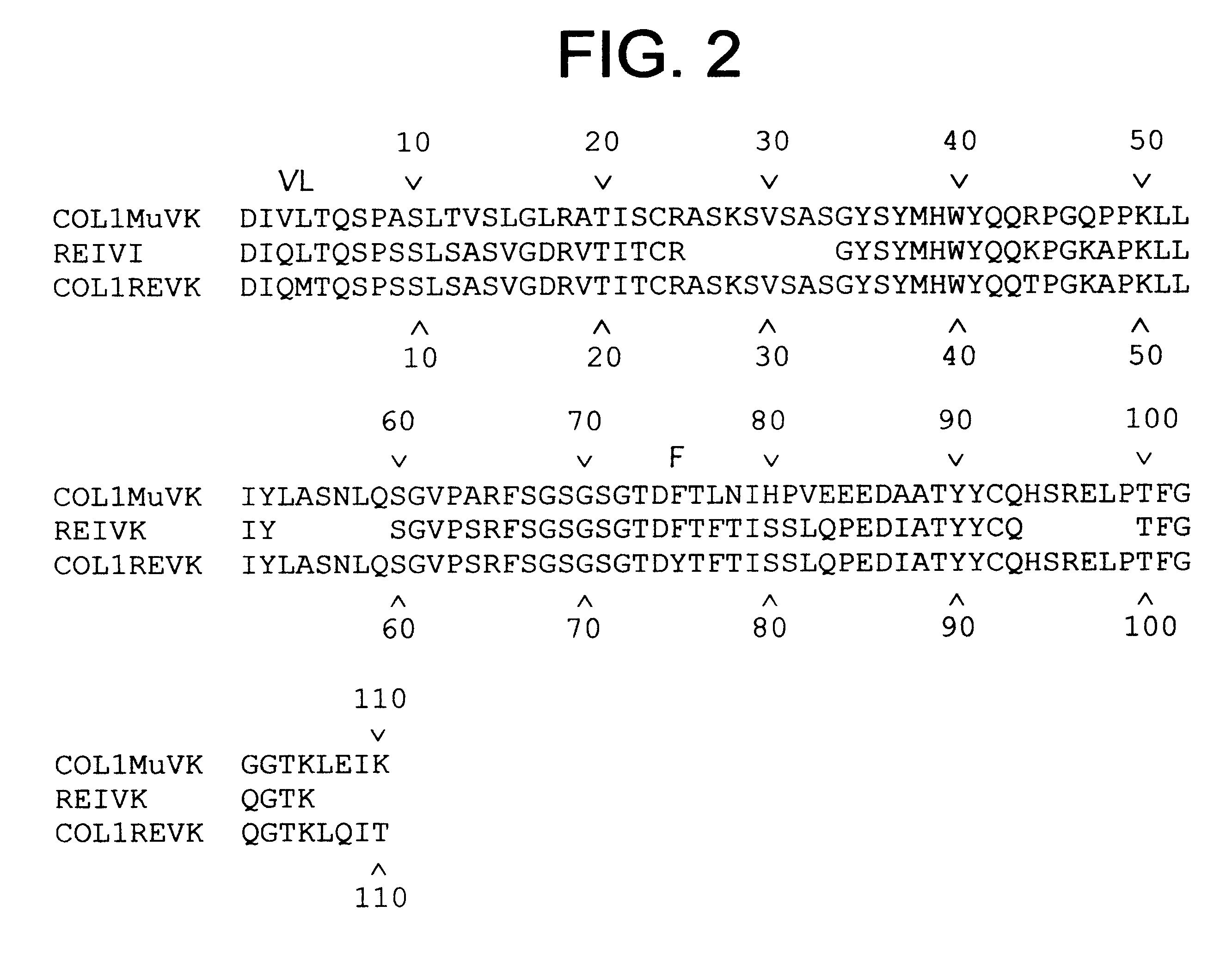
antigen binding structure and thus retain the binding affinity of the parent antibody. As a result of such studies, the FRs of REI and NEWM antibodies have been identified as having
amino acid sequences which are likely to allow the CDRs of COL-1 To retain a significant degree of
antigen binding affinity. As noted, the selected human framework regions will preferably be those that are expected to be suitable for
in vivo administration, i.e., not immunogenic. Based on their amino acid sequences, REI and NEWM human framework regions are expected to be substantially non-immunogenic.
Human
constant domain sequences are well known in the art, and have been reported in the literature. Preferred human
constant light chain sequences (C.sub.L) include the kappa and
lambda constant light sequences. Preferred human constant
heavy chain sequences include human gamma 1, human gamma 2, human gamma 3, human gamma 4, and mutated versions thereof which provide for altered effect or function, e.g., enhanced in vivo half-life, reduced
Fc receptor binding, and the like.
The
phrase "substantially homologous" is used in regard to the similarity of a subject amino acid sequence (of an oligo- or poly-
peptide or
protein) to a related, reference amino acid sequence. This
phrase is defined as at least about 75% "correspondence"--i.e. the state of identical amino acid residues being situated in parallel--between the subject and reference sequences when those sequences are in "alignment," i.e. when a minimal number of "null" bases have been inserted in the subject and / or reference sequences so as to maximize the number of existing bases in correspondence between the sequences. "Null" bases are not part of the subject and reference sequences; also, the minimal number of "null" bases inserted in the subject sequence may differ from the minimal number inserted in the reference sequence. In this definition, a reference sequence is considered "related" to a subject sequence where both amino acid sequences make up proteins or portions of proteins which are either .alpha.CEA antibodies or
antibody fragments with .alpha.CEA binding affinity. Each of the proteins comprising these .alpha.CEA antibodies or
antibody fragments may independently be antibodies or
antibody fragments or bi- or multi-functional proteins, e.g., such as fusion proteins, bi- and multi-specific antibodies,
single chain antibodies, and the like.
As noted above, another preferred application of the subject humanized antibodies or fragments thereof is in the RIGS
system (Radioimmunoguided
Surgery system of Neoprobe Corp., Dublin, Ohio). This technique involves the intravenous administration of a radiolabeled
monoclonal antibody or its fragment prior to
surgery. After allowing for tumor uptake and
blood clearance of radioactivity, the patient is taken to the operating room where surgical exploration is effected with the aid of a hand-held gamma activity probe, e.g., the NEOPROBE.RTM. 1000. This helps the surgeon identify the tumor metastases and lessen the complications of excision.


 Login to View More
  Login to View More