Supercharge Your Innovation With Domain-Expert AI Agents!

Photoresist composition for top-surface imaging processes by silylation

a top-surface imaging and composition technology, applied in the field of photoresist composition for top-surface imaging processes by silylation, can solve the problems of weak etching resistance, low solubility in aqueous tmah solution, and the inability of most photoresists to be suitable for vuv

Inactive Publication Date: 2003-10-07
SK HYNIX INC
View PDF5 Cites 0 Cited by
  • Summary
  • Abstract
  • Description
  • Claims
  • Application Information

AI Technical Summary

Benefits of technology

The proposed photoresist composition achieves high-resolution pattern formation with excellent contrast ratio, adhesiveness, and resistance to pattern collapse, suitable for semiconductor devices, and is less influenced by substrate topology, providing a viable alternative to single-layer resists.

Problems solved by technology

However, most of the photoresists are not suitable for VUV due to their poor transmittance at the 157 nm wavelength.
While photoresists containing fluorine and silicon have good transmittance at these wavelengths, most photoresists containing fluorine with a polyethylene or polyacrylate polymer backbone have weak etching resistance, low solubility in an aqueous TMAH solution and poor adhesiveness to the silicon wafer.
In addition, these photoresists are difficult to mass-produce and are expensive.
Furthermore, during a post-exposure bake (PEB) process these photoresists can generate HF which can contaminate a lens or corrode a device.
Thus, these photoresists are generally not suitable for commercial use.
For this, monomers comprising silicon are used in a large volume, which increases hydrophobicity of the photoresist.
Therefore, the photoresist cannot satisfy selectivity between the exposed region and the non-exposed region in the aqueous TMAH solution, and, as a result, has low adhesiveness to the silicon wafer.
Some of the known limitations of the photolithography include substrate's influence on light (e.g., reflection, scattering, diffraction, etc.), notching, standing wave effect, pattern collapse, non-uniformity of a critical dimension (CD), isolated and grouped bias (IG bias) and the like.
However, there are some problems in using TIPS for a high resolution photoresist pattern formation, such as lack of a high photosensitive photoresist and line edge roughness (LER) after dry etching process

Method used

the structure of the environmentally friendly knitted fabric provided by the present invention; figure 2 Flow chart of the yarn wrapping machine for environmentally friendly knitted fabrics and storage devices; image 3 Is the parameter map of the yarn covering machine
View more

Image

Smart Image Click on the blue labels to locate them in the text.
Viewing Examples
Smart Image
  • Photoresist composition for top-surface imaging processes by silylation
  • Photoresist composition for top-surface imaging processes by silylation
  • Photoresist composition for top-surface imaging processes by silylation

Examples

Experimental program
Comparison scheme
Effect test

preparation example 1

Synthesis of Poly(bicyclo[2.2.1]hept-5-ene-2-carboxylic acid / norbornene / maleic anhydride)

To 70 ml of tetrahydrofuran was added 0.05 M of norbornylene, 0.15 M of bicyclo[2.2.1]hept-5-ene-2-carboxylic acid, 0.2M of maleic anhydride and 0.4 g of AIBN. The resulting solution was reacted at 67.degree. C. for 8 hours. Thereafter, a polymer was precipitated and filtered in petroleum ether / ether (1 / 1) solution, to obtain the title polymer (yield: 58%).

preparation example 2

Synthesis of Poly(bicyclo[2.2.1]hept-5-ene-2-methanol / norbornene / maleic anhydride)

To 70 ml of tetrahydrofuran was added 0.05 M of norbornylene, 0.15 M of bicyclo[2.2.1]hept-5-ene-2-methanol, 0.2 M of maleic anhydride and 0.4 g of AIBN. The resulting solution was reacted at 67.degree. C. for 8 hours. Thereafter, a polymer was precipitated and filtered in petroleum ether / ether (1 / 1) solution, to obtain the title polymer (yield: 57%).

preparation example 3

Synthesis of Poly(bicyclo[2.2.1]hept-5-ene-2-methanol / bicyclo[2.2. 1]hept-5-ene-2-carboxylic acid / norbornene / maleic anhydride)

To 70 ml of tetrahydrofuran was added 0.04 M of norbornylene, 0.1 M of bicyclo[2.2.1]hept-5-ene-2-methanol, 0.06 M of bicyclo[2.2.1]hept-5-ene-2-carboxylic acid, 0.2 M of maleic anhydride and 0.4 g of AIBN. The resulting solution was reacted at 67.degree. C. for 8 hours. Thereafter, a polymer was precipitated and filtered in petroleum ether / ether (1 / 1) solution, to obtain the title polymer. Here, the polymer was washed with aqueous Na.sub.2 CO.sub.3 solution (5%), and re-washed with distilled water to completely remove base. The resulting resin was vacuum-dried to obtain a pure resin (yield: 51%).

the structure of the environmentally friendly knitted fabric provided by the present invention; figure 2 Flow chart of the yarn wrapping machine for environmentally friendly knitted fabrics and storage devices; image 3 Is the parameter map of the yarn covering machine
Login to View More

PUM

PropertyMeasurementUnit
transparency at a wavelengthaaaaaaaaaa
wavelengthaaaaaaaaaa
Login to View More

Abstract

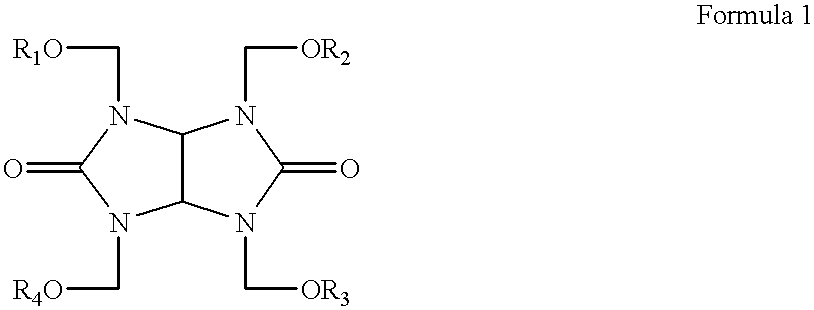
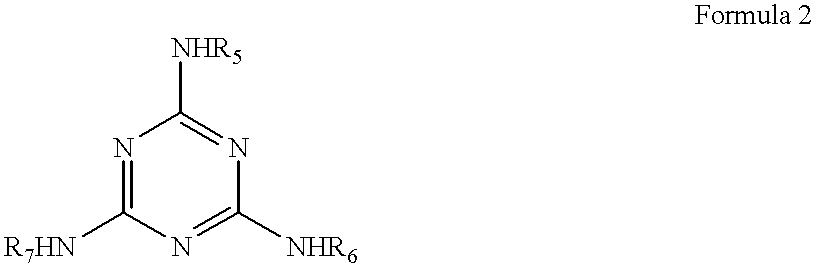
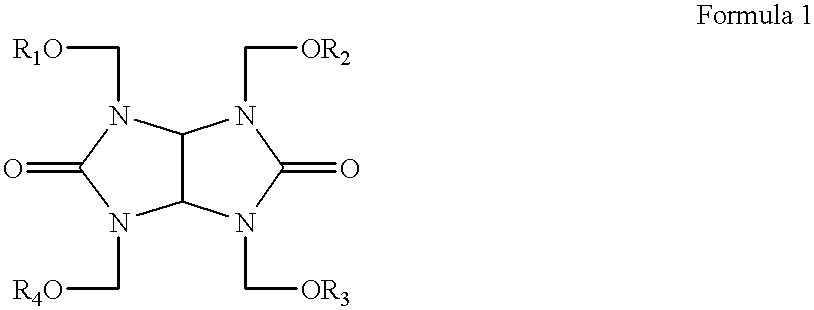
Photoresist compositions for a Top-surface Imaging Process by Silylation (TIPS), and a process for forming a positive pattern according to the TIPS using the same. The photoresist composition for the TIPS comprises a cross-linker of following Formula 1 or 2. A protecting group of the cross-linker and a hydroxyl group of the photoresist polymer are selectively crosslinked in the exposed region, and the residual hydroxyl group reacts to a silylating agent in the non-exposed region by silylation. Thus, the non-exposed region only remains after the dry-development, thereby forming a positive pattern. In addition, the photoresist composition of the present invention is suitable for the TIPS lithography using light sources such as ArF (193 nm), VUV (157 nm) and EUV (13 nm).wherein, R1, R2, R3, R4, R5, R6 and R7 are as defined in the specification.

Description

1. Technical FieldPhotoresist compositions are disclosed for top-surface imaging processes by silylation (TIPS). In particular, photoresist compositions are disclosed which are useful in TIPS, by crosslinking a protecting group of a cross-linker and a hydroxyl group of a photoresist polymer in an exposed region, and by reacting the hydroxyl group and a silylating agent in a non-exposed region.2. Description of the Background ArtRecently, the chemical amplification of type DUV photoresists have been investigated in order to achieve high sensitivity in minute image formation processes for preparing semiconductor devices. In general, a useful photoresist for ArF, VUV, EUV and E-beam has a variety of desired characteristics, such as high transmissibility at the wavelength of each light source, high etching resistance, and high adhesiveness to a wafer. In addition, the photoresist should be easy to develop in readily available developing solutions, such as 2.38wt % and 2.6wt % aqueous te...

Claims

the structure of the environmentally friendly knitted fabric provided by the present invention; figure 2 Flow chart of the yarn wrapping machine for environmentally friendly knitted fabrics and storage devices; image 3 Is the parameter map of the yarn covering machine
Login to View More

Application Information

Patent Timeline
no application Login to View More
Patent Type & Authority Patents(United States)
IPC IPC(8): G03F7/38G03F7/038G03F7/031G03F7/032G03F7/075
CPCG03F7/0382G03F7/38Y10S430/128Y10S430/11Y10S430/106G03F7/031G03F7/075G03F7/032
Inventor KOH, CHA WONLEE, GEUN SUBAIK, KI HO
Owner SK HYNIX INC
Features
  • R&D
  • Intellectual Property
  • Life Sciences
  • Materials
  • Tech Scout
Why Patsnap Eureka
  • Unparalleled Data Quality
  • Higher Quality Content
  • 60% Fewer Hallucinations
Social media
Patsnap Eureka Blog
Learn More