Therefore, an object of the present invention is to provide a sintered bearing and production method therefor capable of facilitating controlling and ensuring uniformity of the coating thickness, and capable of forming an extremely thin coating while obtaining high securing strength of the resin coating.
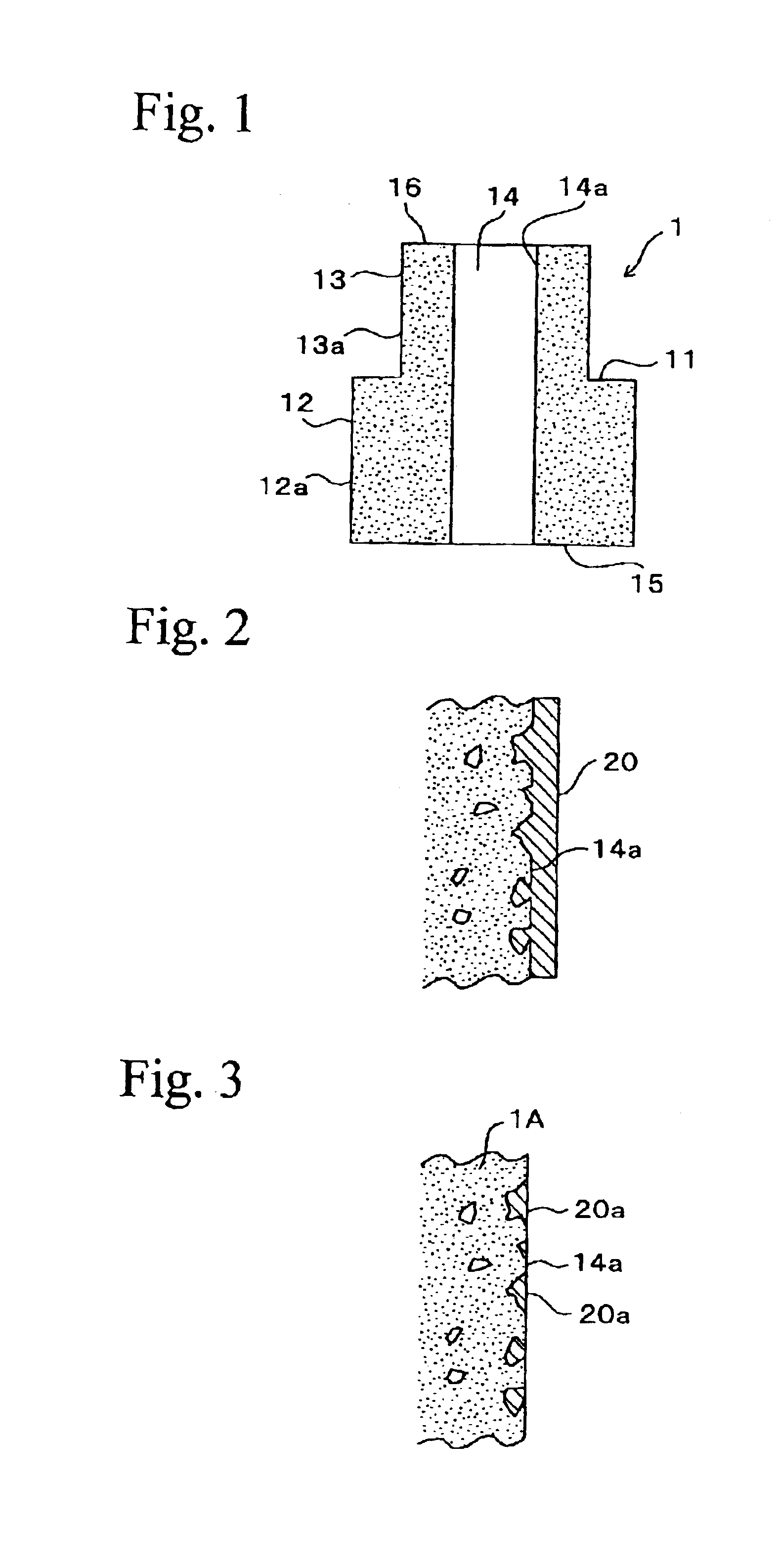
The sintered bearing produced by the invention is thus coated by the resin coating over the entire surface thereof, and is therefore capable of avoiding release of noxious gases and penetration of water, and is capable of maintaining
corrosion resistance since it is not exposed to air. Typical sintered bearings lubricate with lubricating oil retained in the pores. In contrast, the bearing in the invention has
lubrication by the resin coating formed by the electrodeposition instead of the lubricate, whereby fitting performance between the bearing and a rotating shaft,
wear resistance, corrosion resistance, and cleanliness can be obtained.
In the invention, thickness of the resin coating can be easily controlled and made uniform since the electrodeposition is applied. The thickness of the resin coating is easily controlled by controlling the
voltage applied in the electrodeposition,
application time, temperature of the
electrolyte, and the like. The thickness of the resin coating is uniform according to the characteristics of the electrodeposition, and bearings having suitable coating thickness according to the equipment employed are therefore produced. Furthermore, the coating thickness can be extremely thin, so that dimensional stability originally provided in sintered bearings is maintained, and the bearings can be applied to small parts, and additionally, the method can easily applied to
mass-production.
In the production method of the invention, the raw metallic material
powder is mixed with a
magnetic powder, and a
resultant bearing from the sintered compact is magnetized after the electrodeposition. Overall, the bearing produced in this manner is employed as a
magnet since the
magnetic powder is magnetized. When a magnetic fluid is used as a fluid, the magnetic fluid is usually held between the sintered bearing and a rotating shaft by the magnetic force of the bearing, and stable
dynamic pressure properties are therefore obtained and leakage thereof is restrained.
In bearings including a
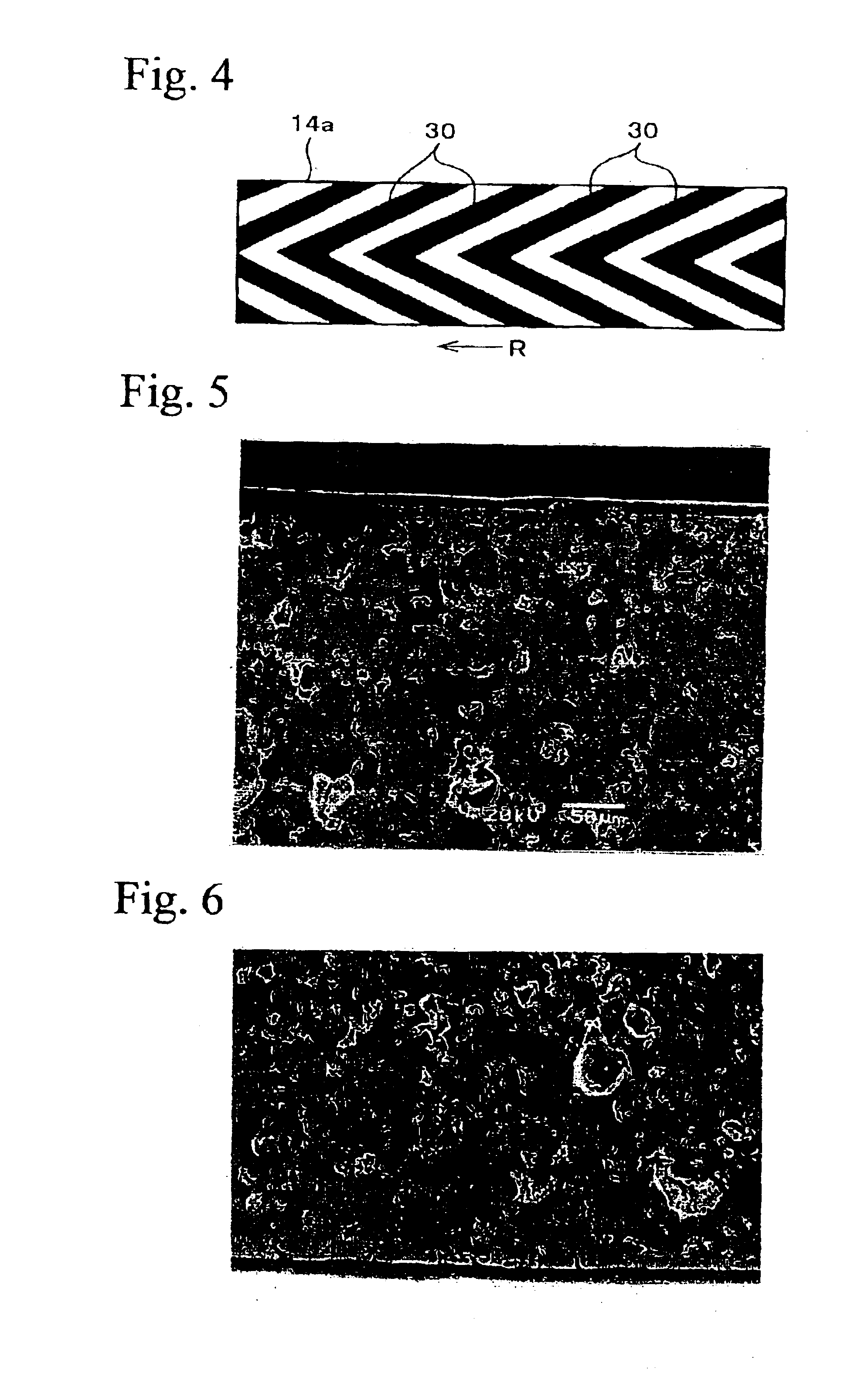
magnetic powder, fitting performance with a rotating shaft is not sufficient and wear may easily occur since comparatively hard magnetic powder is exposed on the surface of the bearing. The magnetic powder exposed on the surface may be broken or scattered by abrasion, and the loosened particles function as an
abrasive between the rotating shaft and the bearing. As a result, wear is promoted and vibration characteristics are not stable, and accurate rotation is not obtained. In contrast, the bearing produced by the production method of the invention is formed with the resin coating over the entire surface thereof, whereby the resin coating lubricates the
bearing surface, and the fitting performance with the rotating shaft is improved in
spite of dispersion of the magnetic powder. Furthermore, the resin coating restrains breakage and scattering of the magnetic powder. As a result, wear due to the magnetic powder existing between the inner
peripheral surface of the bearing and the rotating shaft is restrained, and vibration performance is therefore stable, and highly accurate rotation is obtained.
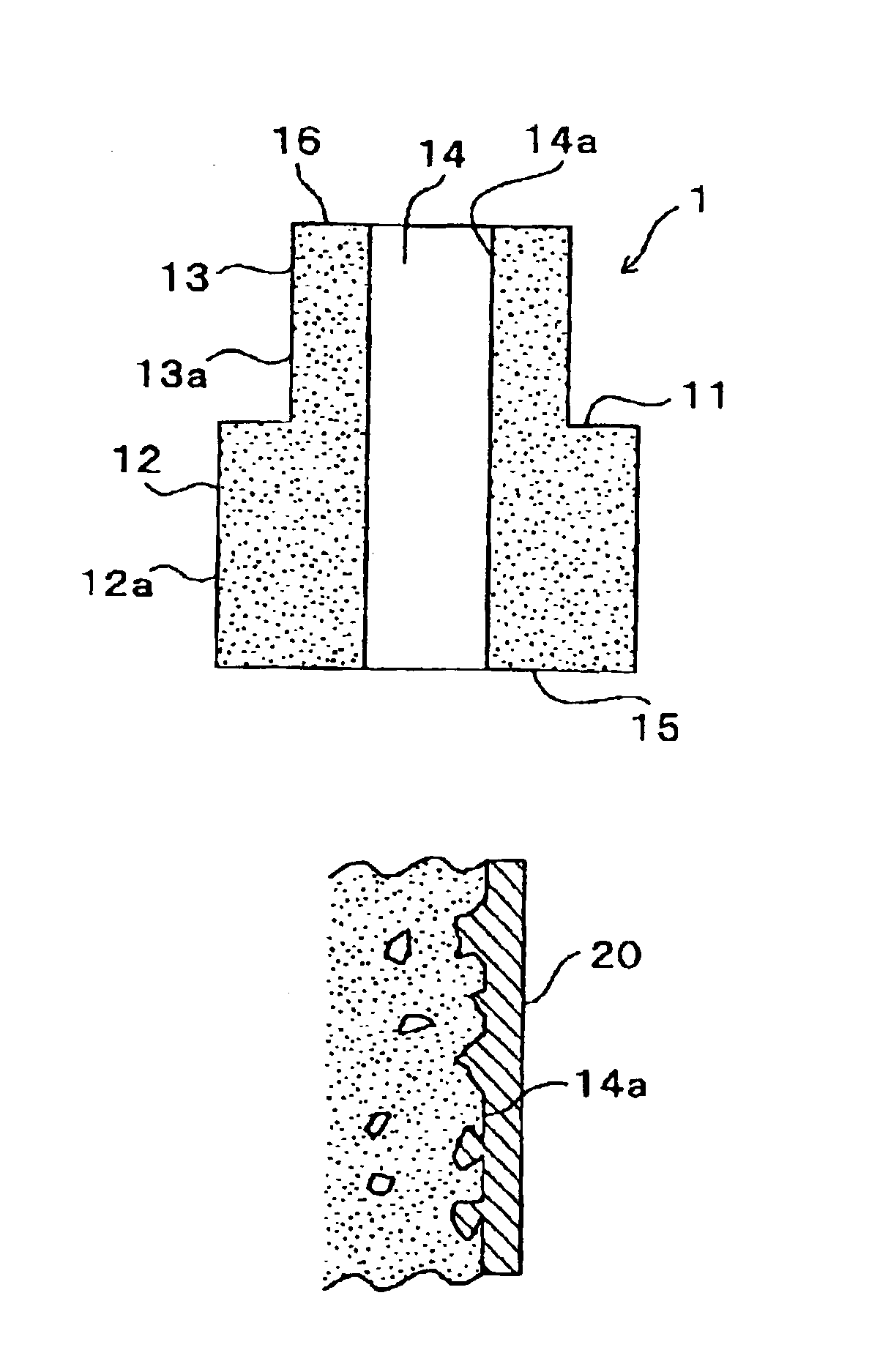
In the production method of the invention, grooves for generating
dynamic pressure may be formed on an inner
peripheral of the bearing. The grooves may be formed, for example, in a
sizing process in which the bearing hole is finished to the predetermined dimension. In this production method, the
bearing surface is covered by the resin coating and the pores on the surface are sealed, whereby the
dynamic pressure generated by the fluid supplied into the grooves does not penetrate, and highly accurate rotation and
high stiffness are ensured. Furthermore, the entire surface of the bearing is covered by the resin coating, so that noxious gases are not generated from the inside of the bearing if the temperature of the bearing increases. Therefore, gas generated from pores, which has been a concern on conventional bearings, is avoided. In addition, in the bearing in which a magnetic powder is mixed therein, breakage and scattering of the magnetic powder are avoided in forming the grooves for generating dynamic pressure, and the grooves can be easily worked and the shape of the grooves and dimensional accuracy of the inner peripheral surface of the bearing are improved.



 Login to View More