Check patentability & draft patents in minutes with Patsnap Eureka AI!

Low power sleep mode operation technique for dynamic random access memory (DRAM) devices and integrated circuit devices incorporating embedded DRAM

a dynamic random access memory and low power sleep mode technology, applied in static storage, information storage, digital storage, etc., can solve the problems of not accurately timed when a refresh operation is required over all possible process corners, voltage and temperature, and not sufficiently reducing the transistor leakage power in all circuit blocks, so as to reduce the overall dram power usage, reduce transistor leakage, and reduce the effect of transistor leakag

Active Publication Date: 2006-08-29
SONY CORP
View PDF12 Cites 10 Cited by
  • Summary
  • Abstract
  • Description
  • Claims
  • Application Information

AI Technical Summary

Benefits of technology

The present invention provides a technique for conducting refresh operations in DRAM-based memory devices and those embedded DRAM. By counting clock cycles, the technique ensures that refresh time does not vary with process, voltage, and temperature (PVT) variations. The invention also includes a method for reducing power in a DRAM array during a sleep mode of operation by inhibiting the main internal clock signal and power-gating related circuitry. The technique further minimizes transistor leakage and reduces overall power usage in the DRAM array. The invention provides an integrated circuit device comprising a dynamic random access memory array with a refresh operation initiated upon reaching a predetermined count of clock transitions.

Problems solved by technology

This process is complicated in most instances and a command address latch is used to hold either the externally supplied row address or the internally generated address from the refresh address counter depending on the command.
Despite these technological advances, conventional memory devices, and those incorporating embedded memory, do not accurately time when a refresh operation is required over all possible process corners, voltages and temperatures (PVT) and do not sufficiently lower transistor leakage power in all circuit blocks accordingly.
Further, conventional techniques do not employ “active” power-gating techniques wherein various circuit blocks can be powered-up or powered-down as required during a refresh operation.

Method used

the structure of the environmentally friendly knitted fabric provided by the present invention; figure 2 Flow chart of the yarn wrapping machine for environmentally friendly knitted fabrics and storage devices; image 3 Is the parameter map of the yarn covering machine
View more

Image

Smart Image Click on the blue labels to locate them in the text.
Viewing Examples
Smart Image
  • Low power sleep mode operation technique for dynamic random access memory (DRAM) devices and integrated circuit devices incorporating embedded DRAM
  • Low power sleep mode operation technique for dynamic random access memory (DRAM) devices and integrated circuit devices incorporating embedded DRAM
  • Low power sleep mode operation technique for dynamic random access memory (DRAM) devices and integrated circuit devices incorporating embedded DRAM

Examples

Experimental program
Comparison scheme
Effect test

Embodiment Construction

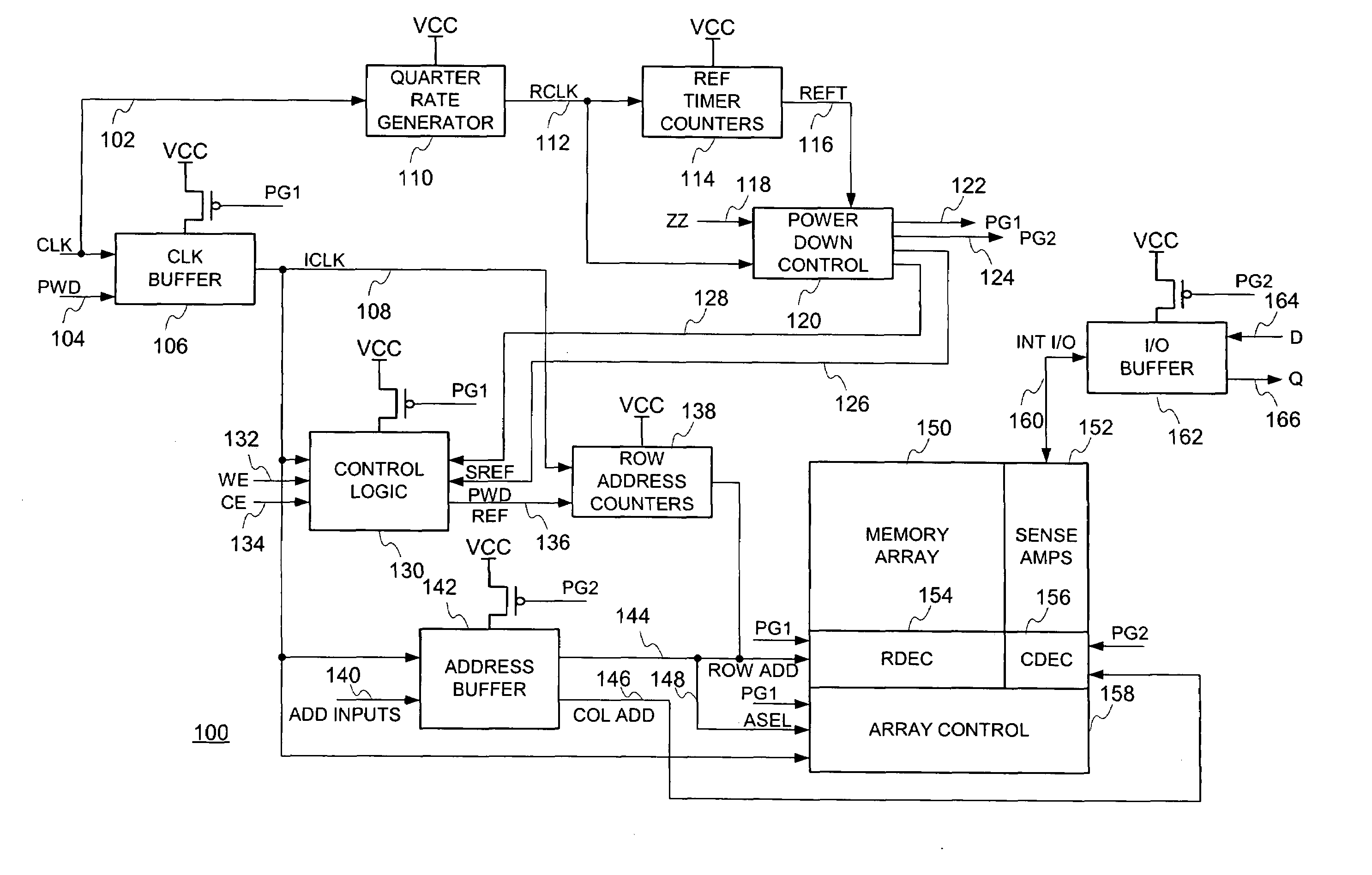
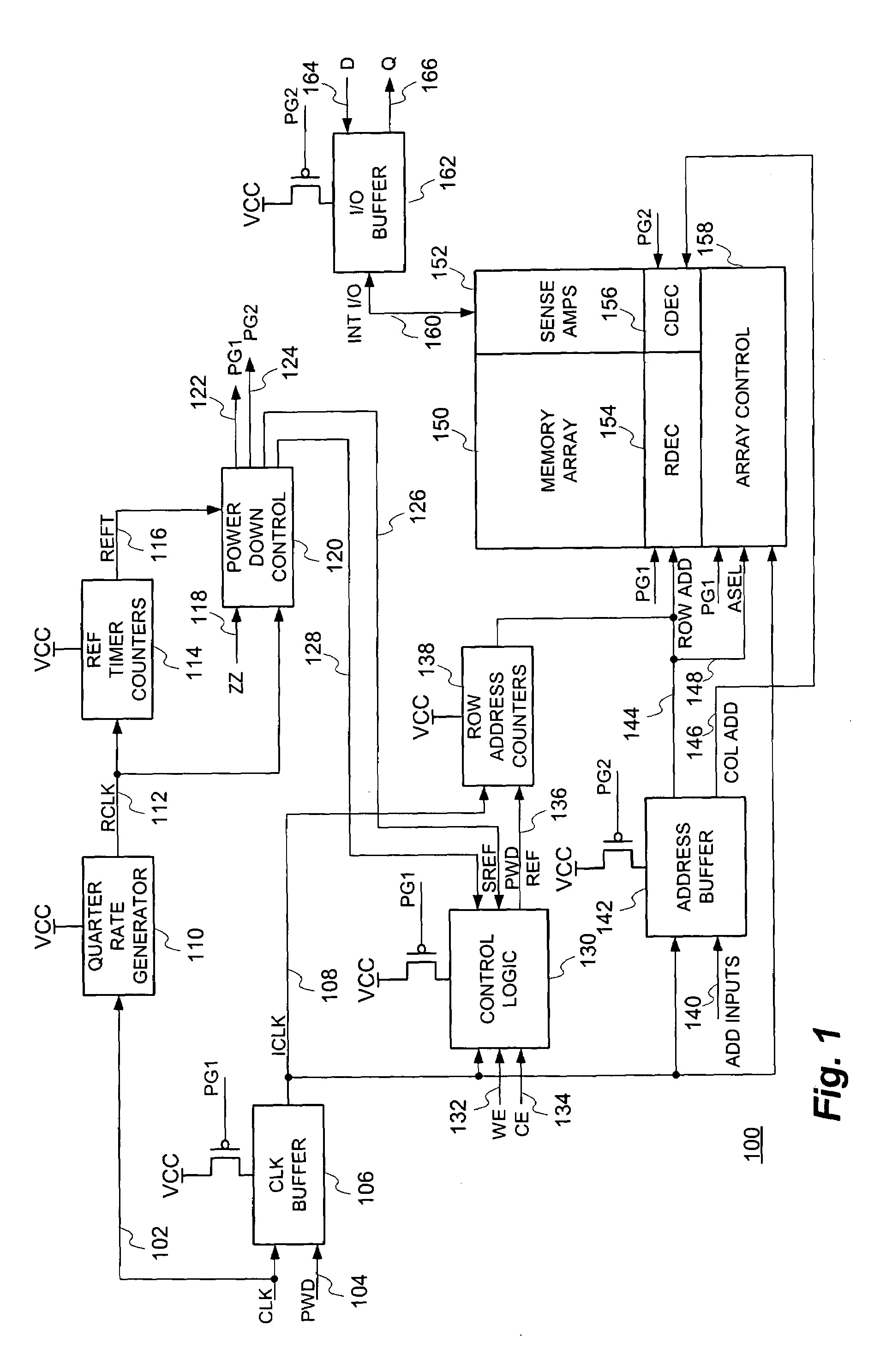
[0020]With reference now to FIG. 1, a functional block diagram of a portion of an integrated circuit device 100 incorporating a memory array and implementing a representative embodiment of the low power Sleep Mode operation technique of the present invention is shown. As will be used herein, the following definitions pertain:

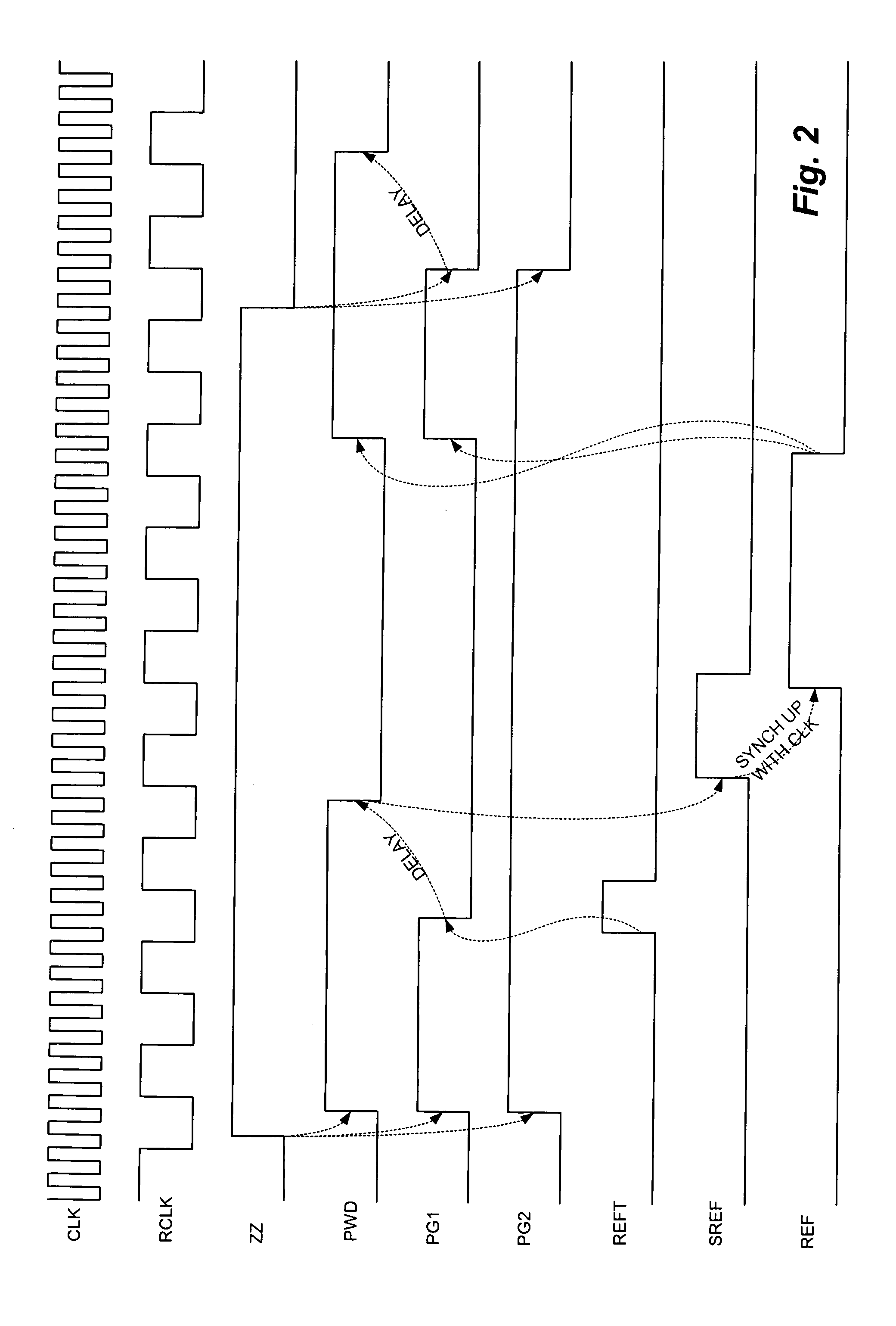
[0021]ClK—the externally applied clock to the embedded DRAM or memory device;

[0022]RCLK—the reduced rate clock which may be ¼th, ⅛th, 1 / 16th or other fraction of the externally applied CLK signal;

[0023]ZZ—the externally applied Sleep Mode command;

[0024]PWD—the power down, enable / disable signal to turn “off” various circuit blocks;

[0025]PG1—the power-gate #1 signal which turns “on” and “off” as required;

[0026]PG2—the power-gate #2 signal which remains “off” for the entire Sleep Mode time;

[0027]REFT—the refresh timer signal which goes “high” when a refresh operation is needed;

[0028]SREF—the start refresh signal which is asserted after the REFT, PG1 and PWD signals...

the structure of the environmentally friendly knitted fabric provided by the present invention; figure 2 Flow chart of the yarn wrapping machine for environmentally friendly knitted fabrics and storage devices; image 3 Is the parameter map of the yarn covering machine
Login to View More

PUM

No PUM Login to View More

Abstract

A low power Sleep Mode operation technique for dynamic random access (DRAM) devices and integrated circuit devices incorporating embedded DRAM. By counting clock (CLK) cycles in accordance with the technique disclosed, refresh time (tREF) does not vary with all possible process corners, voltages and temperatures (PVT) since the clock signal exhibits a steady frequency over PVT applied to the DRAM and an internal timer placed on chip will vary directly with these parameters. After entering Sleep Mode, the main internal clock signal is inhibited from propagating around the device chip and, at this time, much of the associated circuitry can be power-gated to conserve power, typically with signals that have a boosted level to provide a negative gate-to-source voltage (VGS) on the power-gating transistors.

Description

BACKGROUND OF THE INVENTION[0001]The present invention relates, in general, to the field of integrated circuit (IC) devices. More particularly, the present invention relates to a low power Sleep Mode operation technique for dynamic random access (DRAM) devices and integrated circuit devices incorporating embedded DRAM.[0002]DRAM memory devices incorporate one or more arrays of memory cells, each generally consisting of a single transistor and associated capacitor. The transistor has one terminal coupled to an associated bit line and its gate coupled to a word line. Another terminal is generally coupled to circuit ground through the capacitor and by enabling the transistor via the word line, the charge on the capacitor may be placed on the associated bit line. Due to the dynamic nature of the charge stored in the capacitor, it must be periodically refreshed to replenish the leaked charge.[0003]A “refresh” or “active” command can occur on any clock cycle in an integrated circuit memor...

Claims

the structure of the environmentally friendly knitted fabric provided by the present invention; figure 2 Flow chart of the yarn wrapping machine for environmentally friendly knitted fabrics and storage devices; image 3 Is the parameter map of the yarn covering machine
Login to View More

Application Information

Patent Timeline
no application Login to View More
Patent Type & Authority Patents(United States)
IPC IPC(8): G11C8/00G11C11/406
CPCG11C5/144G11C11/406G11C11/40626G11C2211/4068G11C2211/4067
Inventor PARRIS, MICHAEL C.JONES, JR., OSCAR FREDERICKBUTLER, DOUGLAS BLAINE
Owner SONY CORP
Features
  • R&D
  • Intellectual Property
  • Life Sciences
  • Materials
  • Tech Scout
Why Patsnap Eureka
  • Unparalleled Data Quality
  • Higher Quality Content
  • 60% Fewer Hallucinations
Social media
Patsnap Eureka Blog
Learn More