
Integrated semiconductor memory with clock generation
a technology of integrated semiconductor memory and clock generation, which is applied in the direction of generating/distributing signals, pulse techniques, pulse characteristics measurements, etc., can solve the problems of reduced sensitivity of the differential amplifier with regard to level fluctuations of the external clock signal at its input terminal, uncontrolled switching behavior of the internal chip logic, and so on. , to achieve the effect of shortening the sensitivity time of the clock generator circuit, reducing the sensitivity of the differential amplifier with regard to level fluctuations of the external clock
- Summary
- Abstract
- Description
- Claims
- Application Information
AI Technical Summary
Benefits of technology
Problems solved by technology
Method used
Image

Examples
first embodiment
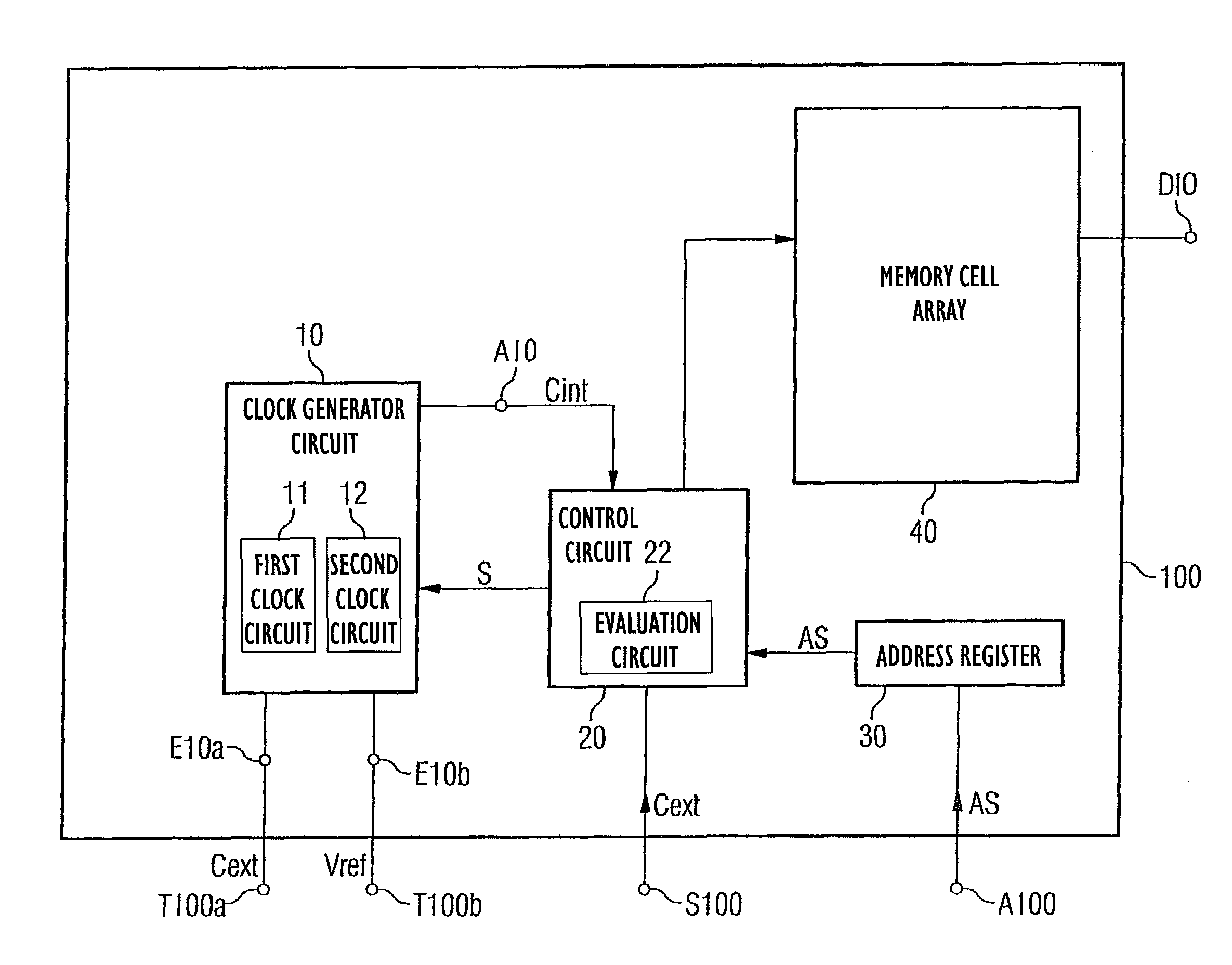
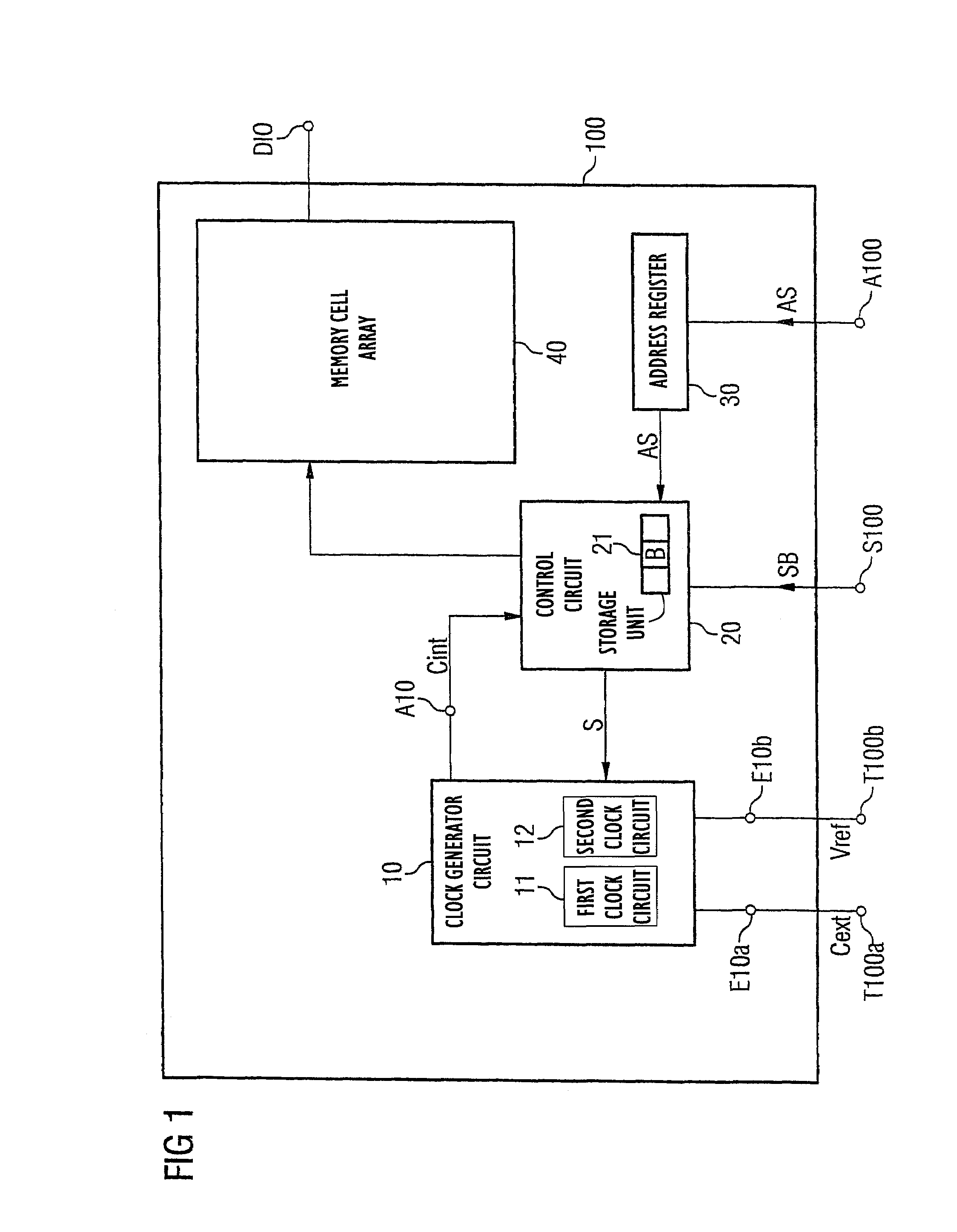
[0036]FIG. 1 shows an integrated semiconductor memory for generating an internal clock signal according to the invention. The integrated semiconductor memory has a clock generator circuit 10 and a control circuit 20 besides the address register 30 and the memory cell array 40. The clock generator circuit 10 is connected via a first input terminal E10a and a second input terminal E10b to an external clock terminal T100a for application of an external clock signal Cext and via a second input terminal E10b to a clock terminal T100b of the integrated semiconductor memory for application of a sensitivity level Vref. The clock generator circuit 10 comprises a first clock circuit 11 and a second clock circuit 12.
[0037]The first clock circuit 11 has a shorter sensitivity time that the second clock circuit 12. Since the sensitivity time is that time for which the clock generator circuit 10 must be driven at least with a high or low level of the external clock signal in order, on the output s...
second embodiment
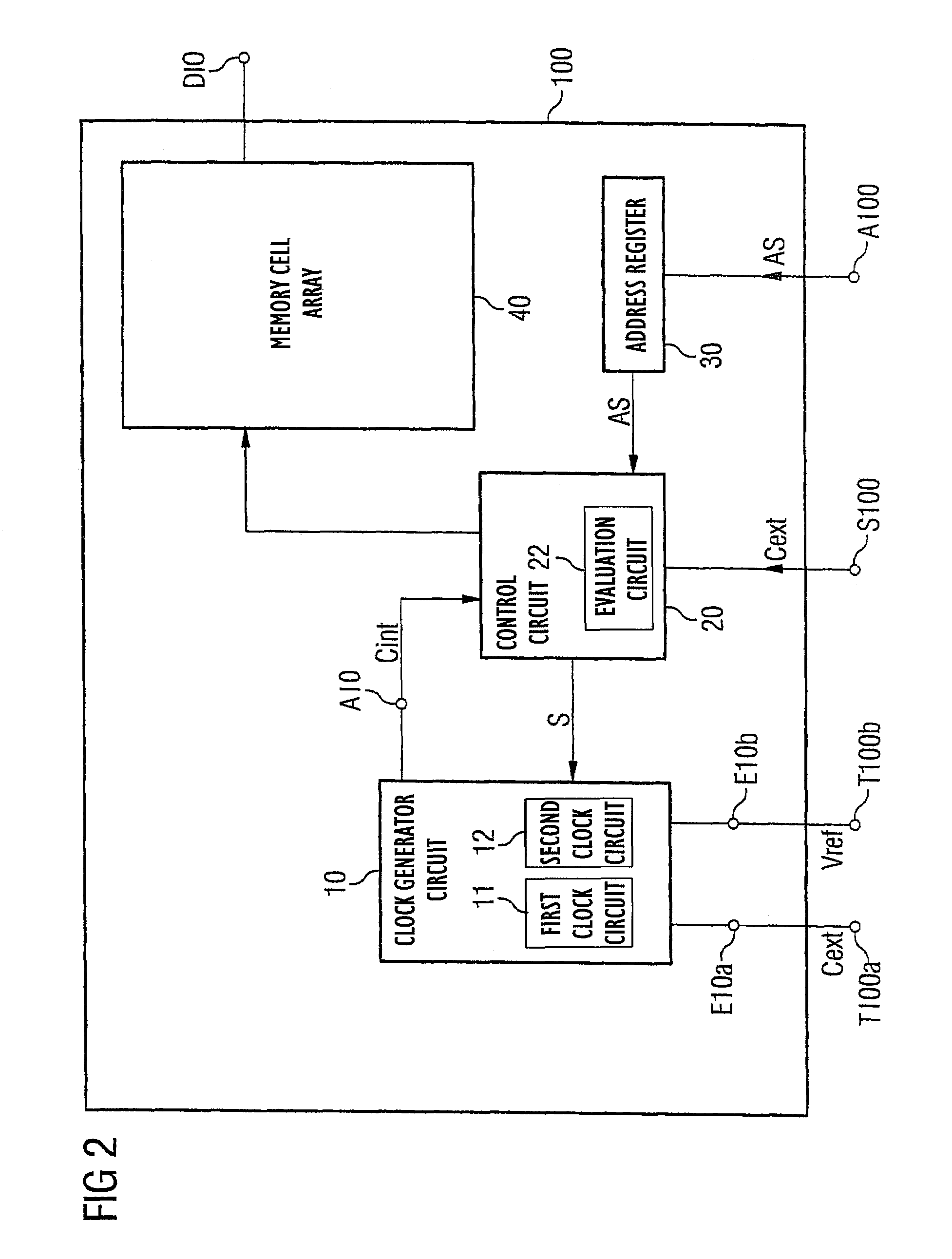
[0043]FIG. 2 shows an integrated semiconductor memory for generating the internal clock signal Cint. The integrated semiconductor memory has a clock generator circuit 10 connected, via a first input terminal E10a, to a clock terminal T100a for application of an external clock signal Cext and, via a second input terminal E10b, to a clock terminal T100b for application of a sensitivity level Vref. The clock generator circuit 10 has the first clock circuit 11 already described in FIG. 1 and the second clock circuit 12, the first clock circuit 11 having a shorter sensitivity time TE than the second clock circuit 12. In order to generate the internal clock signal Cint at the output terminal A10 of the clock generator circuit 10, it is possible optionally to activate the first clock circuit 11 or the second clock circuit 12. The activation of the first or second clock circuit is effected by driving the clock generator circuit 10 with a first or second state of a control signal S generated...
third embodiment
[0046]FIG. 3 shows an integrated semiconductor memory for generating the internal clock signal Cint. The integrated semiconductor memory has a control circuit 20, to which an external clock signal CLK can be fed via a first control terminal S100a and a complementary external clock signal / CLK with respect thereto can be fed via a second control terminal S100b.
[0047]In the embodiment of FIG. 3, then, the control circuit 20 is driven by an external clock signal comprising two individual signals exhibiting mutually complementary behavior. The control circuit 20 has the evaluation circuit 22—already described in FIG. 2—for evaluating the signal / noise ratio and / or the frequency and / or the frequency and phase stability of the external clock signal.
[0048]The clock generator circuit 10 is connected, via a first input terminal E10a, to a first clock terminal T100a for application of the external clock signal CLK and, via a second input terminal E10b, to a second clock terminal T100b of the ...
PUM
 Login to View More
 Abstract
Description
Claims
Application Information
 Login to View More