
Compounds and methods
a technology of compound and method, applied in the field of compound, can solve the problems of high risk of cardiovascular disease, incomplete absence or low level of hdl cholesterol, etc., and achieve the effects of inhibiting cholesterol absorption, increasing reverse cholesterol transport, and reducing inflammation
- Summary
- Abstract
- Description
- Claims
- Application Information
AI Technical Summary
Benefits of technology
Problems solved by technology
Method used
Image

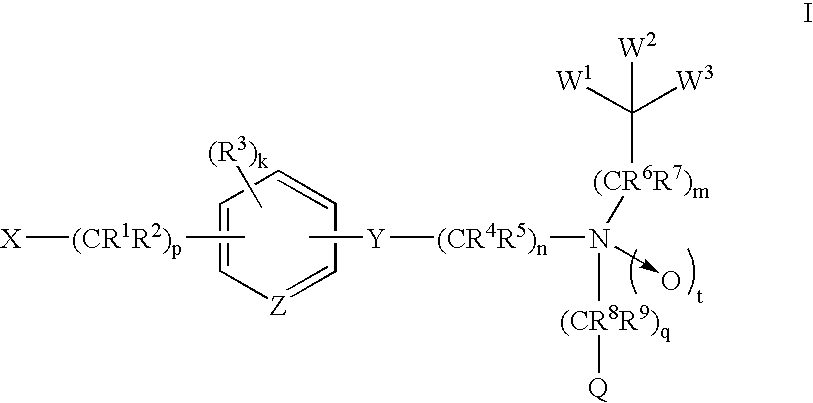
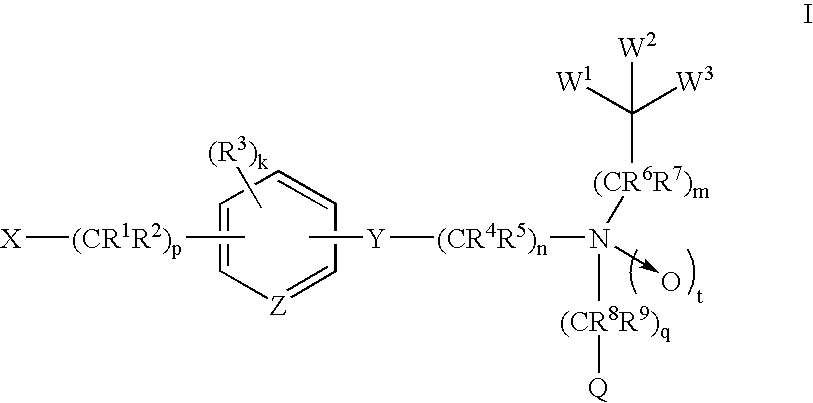
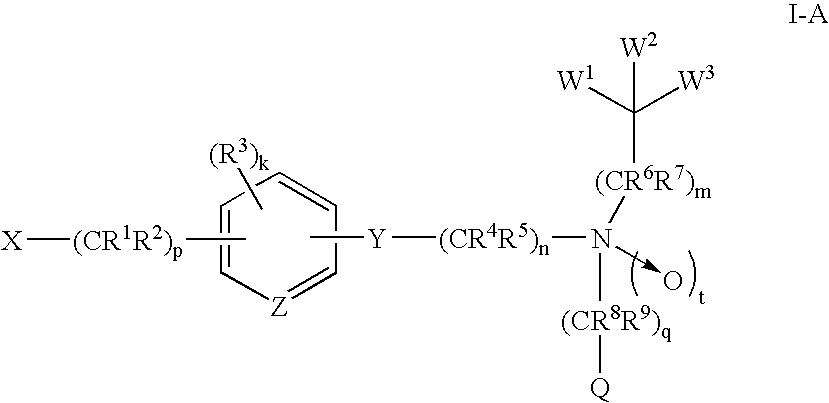
Examples
example 1
2-(3-{3-[[2-Chloro-3-(trifluoromethyl)benzyl](2,2-dephenylethyl)amino]propoxy}phenyl)-ethanol
[0353]
a) Methyl [3-(3-bromopropoxy)phenyl]acetate
[0354]A solution of methyl 3-hydroxyphenylacetate (11.3 g, 0.068 mole) in 300 mL of anhydrous toluene was treated with 3-bromopropanol (12.2 g, 0.088 mole). Polymer bound triphenylphosphine (36.0 g, 0.108 mole, 3 mmol / g, Fluka Chemie) was then added, and the mixture reacted for 15 minutes. The reaction mixture was then cooled to 0° C. and diisopropylazodicarboxylate (16.9 g, 0.084 mol) was added in a dropwise fashion. After stirring at RT overnight, the crude reaction mixture was filtered and the solid washed with 100 mL toluene. After concentration of the filtrate in vacuo, the crude product was purified by column chromatography over silica gel (silica gel 60, EM Science) using 15% ethyl acetate:hexane as eluent to afford 15.8 g (81% yield) of the title compound as an oil: 1H NMR (CDCl3, 400 MHz) δ 7.23-7.19 (m, 1 H), 6.85-6.7 (m, 3), 4.09-4....
example 2
2-(3-{3-[[2-Chloro-3-(trifluoromethyl)benzyl](2,2-diphenylethyl)amino]propoxy}-phenyl)acetic acid, N-oxide
[0359]
[0360]A solution of 2-(3-{3-[[2-chloro-3-(trifluoromethyl)benzyl](2,2-diphenylethyl)amino]propoxy}-phenyl)acetic acid hydrochloride from Example 1d (120 mg, 0.19 mmol) in acetic acid (3 ml) was treated dropwise with H2O2 (1 ml, 30% solution), and the reaction stirred at RT for 16 hr, diluted with water and extracted with CHCl3. The organic extracts were washed with water, dried and evaporated. The residue was crystallized from diethyl ether and gave a pure solid (75 mg, 65%). MS (ESI) 598.0 (M+H)+.
example 3
[0361](3-{3-[[2-Chloro-3-(trifluoromethyl)benzyl](2,2-diphenylethyl)amino]propoxy}-bromobenzene
[0362]
a) 3-(3-Bromopropoxy)bromobenzene
[0363]Diethylazodicarboxylate (0.77 g, 3.8 mmol) was added to solution of 3-bromophenol (0.50 g, 3.2 mmol), 3-bromopropanol (0.53 g, 3.8 mmol), triphenylphosphine (1.0 g, 3.8 mmol) and THF (10 mL). The solution was maintained at RT for 16 h and then concentrated in vacuo. The residue was partitioned between methylene chloride and 10% NaHCO3 aq. solution and layers separated. The aqueous layer was extracted with methylene chloride (2×10 mL). The organic layers were combined, dried (MgSO4) and concentrated in vacuo. The crude product was purified by flash column chromatography (100 g silica gel 60, 230-400 mesh, 9:1 hexane:ethyl acetate as eluent) to give 0.63 g (71%) of the title compound as a pale yellow liquid. MS (ESI) 293.0 [M+H]+.
b) (3-{3-[[2-Chloro-3-(trifluoromethyl)benzyl](2,2-diphenylethyl)amino]propoxy}-bromobenzene
PUM
| Property | Measurement | Unit |
|---|---|---|
| volume | aaaaa | aaaaa |
| temperature | aaaaa | aaaaa |
| temperature | aaaaa | aaaaa |
Abstract
Description
Claims
Application Information
 Login to View More