Unlock instant, AI-driven research and patent intelligence for your innovation.

Coating process to produce controlled release coatings

a technology of coating process and release profile, which is applied in the direction of coating, microcapsule, material granulation, etc., can solve the problems of flammability, carcinogenicity, safety, and inherent problems of coating formulations with organic solvents, and achieve superior release profile stability, superior barrier properties, and lower diffusivity

Inactive Publication Date: 2010-11-09
FMC CORP
View PDF24 Cites 10 Cited by
  • Summary
  • Abstract
  • Description
  • Claims
  • Application Information

AI Technical Summary

Benefits of technology

The present invention is about a process for coating a substrate with a special coating composition. The process involves coating the substrate with the composition under high humidity conditions, followed by a heat treatment step under low humidity conditions. The resulting coated substrate has superior barrier properties, stability, and lower diffusivity compared to substrates coated under low humidity conditions. It also requires a lower film thickness to achieve the desired release profile.

Problems solved by technology

However, the evaporated solvent poses environmental pollution concerns.
In addition, coating formulations with organic solvents have inherent problems with regard to flammability, carcinogenicity, and safety.
However the stability of coated substrates prepared using these aqueous polymer coating compositions remains a challenge.
Such instability is not found when the coating is formulated by dissolution of the polymer composition in an organic solvent.

Method used

the structure of the environmentally friendly knitted fabric provided by the present invention; figure 2 Flow chart of the yarn wrapping machine for environmentally friendly knitted fabrics and storage devices; image 3 Is the parameter map of the yarn covering machine
View more

Image

Smart Image Click on the blue labels to locate them in the text.
Viewing Examples
Smart Image
  • Coating process to produce controlled release coatings
  • Coating process to produce controlled release coatings
  • Coating process to produce controlled release coatings

Examples

Experimental program
Comparison scheme
Effect test

example 1

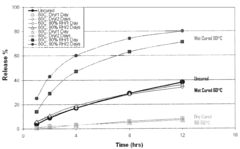
[0047]This example uses a dispersion with 15% solids and provides 4.0% weight gain due to coating, coated under high humidity conditions. Portions of the coated pellets were heat treated under different conditions and the data for heat treatment of the present invention under dry conditions are compared with data for a comparative heat treatment under high humidity.

[0048]An aqueous coating solution of 15% solids was prepared according to the formulation in Table 1. An aqueous coating dispersion of plasticized ethyl cellulose pseudo-lattices was prepared using the formulation in Table 1 by: (1) adding triethyl citrate to AQUACOAT® ECD-30 ethylcellulose dispersion (FMC Corp., Philadelphia Pa.) and mixing for one hour at a slow speed of approximately 100 to 150 RPM using a propeller mixer with a 3 inch impeller blade, and (2) adding deionized water and mixing for an additional 10 minutes.

[0049]

TABLE 1Coating formulation at 15% solidsIngredientWeight (%)Weight (%) of solidsAQUACOAT ECD-...

example 2

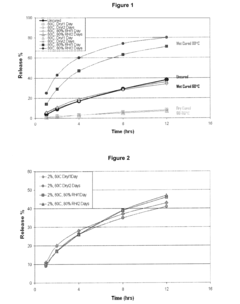
[0065]The 15% solids aqueous coating dispersion from Table 1 was applied to the pellets as in Example 1 but only up to a 2.0% weight gain under high humidity conditions as shown in Table 7.

[0066]

TABLE 7Coating conditions with Niro Fluid Bed Dryer MP-1 with WursterColumnInlet Temperature60° C.Air Flow60 m3 / hrAtomization Pressure1 BarSpray RateMasterflex Pump speed setting 15% RH in BowlHigh humidity: chiller and humidifier offWeight Gain2.0%Coating time10 min

[0067]The coated pellets were divided and heat treated in a closed oven without air circulation under two different conditions:[0068]1) 60° C. dry[0069]2) 60° C. 80% Relative Humidity (RH)

[0070]The dry humidity samples were dried in an open container without active humidity control in a closed oven. The 80% humidity samples were oven dried in a closed container where the humidity was controlled using a saturated salt solution (KCl). Data for pellets cured under dry conditions are reported in Table 8 and illustrate the present inv...

example 3

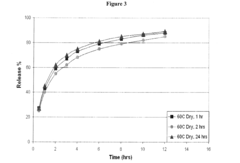
[0074]This example uses a dispersion at 10% solids and provides 1.5% weight gain, coated under high humidity conditions.

[0075]An aqueous coating dispersion of plasticized ethyl cellulose pseudo-lattices was prepared using the formulation in Table 10 by: (1) adding triethyl citrate to AQUACOAT® ECD-30 (FMC Corp., Philadelphia Pa.) and mixing for one hour at slow speed at approximately 100 to 150 RPM using a propeller mixer with a 3 inch impeller blade and (2) adding deionized water and mixing for an additional 10 minutes.

[0076]

TABLE 10Coating formulation at 10% solidsIngredientWeight (%)Weight (%) of solidsAQUACOAT ® ECD-302780ethylcellulose dispersiontriethyl citrate220deionized water710100100

[0077]The coating dispersion was applied to an 800 gram batch size of theophylline pellets (average pellet size 1000 microns, 70% theophylline) according to the coating conditions in Table 11 The coating was conducted in a Niro Fluid Bed Dryer MP-1 with Wurster Column. The coating dispersion wa...

the structure of the environmentally friendly knitted fabric provided by the present invention; figure 2 Flow chart of the yarn wrapping machine for environmentally friendly knitted fabrics and storage devices; image 3 Is the parameter map of the yarn covering machine
Login to View More

PUM

PropertyMeasurementUnit
temperatureaaaaaaaaaa
Login to View More

Abstract

An aqueous polymer coating composition containing at least one latex or pseudolatex is coated on a substrate in a high humidity coating process followed by heat treatment of the coated substrate above the film forming temperature of the coating at low humidity. The coated substrate gives a stable reproducible dissolution profile substantially insensitive to temperature or humidity conditions upon storage. The high humidity coating process is achieved by addition of water to the coating chamber through dilution of the coating formulation or humidification of inlet air. Contrary to the conventional low humidity coating process, residual water is retained in the coating layer of the coated substrates in the coating step. When the coated substrates are heat treated at a temperature greater than the minimum film forming temperature, the residual water in the coating layer will ensure adequate capillary force for the completion of film coalescence. High humidity heat treatment is not needed.

Description

BACKGROUND OF THE INVENTION[0001]1. Field of the Invention[0002]The present invention relates to coating processes used to produce controlled-release coatings and to products made by the process.[0003]2. Brief Description of the Prior Art[0004]Controlled release dosage forms are designed to provide prolonged pharmacological action after the administration of the dosage form, as compared with the administration of an immediate release dosage form. Such sustained response offers many inherent therapeutic benefits that cannot be obtained with immediate release and short acting products.[0005]Controlled release dosage forms known in the art include coated beads, pellets or spheroids, coated capsules, coated tablets and ion exchange resins, wherein the sustained release of the active drug is realized via permeation of the active drug through a coating layer or a matrix formulation to slow down the release of the drug.[0006]An essential characteristic of all controlled release dosage form...

Claims

the structure of the environmentally friendly knitted fabric provided by the present invention; figure 2 Flow chart of the yarn wrapping machine for environmentally friendly knitted fabrics and storage devices; image 3 Is the parameter map of the yarn covering machine
Login to View More

Application Information

Patent Timeline
no application Login to View More
Patent Type & Authority Patents(United States)
IPC IPC(8): B05D3/02
CPCA61K9/282A61K9/2866A61K9/2893A61K9/5026A61K9/5042A61K9/5047A61K9/5089B01J2/006B01J2/30B05D3/0254B05D3/0486A61K9/2813A61K9/284A61K9/2846B05D2401/20
Inventor LI, JIAN-XINCARLIN, BRIAN A. C.
Owner FMC CORP