Supercharge Your Innovation With Domain-Expert AI Agents!

Selective catalytic oxidation of ammonia to water and nitrogen

a catalytic oxidation and ammonia technology, applied in the field of catalysts, can solve problems such as nitrogen oxide formation

Active Publication Date: 2011-05-17
HAMILTON SUNDSTRAND SPACE SYST INT
View PDF45 Cites 2 Cited by
  • Summary
  • Abstract
  • Description
  • Claims
  • Application Information

AI Technical Summary

Benefits of technology

The catalyst effectively oxidizes ammonia to nitrogen and water over a broad temperature range below 200° C., avoiding NOx formation and optimizing energy use in space applications.

Problems solved by technology

Disadvantageously, currently available combinations of active metals and support materials for ammonia oxidation require temperatures above approximately 200° C. to oxidize ammonia and often result in the formation of nitrogen oxide (NOx).

Method used

the structure of the environmentally friendly knitted fabric provided by the present invention; figure 2 Flow chart of the yarn wrapping machine for environmentally friendly knitted fabrics and storage devices; image 3 Is the parameter map of the yarn covering machine
View more

Image

Smart Image Click on the blue labels to locate them in the text.
Viewing Examples
Smart Image
  • Selective catalytic oxidation of ammonia to water and nitrogen
  • Selective catalytic oxidation of ammonia to water and nitrogen

Examples

Experimental program
Comparison scheme
Effect test

Embodiment Construction

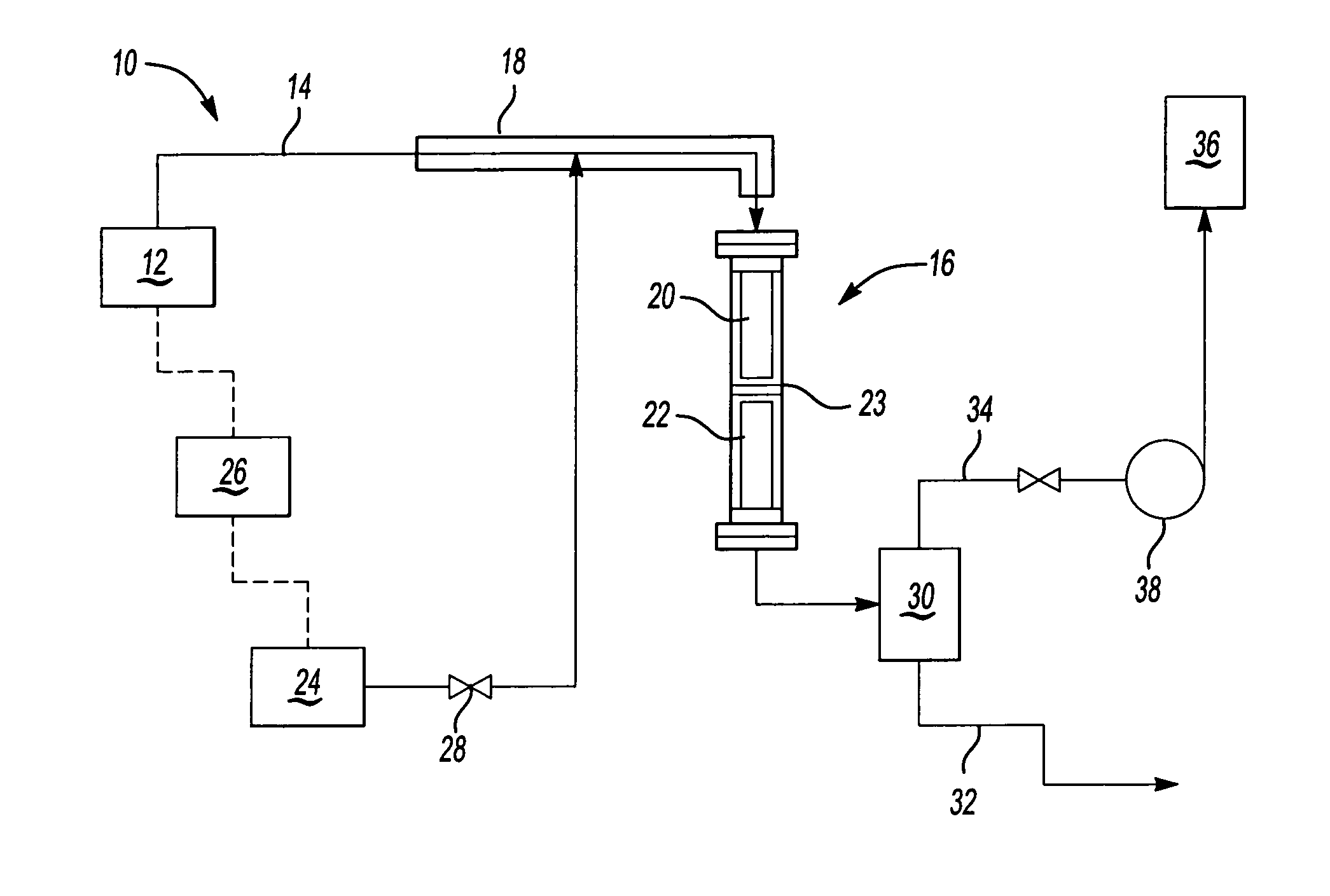
[0012]FIG. 1 illustrates selected portions of an example catalytic system 10 for oxidizing ammonia and hydrocarbons, for example, from a vaporized feed stream. The catalytic system 10 includes a vaporizer 12 that receives a waste water that is collected, for example, from waste urine, wash water, and moisture condensate collected from operating systems on a space vehicle. The vaporizer 12, such as a boiler, vaporizes the waste water. A vaporized stream travels through a conduit 14 to a reactor 16. A heater 18 adjacent to the conduit 14 maintains an elevated temperature along a portion of the conduit 14 to minimize condensation of the vaporized stream.

[0013]The reactor 16 includes an ammonia catalyst 20 and a hydrocarbon catalyst 22. The ammonia catalyst 20 oxidizes the gaseous ammonia to produce gaseous nitrogen and gaseous water. The hydrocarbon catalyst 22 decomposes the gaseous hydrocarbons. A heater 23 near the ammonia catalyst 20 and hydrocarbon catalyst 22 maintains the ammoni...

the structure of the environmentally friendly knitted fabric provided by the present invention; figure 2 Flow chart of the yarn wrapping machine for environmentally friendly knitted fabrics and storage devices; image 3 Is the parameter map of the yarn covering machine
Login to View More

PUM

PropertyMeasurementUnit
temperaturesaaaaaaaaaa
wt %aaaaaaaaaa
Login to View More

Abstract

A catalyst includes a platinum coating deposited on a silica support. The support has an average surface area between about 100 m2 / g and about 120 m2 / g. The platinum coating is between about 5 wt % and about l5 wt % of the catalyst. The combination of the selected surface area, silica support, and selected amount of platinum coating provides a catalytic activation temperature below 200° C. and avoids the formation of NOx.

Description

BACKGROUND OF THE INVENTION[0001]This invention relates to catalysts, and more particularly, to platinum catalysts for oxidizing ammonia in vapor phase catalytic ammonia removal systems.[0002]Catalytic systems are widely known and used for decomposing or oxidizing undesirable chemical species within a fluid. Catalytic systems are used in space vehicles and in space stations to remove ammonia and other chemicals from waste streams generated during a space mission. Typically, water-based waste streams are collected, distilled, and purified before being reused by a crew. The weight of such catalytic systems and the amount of energy that the catalytic systems use is minimized to reduce relatively high expenses related to space travel.[0003]Conventional catalysts typically include an active metal deposited on a support material. Typically, the type of active metal and type of support material are selected based upon the application that the catalyst will be used in. Disadvantageously, cu...

Claims

the structure of the environmentally friendly knitted fabric provided by the present invention; figure 2 Flow chart of the yarn wrapping machine for environmentally friendly knitted fabrics and storage devices; image 3 Is the parameter map of the yarn covering machine
Login to View More

Application Information

Patent Timeline
no application Login to View More
Patent Type & Authority Patents(United States)
IPC IPC(8): B01J23/00B01J20/00B01J29/00B01J21/00
CPCB01D53/8634B01J8/0453B01J8/0496B01J23/42B01J35/10B01J21/08B01D2255/102B01J2219/00006B01J35/1019B01J35/1023B01J35/617B01J35/60B01J35/615
Inventor NALETTE, TIMOTHY A.THIBAUD-ERKEY, CATHERINE
Owner HAMILTON SUNDSTRAND SPACE SYST INT
Features
  • R&D
  • Intellectual Property
  • Life Sciences
  • Materials
  • Tech Scout
Why Patsnap Eureka
  • Unparalleled Data Quality
  • Higher Quality Content
  • 60% Fewer Hallucinations
Social media
Patsnap Eureka Blog
Learn More