
Anode active material, method of preparing the same, anode including the anode active material, and lithium battery including the anode
an anode active material and anode active material technology, applied in the direction of batteries, sustainable manufacturing/processing, cell components, etc., can solve the problems of low charge/discharge efficiency or short circuit, unstable and highly reactive metal lithium, and low battery capacity of carbonaceous anodes
- Summary
- Abstract
- Description
- Claims
- Application Information
AI Technical Summary
Benefits of technology
Problems solved by technology
Method used
Image


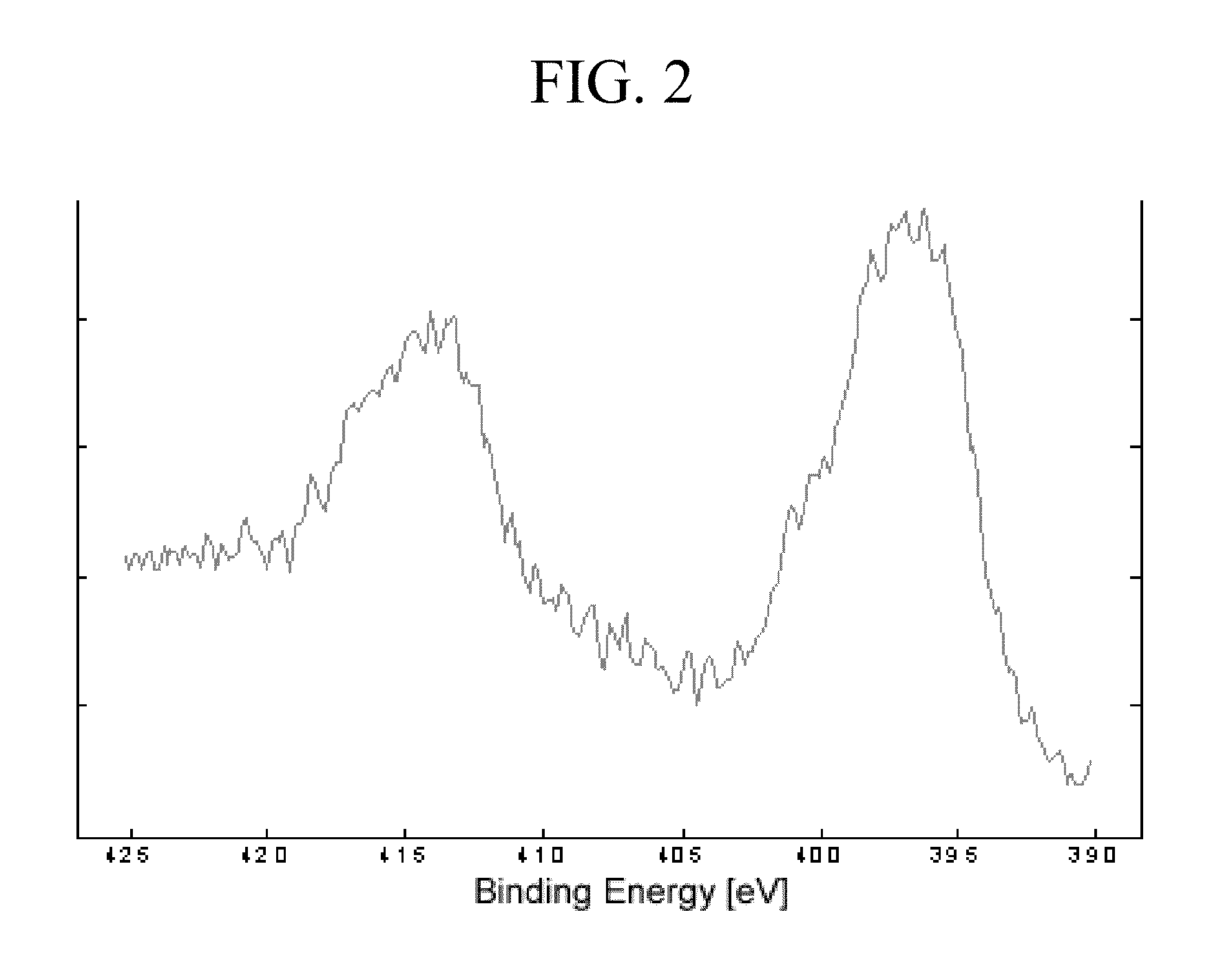
Examples
example 1
[0059]1 g of MoO2 that had an average diameter of 1 μm and that was synthesized by the inventors at room temperature was loaded into a silica tube, and then, argon gas (99.99%) was supplied thereto to remove oxygen and water. In order to stabilize the flow of gas, argon gas was supplied for 30 minutes and then, the furnace was heated at a rate of 7.5° C. / minute from room temperature to a temperature of 400° C., and then maintained at a temperature of 400° C. for 30 minutes, and then heated at a rate of 5° C. / minute until the temperature was 600° C. Then, the argon gas was exchanged with ammonia gas (99.98%) and supplied at a flow rate of 500 sccm (standard cubic centimeters per minute) for 10 minutes in order to perform nitridation, thereby forming a coating layer. When the reaction stopped, the furnace was cooled while supplying argon gas.
[0060]The coating layer formed by nitridation was identified by transmission electron microscopy (TEM) and the thickness of the coating layer was...
example 2
[0061]An anode active material was prepared in the same manner as in Example 1, except that the supply time of the ammonia gas was 20 minutes.
[0062]The thickness of the coating layer formed by nitridation was in the range of 10 nm to 20 nm, and an average thickness of the coating layer was 15 nm, and the TEM image of the coating layer is shown in FIG. 4. In FIG. 4, the thickness of the coating layer is represented by an arrow.
example 3
[0063]An anode active material was prepared in the same manner as in Example 1, except that the supply time of the ammonia gas was 40 minutes.
[0064]The thickness of the coating layer formed by nitridation was in the range of 20 nm to 40 nm, and an average thickness of the coating layer was 30 nm.
PUM
| Property | Measurement | Unit |
|---|---|---|
| average diameter | aaaaa | aaaaa |
| thickness | aaaaa | aaaaa |
| binding energy | aaaaa | aaaaa |
Abstract
Description
Claims
Application Information
 Login to View More