
Water acrylic resin and preparing method thereof
A water-based acrylic and acrylic technology, applied in the coating and other directions, to achieve the effects of long storage time, small particle size and excellent water resistance
- Summary
- Abstract
- Description
- Claims
- Application Information
AI Technical Summary
Problems solved by technology
Method used
Image

Examples
Embodiment 1
[0041] The composition of raw materials for preparing waterborne acrylic resin is shown in Table 3.
[0042] Table 3 Preparation of water-based acrylic resin (embodiment 1) with raw material composition
[0043] Component
mass (g)
Propylene glycol butyl ether
8.3
24.7
acrylic
10.7
3.2
19.8
7.5
14.6
tert-butyl peroxybenzoate
2.8
8.4
Deionized water
160.0
[0044] The specific preparation method is as follows: add propylene glycol butyl ether and glycidyl tertiary carbonate to a 500mL four-necked flask equipped with a thermometer, a stirring device and a condenser, pass through dry nitrogen protection, start stirring and raise the temperature to 150-155°C; then start Add dropwise the mixture of acrylic acid, hydr...
Embodiment 2
[0051] The composition of raw materials for preparing water-based acrylic resin in this example is shown in Table 5. Different from Example 1, in this example, the amount of methyl methacrylate in the raw material components was increased, the amount of butyl acrylate was reduced, and methyl styrene was used instead of styrene.
[0052] Table 5 prepares waterborne acrylic resin (embodiment 2) with raw material composition
[0053] Component
[0054] The specific preparation method is as follows: Add propylene glycol butyl ether and glycidyl tert-carbonate into a 500mL four-necked flask equipped with a thermometer, a stirring device and a condenser, pass through dry nitrogen protection, start stirring and raise the temperature to 150-155°C; then start Add dropwise the mixture of acrylic acid, hydroxyethyl methacrylate, methyl methacrylate, butyl acrylate, methylstyrene and tert-butyl peroxybenzoate, wherein 7g of acrylic acid, 2.4g of tert-butyl peroxybenzoate, Add ...
Embodiment 3
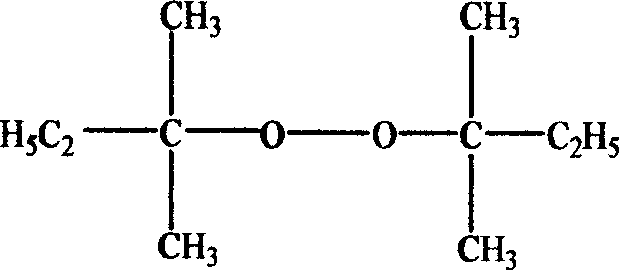
[0061] In this example, di-tert-amyl peroxide was used as the initiator, and the composition of the raw materials used to prepare the resin is shown in Table 7.
[0062] Table 7 prepares waterborne acrylic resin (embodiment 3) with raw material composition
[0063] Component
mass (g)
Propylene glycol butyl ether
8.2
Glycidyl tertiary carbonate
24.7
acrylic
10.7
3.2
19.8
7.5
14.6
Di-tert-amyl peroxide
3.3
8.0
[0064] Deionized water
160.0
[0065] The specific preparation method is as follows: Add propylene glycol butyl ether and glycidyl tert-carbonate into a 500mL four-necked flask equipped with a thermometer, a stirring device and a condenser, pass through dry nitrogen protection, start stirring and raise the temperature to 15...
PUM
| Property | Measurement | Unit |
|---|---|---|
| particle diameter | aaaaa | aaaaa |
| particle diameter | aaaaa | aaaaa |
| molecular weight distribution | aaaaa | aaaaa |
Abstract
Description
Claims
Application Information
 Login to View More