VCSEL (vertical cavity surface emitting laser)-based low-power-consumption gas detection method and device

A technology of gas detection and low power consumption, which is applied in the field of optical fiber sensing, can solve the problems of high power consumption of TEC controllers, difficulties in implementing sensors, and high power consumption of sensors, so as to improve accuracy, simple and reliable methods, and promote development Effect

CN102967580AActive Publication Date: 2013-03-13SHANDONG MICRO PHOTOGRAPHIC ELECTRONICS
3 Cites 22 Cited by

Patent Information

Authority / Receiving Office
CN · China
Current Assignee / Owner
Publication Date
2013-03-13

Smart Images

  • Figure 1
    Figure 1
  • Figure 2
    Figure 2
  • Figure 3
    Figure 3
Patent Text Reader

Abstract

The invention discloses a VCSEL (vertical cavity surface emitting laser)-based low-power-consumption gas detection method and device. The method comprises the following steps that: a microprocessor controls a sawtooth wave current driving circuit to drive a VCSEL to generate light with specified wavelength in the first step; the light emitted from the VCSEL reaches an optical fiber sensing probe and a reference air chamber through a light path; and an optical signal with concentration information enters a photoelectric conversion circuit and is converted into a corresponding analog voltage signal by the photoelectric conversion circuit, the analog voltage signal is converted into a digital voltage signal which can be identified by the microprocessor through an analog / digital (A / D) conversion circuit, a temperature measurement circuit transmits a measured environment temperature value to the microprocessor, and thus the microprocessor obtains the wavelength of the light emitted from the VCSEL in case of a given driving current and calculates a field gas concentration signal according to a Beer-Lambert law. The method has the advantage of implementing the gas concentration detection at low power consumption.
Need to check novelty before this filing date? Find Prior Art

Description

technical field

[0001] The invention relates to the field of optical fiber sensing, in particular to a VCSEL-based low-power gas detection device and method. Background technique

[0002] With the continuous development of industrial and agricultural production technology, timely and accurate monitoring of various gases has become an important problem that needs to be solved urgently in industries such as petroleum, chemical industry, electric power, and coal mine safety. At the same time, with the continuous improvement of people's living standards, human beings have higher and higher requirements for the ecological environment. It is urgent to pay attention to environmental protection and monitor and control the environment while developing. For this reason, the development of gas sensors has become an important topic in the field of sensing today.

[0003] Optical fiber gas detection technology, which appeared in the 1980s, is a new type of gas detection method. It has t...

Examples

Embodiment Construction

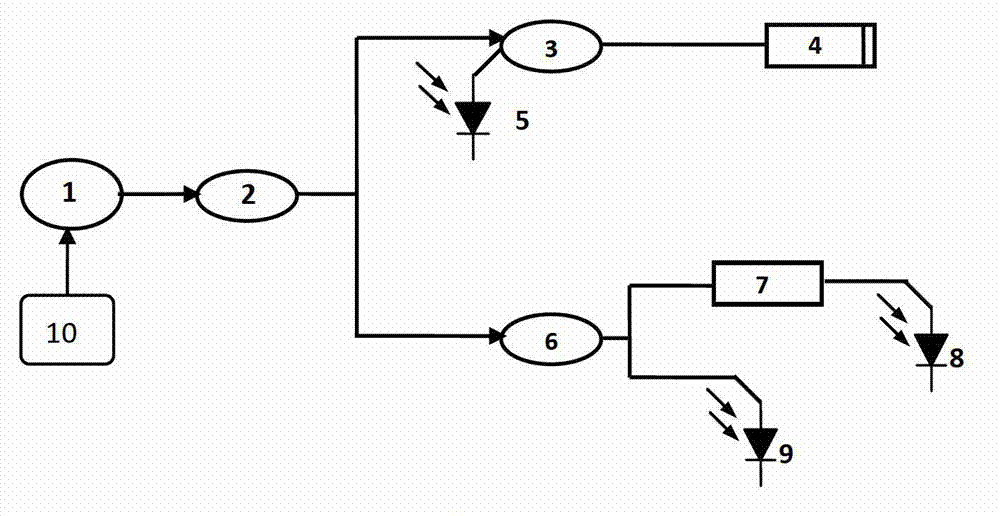
[0034] Now take methane as an example, and cooperate with the accompanying drawing of detection to do the following detailed description to the specific embodiment of the present invention:

[0035] A VCSEL-based low-power gas detection device, including a temperature detection device 10, a VCSEL laser 1, an optical path assembly, an optical fiber sensing probe 4, a reference probe 7, a photoelectric detector, and a power reference detection device; the optical path assembly includes a branch A splitter 2 and a coupler; the temperature detection device 10 is connected to the VCSEL laser 1, and the VCSEL laser 1 is connected to the splitter 2 of the optical path assembly, and the splitter 2 is connected to the input end of the first coupler 3 and the second The input end of the coupler 6, the output end of the first coupler 3 is connected to the optical fiber sensing probe 4, and the return end of the first coupler 3 is connected to the first photodetector 5; The output end is ...