Supercharge Your Innovation With Domain-Expert AI Agents!

Preparation of high-selectivity inorganic skeletal biomimic TiO2 photocatalyst by sol-hydrothermal method at low temperature

A high-selectivity, photocatalyst technology, applied in the direction of catalyst activation/preparation, physical/chemical process catalyst, water/sewage treatment, etc., can solve the problem of molecular recognition site damage, low adsorption efficiency, and unfavorable target organic pollutant selection Sexual photocatalysis and other problems, to achieve high mechanical strength, not easy to damage, good selectivity effect

Inactive Publication Date: 2015-03-11
NANCHANG HANGKONG UNIVERSITY
View PDF3 Cites 0 Cited by
  • Summary
  • Abstract
  • Description
  • Claims
  • Application Information

AI Technical Summary

Problems solved by technology

However, the preparation of the dual-zone structured photocatalyst is very troublesome, and the selective adsorption and degradation capabilities are also limited.
(4) Preparation of anatase TiO with specific crystal faces exposed 2 , {001} facet-exposed anatase TiO 2 It has high selectivity to negatively charged organic pollutants, but poor selective degradation ability to electrically neutral and positively charged organic pollutants
[0004] However, there are still several key scientific and technical issues that need to be solved urgently for the bionic recognition photocatalysis technology combined with bionic recognition technology and photocatalysis technology: (1) The organic imprinted layer of biomimetic photocatalyst is prone to photodegradation during the photocatalytic process, Its molecular recognition site is destroyed, which eventually leads to its low selective photocatalytic efficiency
(2) The hydrophilicity of the biomimetic photocatalyst is not good, which leads to the low adsorption efficiency of most target organic pollutants on the surface of the biomimetic photocatalyst, which is not conducive to the selective photocatalysis of the target organic pollutants
(3) Preparation of biomimetic TiO by high temperature calcination 2 During the process, the molecular recognition site is easily destroyed

Method used

the structure of the environmentally friendly knitted fabric provided by the present invention; figure 2 Flow chart of the yarn wrapping machine for environmentally friendly knitted fabrics and storage devices; image 3 Is the parameter map of the yarn covering machine
View more

Image

Smart Image Click on the blue labels to locate them in the text.
Viewing Examples
Smart Image
  • Preparation of high-selectivity inorganic skeletal biomimic TiO2 photocatalyst by sol-hydrothermal method at low temperature
  • Preparation of high-selectivity inorganic skeletal biomimic TiO2 photocatalyst by sol-hydrothermal method at low temperature
  • Preparation of high-selectivity inorganic skeletal biomimic TiO2 photocatalyst by sol-hydrothermal method at low temperature

Examples

Experimental program
Comparison scheme
Effect test

Embodiment 1

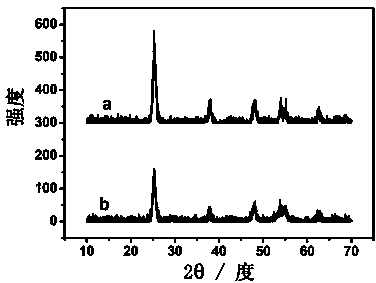
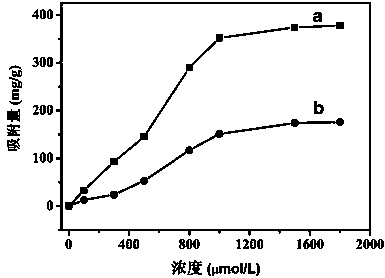
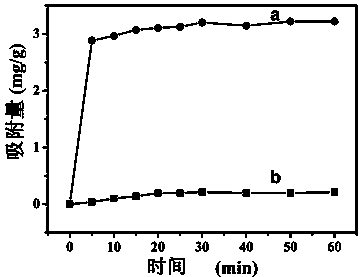
[0022] Add 0.4 g of 4-nitrophenol, 20 mL of anhydrous tetra-n-butyl titanate, 26 mL of absolute ethanol and 4 mL of glacial acetic acid into beaker A. In addition, mix 12 mL of absolute ethanol, 12 mL of glacial acetic acid and 8 mL of water evenly, and this mixture is called liquid B. Slowly drop liquid B into liquid A, stir the solution at room temperature for 3 hours, then transfer to a polytetrafluoroethylene-lined reactor and conduct a hydrothermal reaction at 140°C for 12 hours to obtain a light yellow solid. The solid product was washed three times with ethanol and deionized water respectively, and then the mixture of methanol:ammonia water (volume ratio 1:1) was used as the eluent, and the template molecules were removed by Soxhlet extraction to obtain the white inorganic skeleton biomimetic TiO 2 catalyst of light. Such as figure 1 , 2 , 3, and 4, the inorganic framework biomimetic TiO prepared by the present invention 2 Photocatalysts have good selectivity and hi...

Embodiment 2

[0024]Add 0.4 g of 2-nitrophenol, 20 mL of anhydrous tetra-n-butyl titanate, 26 mL of absolute ethanol and 4 mL of glacial acetic acid into beaker A. In addition, mix 12 mL of absolute ethanol, 12 mL of glacial acetic acid and 8 mL of water evenly, and this mixture is called liquid B. Slowly drop liquid B into liquid A, stir the solution at room temperature for 3 hours, then transfer to a polytetrafluoroethylene-lined reactor and conduct a hydrothermal reaction at 140°C for 12 hours to obtain a light yellow solid. The solid product was washed three times with ethanol and deionized water respectively, and then the mixture of methanol:ammonia water (volume ratio 1:1) was used as the eluent, and the template molecules were removed by Soxhlet extraction to obtain the white inorganic skeleton biomimetic TiO 2 catalyst of light.

Embodiment 3

[0026] Add 0.79 g of 4-nitrophenol, 20 mL of anhydrous tetra-n-butyl titanate, 26 mL of absolute ethanol and 4 mL of glacial acetic acid into beaker A. In addition, mix 12 mL of absolute ethanol, 12 mL of glacial acetic acid and 8 mL of water evenly, and this mixture is called liquid B. Slowly drop liquid B into liquid A, stir the solution at room temperature for 3 hours, then transfer to a polytetrafluoroethylene-lined reactor and conduct a hydrothermal reaction at 140°C for 12 hours to obtain a light yellow solid. The solid product was washed three times with ethanol and deionized water respectively, and then the mixture of methanol:ammonia water (volume ratio 1:1) was used as the eluent, and the template molecules were removed by Soxhlet extraction to obtain the white inorganic skeleton biomimetic TiO 2 catalyst of light.

the structure of the environmentally friendly knitted fabric provided by the present invention; figure 2 Flow chart of the yarn wrapping machine for environmentally friendly knitted fabrics and storage devices; image 3 Is the parameter map of the yarn covering machine
Login to View More

PUM

No PUM Login to View More

Abstract

The invention relates to a method for preparing a high-selectivity inorganic skeletal biomimic TiO2 photocatalyst by a sol-hydrothermal method at a low temperature. The method comprises the following steps of: hydrolyzing an alkoxide of titanium to form an intermediate product with a hydroxyl in the hydrolysis process, forming a molecularly imprinted precursor sol by the hydrolytic intermediate product with the hydroxyl and target organic pollutants under the action of hydrogen bonds and the electrostatic interaction, and stirring at the room temperature and in the hydrothermal process, forming TiO2 through polycondensation of Ti(OH)4 and crystallizing the TiO2; next, by taking the mixed solution of methanol and ammonia water as an eluant, removing the molecules of the template by a Soxhlet extraction method to finally obtain the high-selectivity inorganic skeletal biomimic TiO2 photocatalyst. The method has the outstanding advantages of mild preparation conditions, high mechanical strength of the inorganic skeletal biomimic TiO2 photocatalyst, and good selectivity and high degradation efficiency to the target organic pollutants, and molecular recognition sites are not easy to damage; the method is capable of obviously reducing the concentration of the target pollutants in agricultural reuse water, and simultaneously keeping organic nutritional ingredients in the water to an utmost extent.

Description

technical field [0001] The invention relates to an inorganic skeleton bionic TiO 2 Preparation method of photocatalyst, especially related to a sol-hydrothermal method for low-temperature preparation of inorganic framework biomimetic TiO with high selectivity 2 photocatalytic method. Background technique [0002] my country is a large agricultural irrigation country, and the agricultural water mainly for irrigation accounts for more than 70% of the country's water consumption. However, my country is also a country with a very short supply of water resources. With the further improvement of the national economy and urban living standards, agricultural water is continuously occupied by industrial and urban water, and the water shortage in agricultural production is becoming more and more serious. Especially in northern China, the utilization of water resources has almost reached a critical state, and even endangers the safety of food production. While saving water, the use o...

Claims

the structure of the environmentally friendly knitted fabric provided by the present invention; figure 2 Flow chart of the yarn wrapping machine for environmentally friendly knitted fabrics and storage devices; image 3 Is the parameter map of the yarn covering machine
Login to View More

Application Information

Patent Timeline
no application Login to View More
Patent Type & Authority Patents(China)
IPC IPC(8): B01J21/06B01J37/00C02F1/30C02F1/58
Inventor 邓芳罗旭彪罗胜联吴少林曾桂生
Owner NANCHANG HANGKONG UNIVERSITY
Features
  • R&D
  • Intellectual Property
  • Life Sciences
  • Materials
  • Tech Scout
Why Patsnap Eureka
  • Unparalleled Data Quality
  • Higher Quality Content
  • 60% Fewer Hallucinations
Social media
Patsnap Eureka Blog
Learn More