Supercharge Your Innovation With Domain-Expert AI Agents!

Organic/nano-sodium tantalate composite sun-blind ultraviolet light detector

A solar-blind, nano-tantalum technology, applied in the field of detectors, can solve the problems of unfavorable devices working for a long time, increase the contact probability, etc., to achieve the effect of selective response and avoid interference

Active Publication Date: 2016-03-23
ZHEJIANG UNIV
View PDF7 Cites 0 Cited by
  • Summary
  • Abstract
  • Description
  • Claims
  • Application Information

AI Technical Summary

Problems solved by technology

If the transparent metal electrode is used as the counter electrode and the light is incident from this side, although the detection range of the device can be extended to the wavelength band below 300nm, in order to increase the transmittance of the electromagnetic wave below 300nm in the transparent metal electrode layer as much as possible, it is generally necessary to The transparent metal electrode layer is made very thin, which greatly increases the contact probability between the active layer material in the detector and the water and oxygen in the external environment, which is not conducive to the long-term work of the device, which requires the design of a new device structure
At the same time, if the device is to achieve intrinsic solar-blind ultraviolet band response, it is necessary to strictly limit the bandgap width of the active layer material.

Method used

the structure of the environmentally friendly knitted fabric provided by the present invention; figure 2 Flow chart of the yarn wrapping machine for environmentally friendly knitted fabrics and storage devices; image 3 Is the parameter map of the yarn covering machine
View more

Image

Smart Image Click on the blue labels to locate them in the text.
Viewing Examples
Smart Image
  • Organic/nano-sodium tantalate composite sun-blind ultraviolet light detector
  • Organic/nano-sodium tantalate composite sun-blind ultraviolet light detector
  • Organic/nano-sodium tantalate composite sun-blind ultraviolet light detector

Examples

Experimental program
Comparison scheme
Effect test

Embodiment 1

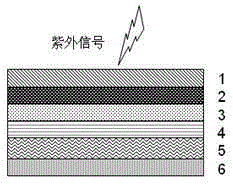
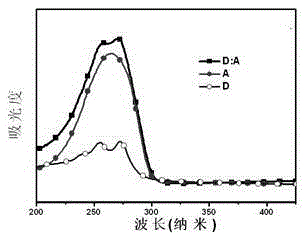
[0021] The quartz substrate was ultrasonically washed with detergent, isopropanol, ethanol, and acetone for 5 minutes, rinsed with deionized water and dried. Vacuum-deposit a layer of 2nm-thick metal aluminum on the quartz substrate, and after UV-ozone treatment, prepare a PEDOT:PSS (polyaniline derivative) electrode modification layer with a thickness of about 40nm by spin coating, and bake at 120°C. Remove after 15 minutes of baking. Choose D (n = 1) as the donor material, and sodium tantalate (particle size 3 nm) as the acceptor material A. First prepare D with a thickness of about 30nm by spin coating on PEDOT:PSS, and then prepare A with a thickness of about 20nm by solution spin coating on the D film. The above two layers constitute an organic-inorganic composite with a planar heterojunction structure. active layer. Finally, 1nm thick LiF and 100nm thick aluminum electrodes were sequentially prepared by vacuum evaporation. As mentioned above, get as figure 1 The orga...

Embodiment 2

[0023] The quartz substrate was ultrasonically washed with detergent, isopropanol, ethanol, and acetone for 5 minutes, rinsed with deionized water and dried. Vacuum-deposit a layer of metallic silver with a thickness of 20nm on the quartz substrate, and after UV-ozone treatment, prepare a PEDOT:PSS (polyaniline derivative) electrode transport layer with a thickness of about 40nm by spin coating, and bake at 120°C Remove after 15 minutes of baking. Choose D (n = 2) as the donor material, and sodium tantalate (particle size 30 nm) as the acceptor material A. A mixed film with a thickness of about 70nm was prepared by solution spin coating on PEDOT:PSS. The weight ratio of donor material D:acceptor material A in the mixed film was 95:5, forming an organic-inorganic structure with a bulk heterojunction structure. Composite active layer. Finally, 1nm thick LiF and 200nm silver electrodes were sequentially prepared by vacuum evaporation method. As mentioned above, get as figure ...

Embodiment 3

[0025] The quartz substrate was ultrasonically washed with detergent, isopropanol, ethanol, and acetone for 5 minutes, rinsed with deionized water and dried. Vacuum-deposit a layer of silver / aluminum mixture with a thickness of 15nm on the quartz substrate, and after UV-ozone treatment, prepare a PEDOT:PSS (polyaniline derivative) electrode modification layer with a thickness of about 40nm by spin coating, at 120°C Remove from the oven after 15 minutes. Choose D (n = 3) as the donor material, and sodium tantalate (particle size 10 nm) as the acceptor material A. First prepare D with a thickness of about 30nm on PEDOT:PSS by vacuum evaporation, and then prepare A with a thickness of about 30nm on the D film by solution spin coating. - Inorganic composite active layer. Finally, 1nm thick LiF and 300nm gold electrodes were sequentially prepared by vacuum evaporation. As mentioned above, get as figure 1 The organic / nano-sodium tantalate composite sun-blind UV photodetector sho...

the structure of the environmentally friendly knitted fabric provided by the present invention; figure 2 Flow chart of the yarn wrapping machine for environmentally friendly knitted fabrics and storage devices; image 3 Is the parameter map of the yarn covering machine
Login to View More

PUM

PropertyMeasurementUnit
particle diameteraaaaaaaaaa
thicknessaaaaaaaaaa
particle diameteraaaaaaaaaa
Login to View More

Abstract

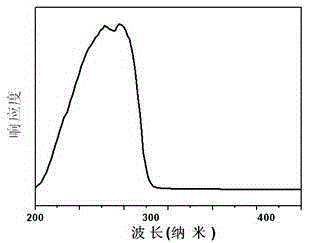
The invention discloses an organic / nano-sodium tantalate composite sun-blind ultraviolet light detector. It includes a quartz substrate, a transparent metal electrode layer, an electrode modification layer, an organic-inorganic composite active layer, a cathode modification layer, and a metal electrode layer; from the bottom to the top of the quartz substrate, a transparent metal electrode layer, an electrode modification layer, an organic - inorganic composite active layer, cathode modification layer, metal electrode layer; the organic-inorganic composite active layer is: a mixed layer of organic donor material D and inorganic acceptor material A or a laminated organic donor material D layer and Inorganic acceptor material A layer. The general molecular structure formula of the organic donor material D is: ? ? ? ? ? ? ? ? ? ? ? ? ? ? ? ? ? ? ? ? ? ? ? ? ? ? ? ? ? ? ? ? ? ? ? ? ? ? ? ? ? ? ? ? ? ? ? ? ? Among them, n=1~5. The invention can improve the carrier mobility of the ultra-wide bandgap organic donor material, realize the selective response to the radiation below 300nm, and greatly avoid the absorption of the radiation below 300nm by the common ITO substrate.

Description

technical field [0001] The invention relates to a detector, in particular to an organic / nano-sodium tantalate composite sun-blind ultraviolet light detector. technical background [0002] During the passage of solar ultraviolet radiation through the atmosphere, due to strong absorption by oxygen atoms in the thermosphere and ozone in the stratosphere, only ultraviolet rays in the 300-400nm band can reach the near-surface space (below 25,000 meters), resulting in There is almost no ultraviolet radiation in the 0-300nm band in the atmosphere, and this band is the so-called "solar blind zone"; while the ultraviolet rays reaching the surface form a uniform ultraviolet background due to the scattering effect of the atmosphere, which is called the "visible blind zone". In view of the advantages of the "sun blind zone" ultraviolet signal having a clean surface background, no interference from sunlight, and light signal processing burden, the detection (reception) of the "sun blind ...

Claims

the structure of the environmentally friendly knitted fabric provided by the present invention; figure 2 Flow chart of the yarn wrapping machine for environmentally friendly knitted fabrics and storage devices; image 3 Is the parameter map of the yarn covering machine
Login to View More

Application Information

Patent Timeline
no application Login to View More
Patent Type & Authority Patents(China)
IPC IPC(8): H01L51/42H01L51/46H01L51/44
CPCH10K71/12H10K85/111H10K30/15H10K2102/00Y02E10/549
Inventor 吴刚陈红征汪茫
Owner ZHEJIANG UNIV
Features
  • R&D
  • Intellectual Property
  • Life Sciences
  • Materials
  • Tech Scout
Why Patsnap Eureka
  • Unparalleled Data Quality
  • Higher Quality Content
  • 60% Fewer Hallucinations
Social media
Patsnap Eureka Blog
Learn More