
Copper-aluminum abutting and lap joint type conducting bar
A technology of conductive strips and aluminum strips, applied in conductive connection, welding/welding/cutting items, conductors, etc., can solve the problems that the connection parts cannot reach the conductivity of aluminum strips, safety risks, and reduce the current of conductive strips. Overcome the limitations of cross-sectional shape selection, solve reliable connections, and overcome the effect of interface oxidation
Active Publication Date: 2015-02-04
JIANGSU ONEQ ELECTRICAL APPLIANCE GRP
View PDF14 Cites 5 Cited by
- Summary
- Abstract
- Description
- Claims
- Application Information
AI Technical Summary
Problems solved by technology
The rotary friction welding process has its limitations. It is limited to the transitional welding of cylindrical or round tube copper-aluminum profiles, such as cable joint terminals, and materials with flat, oval, and rectangular cross-sections cannot be welded; the flash resistance welding process is also It is applied to the butt welding of copper-aluminum joints (see utility model patent: liquid-immersed transformer copper-aluminum row, publication number: CN201072694Y), flash resistance welding achieves butt joint through high-temperature diffusion of aluminum atoms due to the large difference in melting point of copper and aluminum , the metallurgical reaction process of recrystallization cannot be achieved, and because there is no vacuum environment or inert gas protection, only relying on the metal vapor generated during the welding process cannot prevent the high-temperature oxidation of metal copper and aluminum. In addition, due to the complex process parameters of flash welding It is not easy to master, so this process will seriously affect the welding quality of the copper-aluminum transition part. The connection part cannot reach the proper conductivity of the aluminum bar itself, which greatly increases the resistivity of the conductive bar and reduces the current carrying capacity of the conductive bar. Using this There is a serious safety risk in the conductive bar
Method used
the structure of the environmentally friendly knitted fabric provided by the present invention; figure 2 Flow chart of the yarn wrapping machine for environmentally friendly knitted fabrics and storage devices; image 3 Is the parameter map of the yarn covering machine
View moreImage
Smart Image Click on the blue labels to locate them in the text.
Smart ImageViewing Examples

Examples
Experimental program
Comparison scheme
Effect test
Embodiment 1
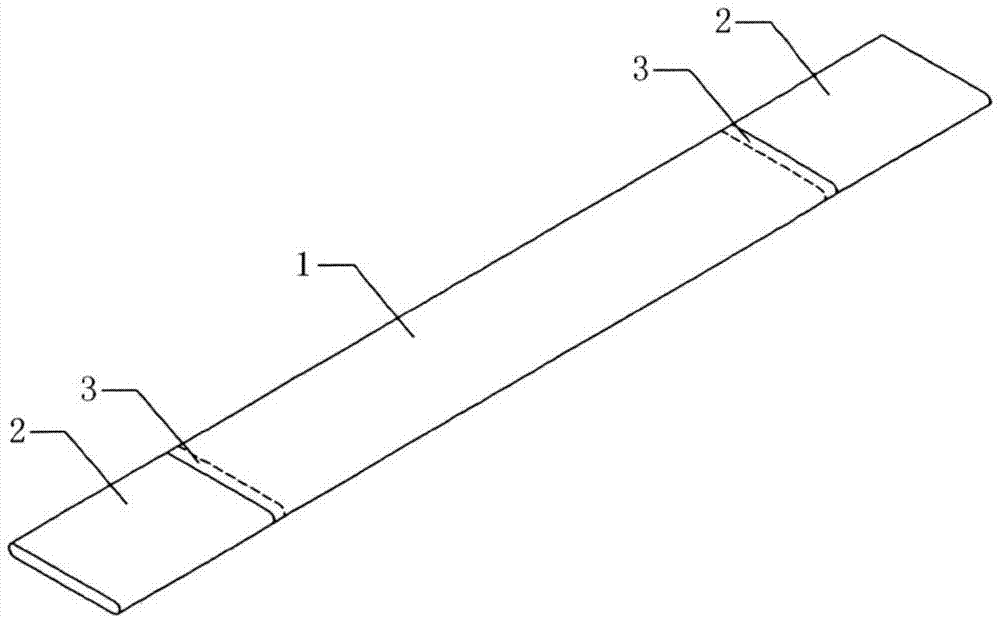
[0017] Embodiment 1: The two ends of the aluminum bar 1 are butted with the copper bar 2, and the butt joint 3 is welded together by mechanical friction stir welding to form a copper-aluminum butt-connected conductive bar.
Embodiment 2
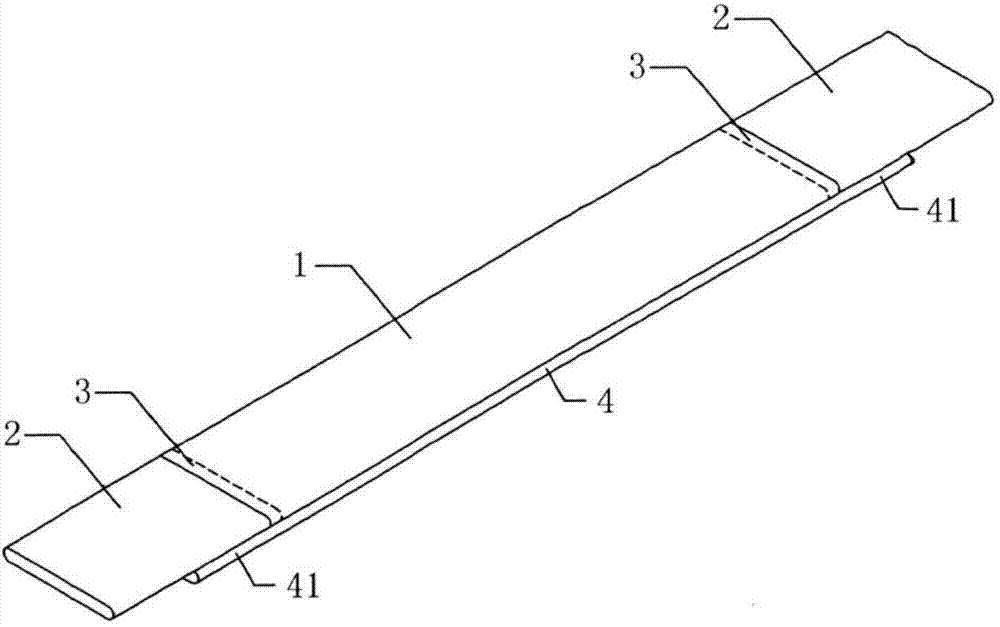
[0018] Embodiment 2: The two ends of the aluminum row 1 are docked with the copper row 2, and at the same time, an aluminum row 4 is superimposed on one side of the conductive row. For the butt joint part 41 of the copper bar, the butt welding and superimposition welding are performed on the butt joint part 3 at one time through the method of mechanical friction stir welding, so that the aluminum bar, the copper bar, and the superimposed aluminum bar become a butt joint and superimposed conductive bar.
the structure of the environmentally friendly knitted fabric provided by the present invention; figure 2 Flow chart of the yarn wrapping machine for environmentally friendly knitted fabrics and storage devices; image 3 Is the parameter map of the yarn covering machine
Login to View More PUM
 Login to View More
 Abstract
The invention provides a copper-aluminum abutting and lap joint type conducting bar. The conducting bar comprises an aluminum bar (1), copper bars (2) and a lap joint aluminum bar (4), wherein the aluminum bar (1) is positioned in the middle; the copper bars are connected to two ends of the aluminum bar (1); the shape and size of the section of the aluminum bar (1) are consistent with those of the sections of the copper bars (2); the lap joint aluminum bar (4) which is as wide as the aluminum bar (1) is connected to the lower surface of the aluminum bar (1); two ends of the lap joint aluminum bar (4) are longer than a part (3) in which the aluminum bar (1) is connected with the copper bars (2); the exceeded part (41) of the lap joint aluminum bar is connected with the lower surfaces of the copper bars (2) at the two ends of the aluminum bar (1). The conducting bar is the most economic copper-aluminum abutting or lap joint type conducting bar which replaces the copper with the aluminum and is high in conductivity, small in resistance, safe and reliable and long in service life; the section of the conducting bar is flat, rectangular or rounded rectangular.
Description
technical field [0001] The invention relates to a busbar for electric power transmission or distribution. It belongs to the persistent technical field of conductive row. Background technique [0002] Since metal copper is scarce in resources and high in price compared with metal aluminum, which is also a conductive material, it is very economical to replace copper with aluminum. However, since the surface of metal aluminum is easy to oxidize, after contacting with copper, electrochemical corrosion is more likely to occur due to potential difference, which intensifies surface oxidation, and the produced aluminum oxide cannot conduct electricity, which seriously affects the conductivity of the connection of the conductive bar. In order to solve this problem, the existing technologies include copper plating and tin plating on the aluminum conductor joints, copper-clad aluminum bars, and casting transitions through the copper-aluminum joint body, but there are some disadvantage...
Claims
the structure of the environmentally friendly knitted fabric provided by the present invention; figure 2 Flow chart of the yarn wrapping machine for environmentally friendly knitted fabrics and storage devices; image 3 Is the parameter map of the yarn covering machine
Login to View More Application Information
Patent Timeline
 Login to View More
 IPC IPC(8): H01R4/62H01F27/29
CPCB23K20/122B23K2103/18H01B1/02H01B5/00H01B5/02H01R4/625
Inventor马纪财马松涛
OwnerJIANGSU ONEQ ELECTRICAL APPLIANCE GRP