Check patentability & draft patents in minutes with Patsnap Eureka AI!

Preparation method of acraldehyde

A technology for acrolein and crude glycerin, which is applied in the preparation of carbon-based compounds, chemical instruments and methods, and the preparation of organic compounds, etc., can solve the problems of high energy consumption, short life, and complicated process of purification operations, and achieve low glycerin purity requirements , reduce cost and energy consumption, and simplify the process flow

Active Publication Date: 2015-03-04
TSINGHUA UNIV
View PDF7 Cites 2 Cited by
  • Summary
  • Abstract
  • Description
  • Claims
  • Application Information

AI Technical Summary

Problems solved by technology

[0012] Most of the existing research results use refined glycerin as raw material. In order to obtain glycerin raw material with high purity and low impurity content, it is necessary to evaporate and concentrate crude glycerin, remove organic matter such as methanol, desaltize, decolorize, and adjust pH. Pretreatment, in which water evaporation needs to be carried out under vacuum conditions, these purification operations have high energy consumption, complicated process, and cause a large amount of glycerin loss at the same time, so the utilization rate of crude glycerol in the whole reaction process is poor, which does not meet the requirements of green chemistry and increases Reduced the cost of preparing acrolein by dehydrating crude glycerol from biomass, which became a bottleneck limiting the production of acrolein from glycerin
[0013] Patent FR 695931 proposes a method for preparing acrolein using solid acid as a catalyst and 20% refined glycerin aqueous solution as a raw material. The 20wt% refined glycerin aqueous solution is gasified and then passed through a fixed-bed reactor under high temperature conditions. The catalyst uses a supported tribasic acid , the highest yield of acrolein can reach 80%, but the method is repeated according to the patent DE 423493, and the corresponding yield cannot be obtained
[0014] Patents US 5426249 and CN 1034803C disclose a method for preparing acrolein using alumina, HZSM-5, HY and other supported phosphates as catalysts and refined glycerin as raw material, but when the highest yield of acrolein can reach 71%, glycerin Conversion rate is only 19%
[0015] Chinese patent CN 201010213226.1 proposes a method for preparing acrolein using refined glycerin as a raw material in a miniature fixed-bed reactor by using heteropolyacid loaded on alumina, diatomite, activated carbon, rutile titanium dioxide or kaolin as a catalyst, and the conversion rate of glycerin is 13.5-80.6%, the highest yield of acrolein is 49.0-90.5%, but the catalyst is easily deactivated, the life is short, and the selectivity of the later conversion rate is significantly reduced
[0016] Patent CN200880105819.7 adopts the method of reaction evaporation to directly prepare acrolein from crude glycerol, and uses crude glycerol as raw material, and simultaneously evaporates and purifies in the reactor to remove moisture and other impurities in glycerin, and then reacts on the catalyst, but Because the evaporation purification and dehydration reactions are not easy to control, and the glycerin purification operation is not complete enough, there are still a large number of salts in the crude glycerin that have not been removed before the reaction, causing a large amount of salts to deposit on the catalyst, resulting in significant catalyst activity and selectivity in the later stage of the reaction. decrease, the yield of acrolein is only 20-30% after 26 hours of reaction

Method used

the structure of the environmentally friendly knitted fabric provided by the present invention; figure 2 Flow chart of the yarn wrapping machine for environmentally friendly knitted fabrics and storage devices; image 3 Is the parameter map of the yarn covering machine
View more

Image

Smart Image Click on the blue labels to locate them in the text.
Viewing Examples
Smart Image
  • Preparation method of acraldehyde
  • Preparation method of acraldehyde
  • Preparation method of acraldehyde

Examples

Experimental program
Comparison scheme
Effect test

Embodiment 1

[0053] Example 1 (reaction effect comparison between desalted crude glycerin and crude glycerin)

[0054] This example compares the reaction effect of dehydration reaction to prepare acrolein with crude glycerol that has been desalted substantially as raw material and the reaction effect of dehydration reaction with crude glycerol as raw material.

[0055] Catalyst preparation: weigh 0.25g of Cs according to 20% load 2 CO 3 , and dubbed into 0.2mol L -1 concentration of aqueous solution, add 8g of SBA-15 carrier to the above aqueous solution, so that the loading capacity is 50%, stir vigorously for 2 to 5 hours, soak at room temperature overnight, dry at 80°C for later use, weigh an appropriate amount of heteropolyacid H 3 PW 12 o 40 12H 2 O and made into 0.08mol·L -1 Concentration in aqueous solution makes Cs x h 3-x PW 12 o 40 Where x=2.5 and mixed with the above-mentioned carrier, vigorously stirred for 2-5 hours by equal volume impregnation, then impregnated over...

Embodiment 2

[0061] Example 2 (desalted crude glycerin and refined glycerol are raw materials for reaction effect comparison)

[0062] This embodiment compares the reaction effect of desalted crude glycerin as raw material to prepare acrolein by dehydration reaction and that of refined glycerin as raw material.

[0063] Respectively adopt refined glycerol after water evaporation and concentration, desalination, removal of organic matter such as methanol, fatty acid and its esters, and basically only desalination treatment (for example, desalination treatment to a salt content lower than 1wt%), without other The desalted crude glycerol in the refining operation is used as raw material, and the catalytic dehydration reaction is carried out under the same conditions as other conditions; the preparation of the catalyst and the reaction conditions are the same as in Example 1. The results are compared in Table 2 below.

[0064] It can be seen from Table 2 that the conversion rate of glycerin r...

Embodiment 3

[0067] Embodiment 3 (glycerol containing different impurities is a raw material for reaction effect comparison)

[0068] Using the refined glycerol after water evaporation and concentration, desalting, methanol, fatty acid and its esters and other organic matter removal as raw material, add 2wt% methanol, 2wt% fatty acid, 2wt% fatty acid ester and 2wt% salt for reaction. Carry out sampling evaluation catalyst activity after continuous reaction 40h, selectivity and stability, catalyst composition and other reaction conditions are with embodiment example 1, and the result is compared in following table 3.

[0069] By comparing the reaction yields in Table 3, it can be seen that organic impurities such as methyl alcohol in crude glycerin, fatty acid, and fatty acid ester will not affect the catalyst reaction effect. The yield of acrolein is 88%, comparable to that of refined glycerin and desalted crude glycerin. However, the catalytic activity of refined glycerol containing salt...

the structure of the environmentally friendly knitted fabric provided by the present invention; figure 2 Flow chart of the yarn wrapping machine for environmentally friendly knitted fabrics and storage devices; image 3 Is the parameter map of the yarn covering machine
Login to View More

PUM

No PUM Login to View More

Abstract

The invention provides a method for preparing acraldehyde by carrying out catalytic dehydration on desalted crude glycerine. The method for preparing acraldehyde is characterized in that biodiesel byproduct crude glycerine is taken as a raw material, almost only desalination treatment is carried out, and a catalytic dehydration reaction is directly carried out for preparing acraldehyde without carrying out essential water evaporation concentration and removal of methanol, fatty acid, fatty acid ester and other impurity compounds. Experiments find that a catalytic effect is equivalent to that if refined glycerine is taken as a raw material when salt content of desalted crude glycerine is lower than 1wt%, and desalination operation cost is reduced; the biodiesel byproduct desalted crude glycerine is adopted as the raw material, and refining processes such as water evaporation concentration and removal of organic matter impurities with high energy consumption, complex steps and high cost are eliminated, thus the yield, the same as that if the refined glycerine is taken as the raw material, of the target product acraldehyde can be obtained; meanwhile, operation is simple, raw material cost is low, loss of glycerine in the refining process is reduced, the utilization rate of crude glycerine is high, the reaction rate is high, the yield of acraldehyde is high, catalyst life is long, and green chemistry industrial requirements are met.

Description

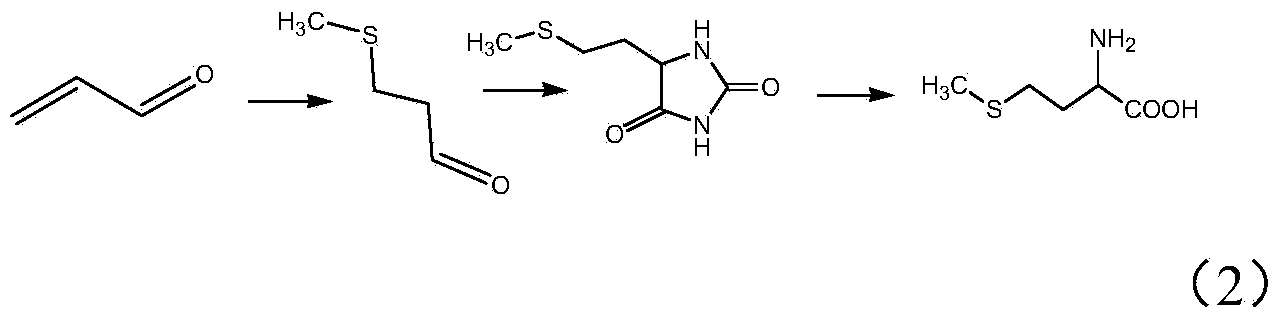
technical field [0001] The present invention generally relates to a method for preparing acrolein, and in particular to a method for preparing acrolein using glycerin. Background technique [0002] Acrolein is an important intermediate in organic synthesis, which plays a bridge role in the conversion and utilization of crude glycerol - acrolein can be further oxidized to produce acrylic acid and its esters, which are widely used, and can also be used as a raw material for polymerization reactions to synthesize polymer materials (such as: sodium polyacrylate), the reaction formula is as shown in formula (1): [0003] [0004] Acrolein can also be used to synthesize methionine, and the reaction formula is as shown in formula (2): methionine is an amino acid that cannot be synthesized by a living body, and it can be used to promote animal growth. The natural methionine source (plant, microorganism) provides Methionine concentration and production are relatively low, unable ...

Claims

the structure of the environmentally friendly knitted fabric provided by the present invention; figure 2 Flow chart of the yarn wrapping machine for environmentally friendly knitted fabrics and storage devices; image 3 Is the parameter map of the yarn covering machine
Login to View More

Application Information

Patent Timeline
no application Login to View More
IPC IPC(8): C07C47/22C07C45/52
CPCC07C29/76C07C29/78C07C45/52C07C47/22C07C31/225
Inventor 王铁峰刘蓉刘畅金涌
Owner TSINGHUA UNIV
Features
  • R&D
  • Intellectual Property
  • Life Sciences
  • Materials
  • Tech Scout
Why Patsnap Eureka
  • Unparalleled Data Quality
  • Higher Quality Content
  • 60% Fewer Hallucinations
Social media
Patsnap Eureka Blog
Learn More