A kind of heavy oil hydrogenation conversion method
A heavy oil hydrogenation, heavy oil technology, applied in the direction of hydrotreating process, petroleum industry, treatment of hydrocarbon oil, etc., can solve the problem of difficult to achieve the effect of upgrading, reduce the probability of secondary reaction, improve the rate of lightening and fractions The effect of high oil yield and heavy oil conversion rate
- Summary
- Abstract
- Description
- Claims
- Application Information
AI Technical Summary
Problems solved by technology
Method used
Image


Examples
preparation example Construction
[0040] In the method provided by the present invention, the preparation method of the hydrothermal cracking catalyst comprises: contacting the metal source and the nonmetal source with a sulfidation agent in the presence of a solvent and under sulfidation reaction conditions to obtain the hydrothermal cracking catalyst. Wherein, the metal source is a substance containing V, Ni and lanthanide metal elements and / or Group VIB metal elements, the non-metal source is a substance containing carbon, and the metal source, non-metal source and vulcanizing agent The amount of the metal element contained in the solid product obtained after contacting contains 2-15% by weight of metal elements and 85-98% by weight of non-metallic elements, and based on the weight of the metal elements, the metal elements of more than 95% by weight are V, Ni and lanthanide metal elements and / or Group VIB metal elements; based on the weight of non-metal elements, more than 95% by weight of the non-metal elem...
Embodiment 1-4
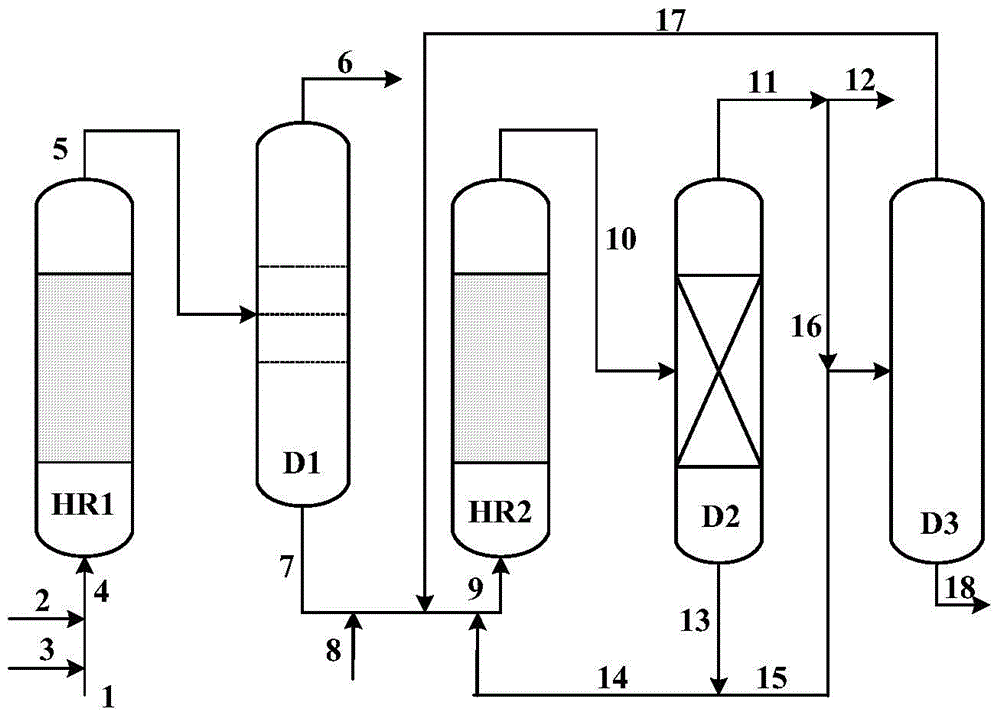
[0063] The experimental flow chart is attached figure 1 As shown, two separation devices are used to mix the residual oil raw material with hydrogen, fresh catalyst, and heavy wax oil in the second reaction zone in the raw material tank, and then transport it to the preheating furnace through a pump, and preheat it to 380°C to enter the first reaction Reactor, the reaction product of the first reactor enters the separation unit D1, and at least the product of 500°C residual oil in the heavy oil raw material according to the yield of <500°C distillate oil. The experimental conditions and reaction results are listed in Table 3.
Embodiment 5
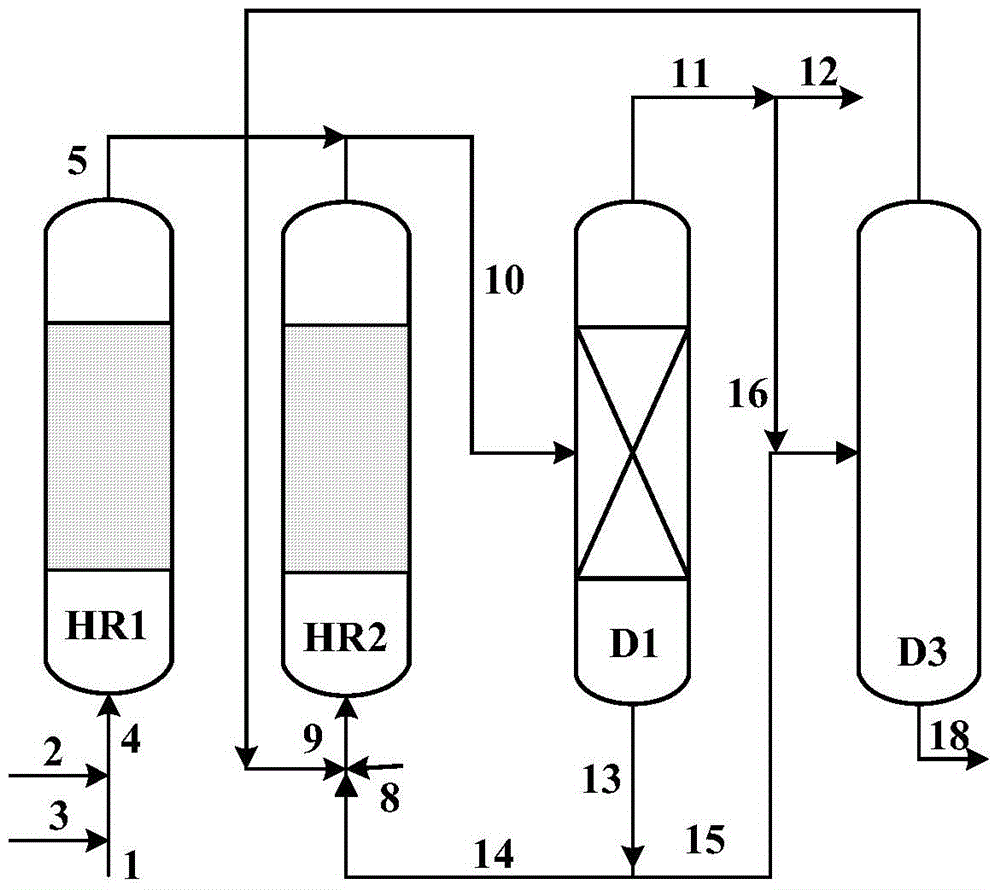
[0065] Use as attached figure 2 The device and process shown are different from Example 1 in that the first reactor and the second reactor products use the same set of separation equipment D1, and the residue raw material is mixed with hydrogen and heavy wax oil from the separation unit in the raw material tank After uniformity, it is transported to the preheating furnace by a pump, preheated to a certain temperature, and enters the first reactor for reaction. The reaction product of the first reactor enters the separation unit D1, and at least the product <430°C is separated, and the obtained residue is mixed with hydrogen and fresh catalyst. After mixing evenly and preheating, it enters the second reactor, and the reaction product of the second reactor enters the separation unit D1, and is separated to obtain light distillate oil, heavy diesel oil and residual oil. The experimental conditions and reaction results are listed in Table 3.
PUM
| Property | Measurement | Unit |
|---|---|---|
| particle size | aaaaa | aaaaa |
| particle size | aaaaa | aaaaa |
| particle size | aaaaa | aaaaa |
Abstract
Description
Claims
Application Information
 Login to View More
 - R&D
- Intellectual Property
- Life Sciences
- Materials
- Tech Scout
- Unparalleled Data Quality
- Higher Quality Content
- 60% Fewer Hallucinations
Browse by: Latest US Patents, China's latest patents, Technical Efficacy Thesaurus, Application Domain, Technology Topic, Popular Technical Reports.
© 2025 PatSnap. All rights reserved.Legal|Privacy policy|Modern Slavery Act Transparency Statement|Sitemap|About US| Contact US: help@patsnap.com