Preparation method of secondary start-up lithium ion battery cathode material
A lithium-ion battery, secondary starting technology, applied in battery electrodes, negative electrodes, active material electrodes, etc., can solve the problems of small discharge current, poor low temperature performance, poor discharge rate performance, etc., to meet low temperature requirements and low cost , the effect of simple preparation process
- Summary
- Abstract
- Description
- Claims
- Application Information
AI Technical Summary
Problems solved by technology
Method used
Image

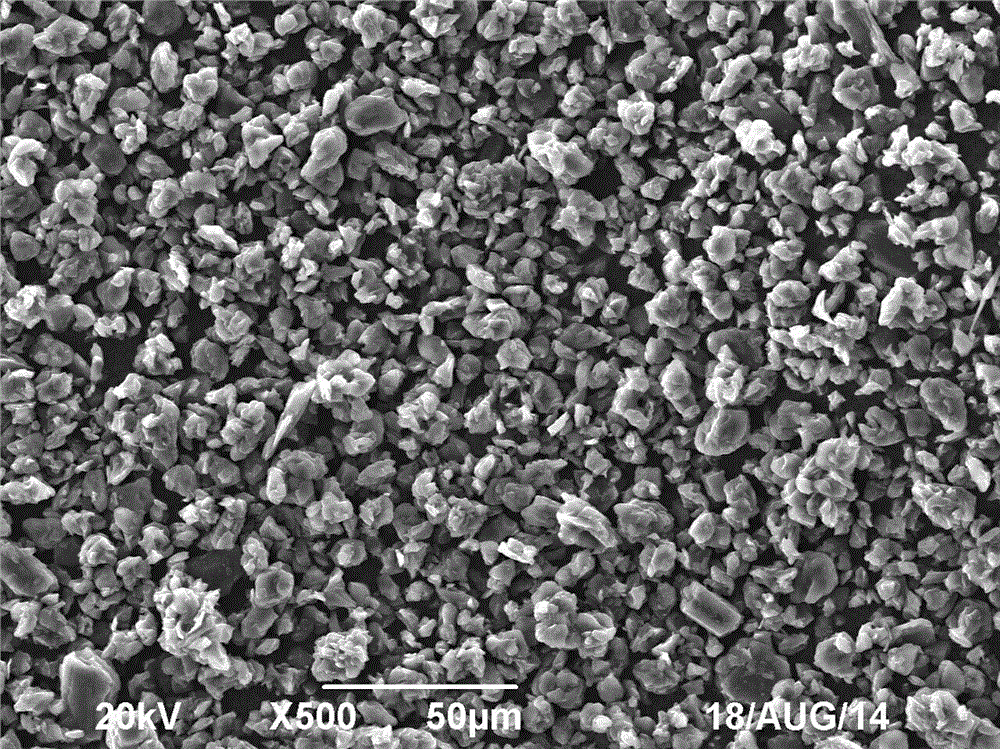


Examples
Embodiment 1
[0028] (1) The preparation method of the lithium-ion battery negative electrode material for secondary starting is as follows:
[0029] Weighing raw materials: 700g of petroleum coke and pitch coke particles crushed to 1-15μm by ultra-fine turbine pulverizer are used as raw material matrix, and 300g of petroleum asphalt and coal tar pitch with particle size of 1-5μm after passing through jet mill are used as binder; 150 g of phenolic resin and melamine resin crushed to 1-10 μm after passing through the jet mill are organic carbon sources;
[0030] The specific steps include: a. Preparation of the precursor: put the raw material matrix and the binder into the double-helix conical mixer at a weight ratio of 70%: 30%, and mix for 5 hours to make the material reach a good uniformity; put the mixed material Put it into a rotary kiln for thermal kneading, heating temperature 800°C, stirring frequency 50HZ, stirring time 10h, then cool down to form 15-30μm agglomerated secondary part...
Embodiment 2
[0036] (1) The preparation method of the lithium-ion battery negative electrode material for secondary starting is as follows:
[0037] Weighing raw materials: 600g of petroleum coke and pitch coke particles crushed to 1-15μm by ultra-fine turbine pulverizer are used as raw material matrix, and 400g of petroleum asphalt and coal tar pitch with particle size of 1-5μm after passing through jet mill are used as binder; 200 g of phenolic resin and melamine resin crushed to 1-10 μm after passing through the jet mill are organic carbon sources;
[0038]The specific steps include: a. Preparation of the precursor: put the raw material matrix and the binder into the double-helix conical mixer at a weight ratio of 60%:40%, and mix for 3 hours to make the material reach a good uniformity; put the mixed material Put it into a rotary kiln for thermal kneading, heating temperature 800°C, stirring frequency 40HZ, stirring time 8h, then cooling down to form 15-30μm agglomerated secondary part...
Embodiment 3
[0042] (1) The preparation method of the lithium-ion battery negative electrode material for secondary starting is as follows:
[0043] Weighing raw materials: 550g of petroleum coke and pitch coke particles crushed to 1-15μm by ultra-fine turbo mill as raw material matrix, 450g of petroleum asphalt and coal tar pitch with particle size of 1-5μm after passing through jet mill as binder; 200 g of phenolic resin and melamine resin crushed to 1-10 μm after passing through the jet mill are organic carbon sources;
[0044] The specific steps include: a. Preparation of the precursor: put the raw material matrix and the binder into the double-helix conical mixer at a weight ratio of 55%:45%, and mix for 3 hours to make the material achieve good uniformity; mix the mixed material Put it into a rotary kiln for thermal kneading, heating temperature 800°C, stirring frequency 40HZ, stirring time 8h, then cooling down to form 15-30μm agglomerated secondary particles; High-temperature grap...
PUM
| Property | Measurement | Unit |
|---|---|---|
| particle diameter | aaaaa | aaaaa |
Abstract
Description
Claims
Application Information
 Login to View More
PatSnap Eureka turns technology decisions into work you can execute. Powered by our Innovation Knowledge Graph, it runs expert workflows across engineering, life sciences, materials and intellectual property. Get your review-ready output in minutes.


