
A method for obtaining thermosensitive sterile lines by site-directed mutation of p/tms12-1 using CRISPR/Cas9 system
A temperature-sensitive sterile line and site-directed mutation technology is applied in the field of cultivation of rice temperature-sensitive sterile lines, which can solve the problem of reducing the genetic diversity between restorer lines and sterile lines, reducing the expression of light/thermo-sensitive sterile genes, The high sterile starting point temperature of transgenic plants can improve the utilization efficiency of heterosis, avoid possible risks and minimize genome damage.
- Summary
- Abstract
- Description
- Claims
- Application Information
AI Technical Summary
Problems solved by technology
Method used
Image



Examples
Embodiment 1
[0050] The clone obtained by cloning the main gene P / TMS12-1 double-stranded fragment that controls the temperature-sensitive sterility of Pei'ai 64S, the steps are as follows:
[0051] 1) Mapping of the thermosensitive sterile gene p / tms12-1
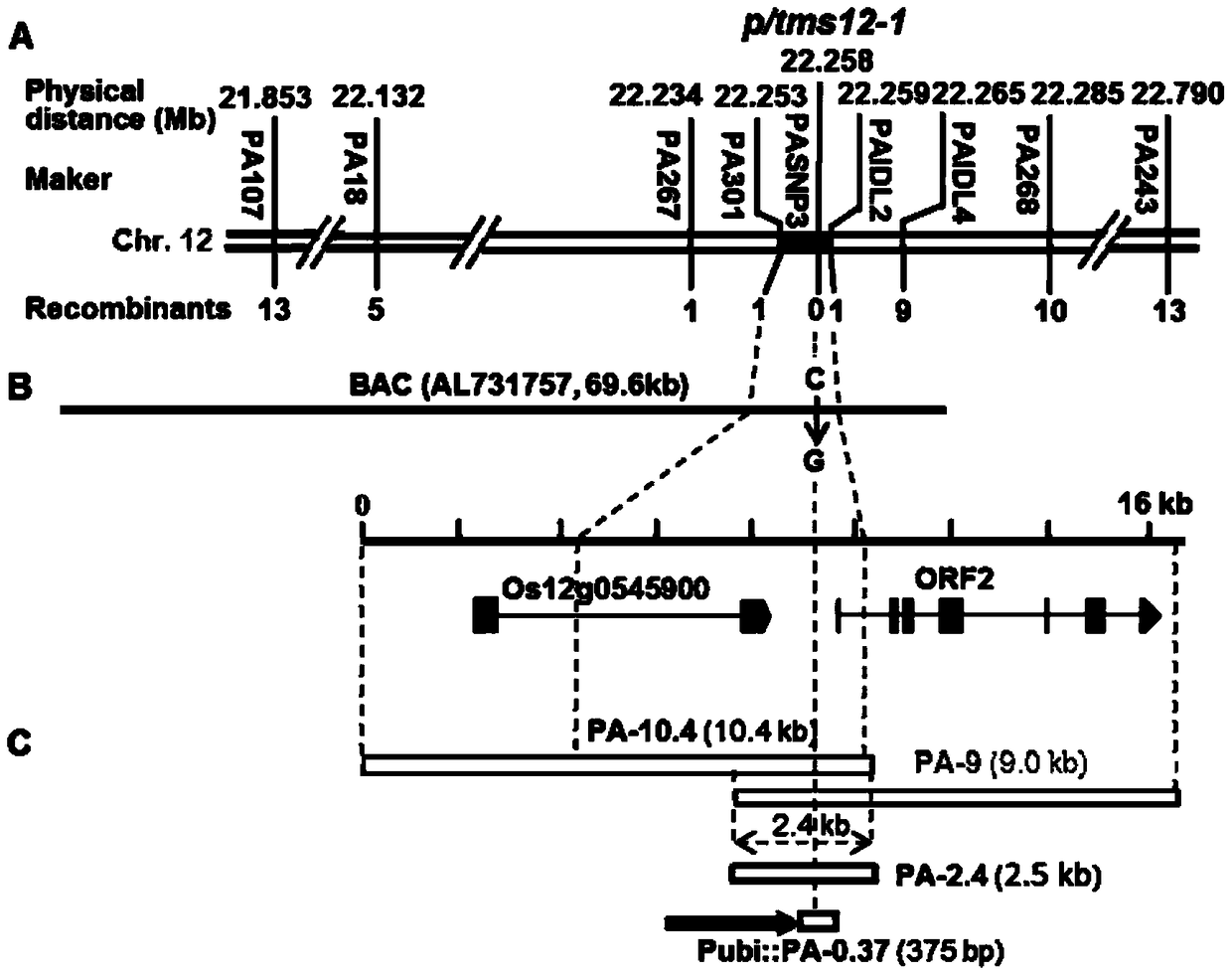
[0052] On the 12th chromosome of Peiai 64S, there is a major gene p / tms12-1 located in the 5.8kb physical interval between the molecular markers PA301 and PAIDL2 on the 12th chromosome BAC clone AL731757, see figure 1 ;
[0053] 2) Cloning of P / TMS12-1 double-stranded fragment
[0054] Sequence analysis of this interval found that there was a C-G mutation SNP in Pei'ai 64S. Gene prediction in this interval found two possible genes, and the above SNP was located between these two candidate genes; these two predicted genes were used as candidate genes , cloned two DNAs containing the above predicted genes and larger fragments for functional complementation, named PA10.4 (SEQ ID NO.1) and PA9 (SEQ ID NO.2) respectively; between these two...
Embodiment 2
[0060] In the japonica rice variety Zhonghua 11, a temperature-sensitive sterile line was obtained by site-directed mutation P / TMS12-1 using the CRISPR / Cas9 system. The specific steps are as follows:
[0061] 1) Utilize the CRISPR / Cas9 system to design the target sequence according to the SEQ ID NO.4 fragment sequence of Example 1:
[0062] Target-P / TMS12-1-1 (SEQ ID NO. 6): CTAGATGCAGTATAACTTCT;
[0063] 2) Construct the pU3-gRNA vector containing the Target-P / TMS12-1-1 fragment:
[0064] First synthesize the target primer P / TMS12-1-1F (SEQ ID NO.7): GGCACTAGATGCAGTATAACTTCT, P / TMS12-1-1 (SEQ ID NO.8): AAACAGAAGTTATACTGCATCTAG; denature the adapter primer and move to room temperature Cool to complete the annealing, link the annealed primers to the digested pU3-gRNA carrier; obtain a positive plasmid containing the Target-P / TMS12-1-1 fragment through PCR amplification and sequencing verification;
[0065] 3) Construction of pCRISPR / Cas9 vector containing Target-P / TMS12-1-1 f...
Embodiment 3
[0079] In the japonica rice variety Zhonghua 11, a temperature-sensitive sterile line was obtained by site-directed mutation P / TMS12-1 using the CRISPR / Cas9 system. The specific steps are as follows:
[0080] 1) Utilize the CRISPR / Cas9 system to design the target sequence according to the SEQ ID NO.4 fragment sequence of Example 1:
[0081] Target-P / TMS12-1-2 (SEQ ID NO. 17): CTTCTCGGGTCTATCTATAA;
[0082] 2) Construct the pU6-gRNA vector containing the Target-P / TMS12-1-2 fragment:
[0083] First, target primers P / TMS12-1-2F (SEQ ID NO.18) with cohesive ends (underlined parts) were synthesized: GCCGCTTCTCGGGTCTATCTATAA, P / TMS12-1-2R (SEQ ID NO.19): AAACTTATAGATAGACCCGAGAAG;
[0084] Denature the adapter primers and move them to room temperature to cool down to complete annealing. Link the annealed primers to the digested pU6-gRNA carrier, and obtain the target-P / TMS12-1-2 fragment containing Target-P / TMS12-1-2 through PCR amplification and sequencing verification positive pl...
PUM
 Login to View More
 Abstract
Description
Claims
Application Information
 Login to View More