

Two black mustard repeated DNA sequences and application thereof
A technology of DNA molecules and sequences, which is applied to two kinds of black mustard genome DNA sequences and its application fields, can solve the problems of cumbersome methods, poor repeatability, and the identification is greatly affected by subjective factors, and achieve the effect of easy identification
- Summary
- Abstract
- Description
- Claims
- Application Information
AI Technical Summary
Problems solved by technology
Method used
Image

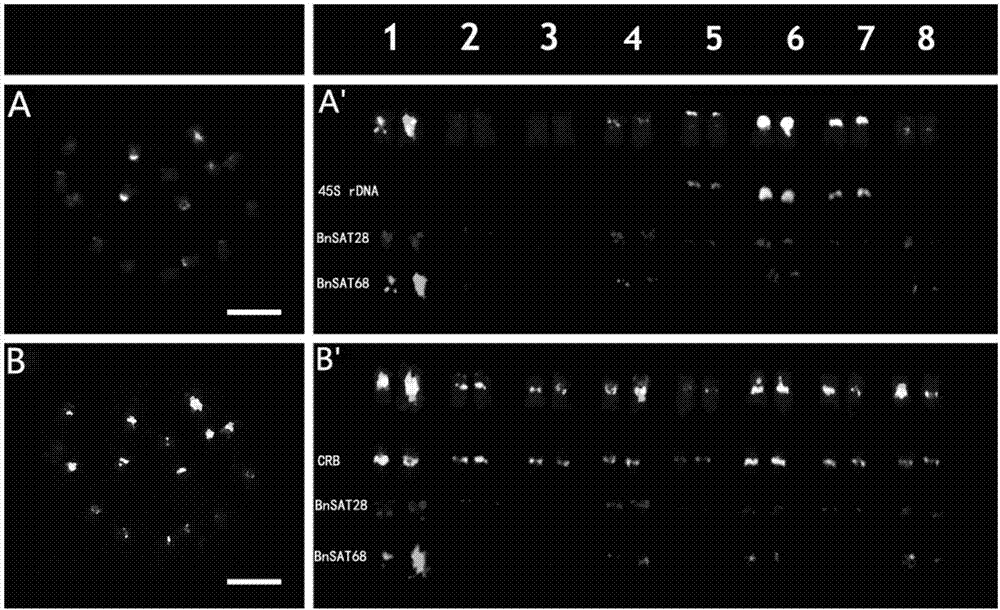
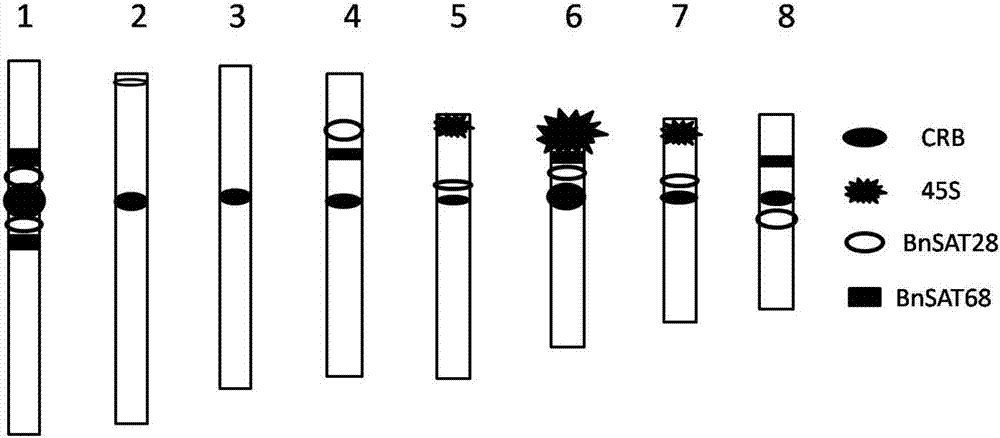
Examples
Embodiment 1
[0036] Embodiment 1, the isolation of DNA repeat sequence BNSAT28 and BNSAT68
[0037] Using black mustard 'G1 / 1' as a material, the base number of 0.6G obtained by random genome sequencing is equivalent to about 0.8 times of the black mustard genome (calculated based on the genome size of 630Mb, Johnston et al., 2005). Combining the methods of Novák et al. (2010) and Macas et al. (2010) for repeat sequence analysis, two tandem repeat sequences BNSAT28 and BNSAT68 with abundant genome content were found, which were verified by PCR cloning.
[0038] The nucleotide sequence of BNSAT28 is sequence 1 in the sequence listing.
[0039] The nucleotide sequence of BNSAT68 is sequence 2 in the sequence listing.
Embodiment 2
[0040] Embodiment 2, the application of DNA repeat sequence BNSAT28 and BNSAT68 as detection probe
[0041] One, BNSAT28 and BNSAT68 as the fluorescence in situ hybridization (FISH) test method of detection probe
[0042] 1. Chromosome production
[0043] 1) Put the plant seeds to be tested in a petri dish with moist filter paper, and take root at room temperature;
[0044] 2) When the root tip length is 0.5-1cm, cut off the root tip and put it into the d 2 h 2 O in a test tube, and put the test tube into an ice box filled with ice-water mixture and place it in the refrigerator for 22-24h for pretreatment;
[0045] 3) Put the pretreated root tip into fixative solution (absolute ethanol:glacial acetic acid=3:1 (v / v)) and fix it for 1-7 days;
[0046] 4) Excise part of the root tip meristem and place it in a mixed solution of 4% (volume percentage) cellulase and 1% (volume percentage) pectinase, and treat at 37°C for 50 minutes to soften the root tip;
[0047] 5) Apply the ...
PUM
 Login to View More
 Abstract
Description
Claims
Application Information
 Login to View More