
Preparation method of D-pantolactone
A technique for pantolactone and lactone, which is applied in the field of preparation of D-pantolactone, can solve the problems of low yield and low enzyme conversion rate, achieve low enzyme conversion rate improvement, improve optical purity and chemical purity, and obtain rate-boosting effect
Patent Information
- Authority / Receiving Office
- CN · China
- Patent Type
- Applications(China)
- Current Assignee / Owner
- Publication Date
- 2017-12-08
- Estimated Expiration
- Not applicable · inactive patent
Smart Images
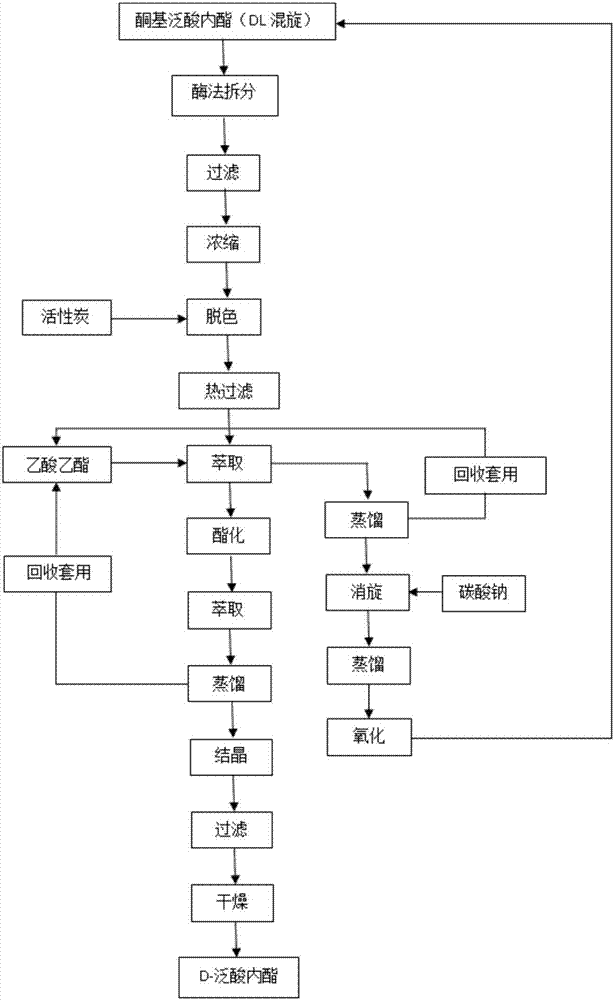
Figure 1 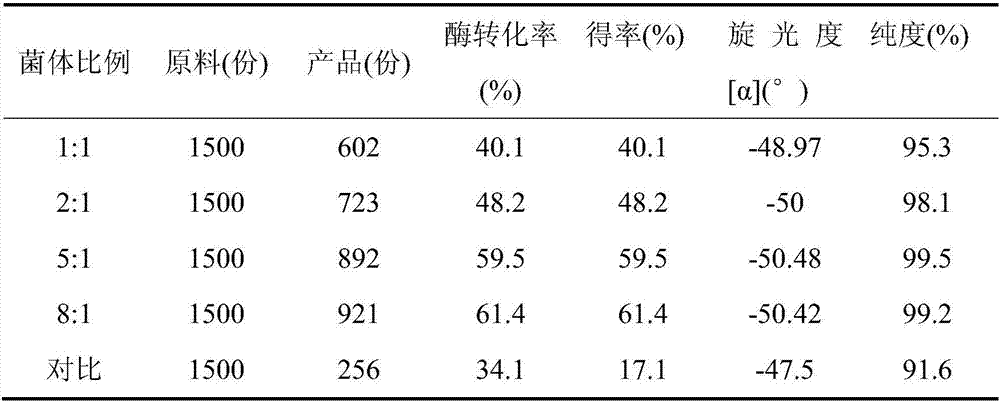
Figure 2
Abstract
Description
technical field
[0001] The invention relates to a preparation method of D-pantolactone, which belongs to the field of material separation. Background technique
[0002] DL-pantoate lactone is a racemic compound, and the DL-pantoate lactone is split into D-pantoate lactone for the synthesis of D-calcium pantothenate. Its resolution is generally used to form and separate diastereoisomers or biological enzymatic methods. Although the separation of DL-pantolactone is difficult, the separation from intermediate products can greatly reduce the cost of synthesis.
[0003] Use chiral resolution reagents such as D-camphorsulfonic acid and DL-pantolactone alkali hydrolyzate to form double salts, and use the difference in solubility to separate. After recovering the resolution reagent, D-pantoic acid is obtained, and dehydration lactonization is used to obtain D-pantoic acid lactone. However, chiral resolution reagents are generally more expensive, and the process of this method is ...
Examples
Embodiment 1
[0033] The raw materials used include: 1,500 parts of ketone pantothenate, 6,000 parts of water, 300 parts of compound enzyme (1:1 mixture of Rhodotorula and Monostella moniliformis), 600 parts of 10% ammonia water, 33,000 parts of ethyl acetate, activated carbon 1.5 parts, concentrated sulfuric acid (98%), said parts are parts by mass.
[0034] Its preparation method of D-pantothenic acid lactone is:
[0035] 1) Dissolve the raw material ketopantothenate in water, add compound enzymes for enzymolysis, the enzymolysis temperature is 40-50°C, the enzymolysis time is 35h, and the pH during the enzymolysis process is adjusted to 7 by ammonia water;
[0036] 2) Filtrate, filter out the mycelium (composite enzyme) for reuse, concentrate the filtrate to 60% of the original volume, and use 0.03% (the quality of activated carbon relative to the quality and dosage of ketopantothenic acid lactone) under the condition of 75-85°C Activated carbon decolorization, hot filtration (filtering...
Embodiment 2
[0040] The raw materials used include: 1,500 parts of ketone pantothenate, 6,000 parts of water, 300 parts of compound enzyme (mixture of Rhodotorula minor and Rhodotorula moniliformis 2:1), and 600 parts of 10% ammonia water. 33000 parts of ethyl acetate, 1.5 parts of activated carbon, and the consumption of concentrated sulfuric acid is undecided, and the said parts are parts by mass.
[0041] Its preparation method of D-pantothenic acid lactone is:
[0042] Dissolve the raw material ketopantothenate in water, add compound enzymes for enzymolysis, enzymolysis temperature 30-40°C, enzymolysis time 40h, use ammonia water to adjust the pH of the enzymolysis process to 7; filter and filter out the mycelium Repeated use, the filtrate was concentrated to 70% of the original volume, under the condition of 75-85 ° C, use 0.02% activated carbon for decolorization, heat filtration, add ethyl acetate (EA:H 2 O=1.1:1) Six rounds of extraction, distillation and recovery of ethyl acetate...
Embodiment 3
[0044]D-pantothenolactone, its raw materials include: 1500 parts of ketone pantothenate lactone, 6000 parts of water, 300 parts of enzyme (5:1 mixture of Rhodotorula minor and Vernis moniliformis), 600 parts of 10% ammonia water. 33000 parts of ethyl acetate, 1.5 parts of activated carbon, and the consumption of concentrated sulfuric acid is undecided, and the said parts are parts by mass.
[0045] Its preparation method of D-pantothenic acid lactone is:
[0046] Dissolve the raw material ketopantothenate in water, add compound enzymes for enzymolysis, enzymolysis temperature 30-40°C, enzymolysis time 40h, use ammonia water to adjust the pH of the enzymolysis process to 7; filter and filter out the mycelium For repeated use, the filtrate is concentrated to 60% of the original volume. Under the condition of 75-85 ° C, use 0.05% activated carbon for decolorization, heat filtration, add ethyl acetate (EA:H 2 O=1.1:1) Six rounds of extraction, distillation and recovery of ethyl a...