
A kind of anti-radiation decorative cement
A radiation protection and cement technology, applied in the field of building materials, can solve problems such as cracking and alkali return of decorative cement, achieve excellent radiation protection performance, reduce the risk of cracking, and avoid the effect of alkali return
- Summary
- Abstract
- Description
- Claims
- Application Information
AI Technical Summary
Problems solved by technology
Method used
Image

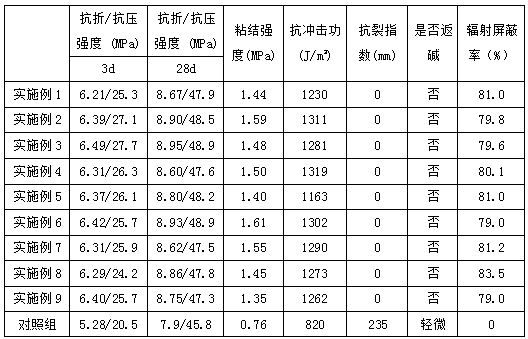
Examples
Embodiment 1
[0030] A radiation-proof decorative cement composed of the following raw materials in parts by weight: 50 parts of barium cement, 4 parts of expansion agent, 4 parts of metakaolin, 6 parts of silica fume, 1 part of whiskers, 8 parts of redispersible latex powder , 1.5 parts of water reducing agent, 0.37 parts of defoaming agent, 0.13 parts of cellulose ether, 25 parts of barite powder.
[0031] In this embodiment, the expansion agent is a sulfoaluminate expansion agent.
[0032] In this embodiment, the redispersible latex powder is a redispersible latex powder with a glass transition temperature of -3°C.
[0033] In this embodiment, the cellulose ether is hydroxypropyl methylcellulose with a viscosity of 300 mPa.s.
[0034] In this embodiment, the whiskers are calcium sulfate whiskers, with an average diameter of 1 um and an average length of 30 um.
[0035] In this embodiment, the barium sulfate content of the barite powder is greater than 90%, and the average particle size is 1 μm.
...
Embodiment 2
[0039] A radiation-proof decorative cement composed of the following raw materials in parts by weight: 40 parts barium cement, 2 parts expansion agent, 9.9 parts metakaolin, 3 parts silica fume, 2 parts whiskers, 10 parts redispersible latex powder , 2 parts of water reducing agent, 1 part of defoamer, 0.1 part of cellulose ether, 30 parts of barite powder.
[0040] In this embodiment, the expansion agent is a sulfoaluminate expansion agent.
[0041] In this embodiment, the redispersible latex powder is a redispersible latex powder with a glass transition temperature of 0°C.
[0042] In this embodiment, the cellulose ether is hydroxypropyl methylcellulose with a viscosity of 400 mPa.s.
[0043] In this embodiment, the whiskers are calcium sulfate whiskers with an average diameter of 8um and an average length of 200um.
[0044] In this embodiment, the barium sulfate content of the barite powder is greater than 90%, and the average particle size is 10 μm.
[0045] In this embodiment, the ...
Embodiment 3
[0048] A radiation-proof decorative cement composed of the following raw materials in parts by weight: 45 parts of barium cement, 4 parts of expansion agent, 6.88 parts of metakaolin, 3 parts of silica fume, 3 parts of whiskers, and 10 parts of redispersible latex powder , 2 parts of water reducing agent, 1 part of defoamer, 0.12 parts of cellulose ether, 25 parts of barite powder.
[0049] In this embodiment, the expansion agent is a sulfoaluminate expansion agent.
[0050] In this embodiment, the redispersible latex powder is a redispersible latex powder with a glass transition temperature of 3°C.
[0051] In this embodiment, the cellulose ether is hydroxypropyl methylcellulose with a viscosity of 500 mPa.s.
[0052] In this embodiment, the whiskers are calcium sulfate whiskers with an average diameter of 6um and an average length of 100um.
[0053] In this embodiment, the barium sulfate content of the barite powder is greater than 90%, and the average particle size is 5 μm.
[0054] ...
PUM
| Property | Measurement | Unit |
|---|---|---|
| glass transition temperature | aaaaa | aaaaa |
| diameter | aaaaa | aaaaa |
| length | aaaaa | aaaaa |
Abstract
Description
Claims
Application Information
 Login to View More