
Polyphenylene sulfide thermoplastic prepreg preparation method capable of improving permeability
A polyphenylene sulfide and prepreg technology, which is applied in the field of preparing polyphenylene sulfide thermoplastic prepregs, can solve the problems of poor impregnation effect and difficult impregnation of thermoplastic resins, achieve uniform resin content, and promote uniform dispersion time. , cost reduction effect
- Summary
- Abstract
- Description
- Claims
- Application Information
AI Technical Summary
Problems solved by technology
Method used
Image

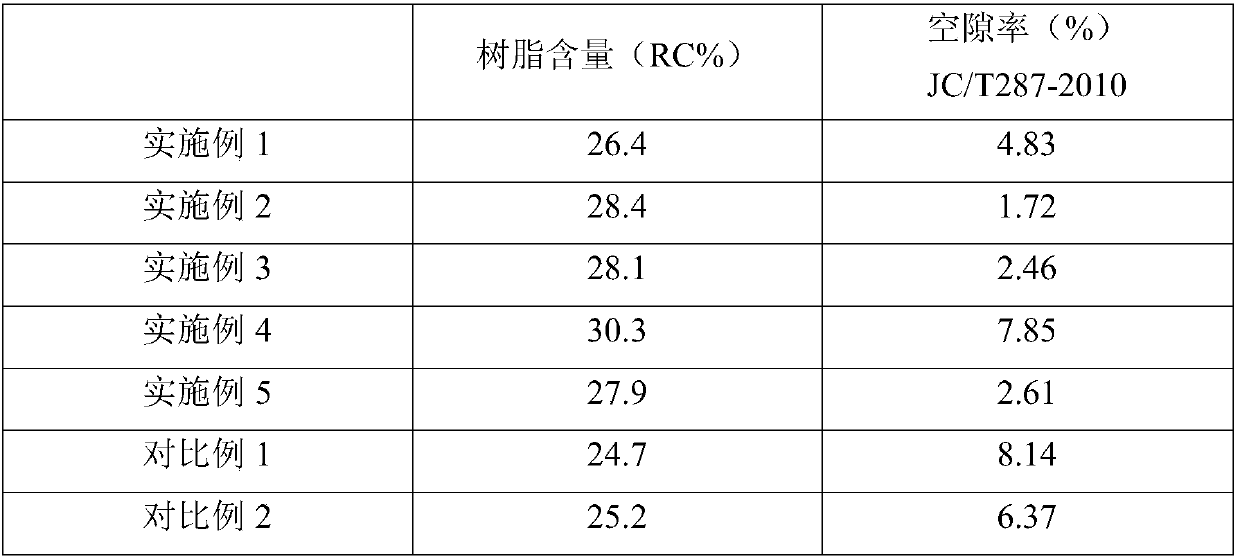
Examples
Embodiment 1
[0039] (1) The polyphenylene sulfide particles were ground in a liquid nitrogen pulverizer at -5°C for 30-120 minutes to obtain three powder particle sizes: 30um (R1), 75um (R2), and 120um (R3).
[0040] (2) Mix powders of three different particle sizes by a high-speed mixer in proportion, R1:R2:R3 (mass ratio)=1:2:7.
[0041] (3) Mix 50 parts of polyphenylene sulfide powder, 150 parts of deionized water, 3 parts of surfactant (fatty alcohol polyoxyethylene ether), 0.5 parts of defoamer BYK-A530, stir under mechanical stirring and ultrasonic vibration 40min. The conductivity of the deionized water used is 10us / cm.
[0042] (4) Preparation of carbon fiber thermoplastic prepreg: pour the above slurry into the dipping tank; carbon fiber (FAW: 100g / m 2 ) is drawn from the creel to weave the yarn, and the sizing agent on the surface of the carbon fiber is removed through a high-temperature furnace at 300°C, and passed through the dipping tank at a line speed of 3m / min to make the...
Embodiment 2
[0044] In this example, compared with Example 1, the amount of small particle size powder used is increased, and the amount of defoamer used is increased to improve the penetration effect of polyphenylene sulfide.
[0045] (1) The polyphenylene sulfide particles were ground in a liquid nitrogen pulverizer at -5°C for 30-120 minutes to obtain three powder particle sizes: 30um (R1), 75um (R2), and 120um (R3).
[0046] (2) Mix powders of three different particle sizes by a high-speed mixer according to the ratio, R1:R2:R3 (mass ratio)=4:3:3.
[0047] (3) Mix 50 parts of polyphenylene sulfide powder, 150 parts of deionized water, 3 parts of surfactant fatty alcohol polyoxyethylene ether, 2.5 parts of defoamer BYK-A 530, and stir for 40 minutes under mechanical stirring and ultrasonic vibration . The conductivity of the deionized water used is 10us / cm.
[0048] (4) Preparation of carbon fiber thermoplastic prepreg: pour the above slurry into the dipping tank; carbon fiber (FAW: 1...
Embodiment 3
[0050]Compared with Example 1, this example only increases the amount of powder with a small particle size. The ratio of polyphenylene sulfide powders with three different particle sizes is R1:R2:R3=4:3:3. Others are all the same as in Example 1.
PUM
| Property | Measurement | Unit |
|---|---|---|
| Conductivity | aaaaa | aaaaa |
| Conductivity | aaaaa | aaaaa |
| Conductivity | aaaaa | aaaaa |
Abstract
Description
Claims
Application Information
 Login to View More