Oxaspirobisphosphine Ligands and Their Applications in Asymmetric Hydrogenation of α,β-Unsaturated Carboxylic Acids
What is AI technical title?
AI technical title is built by Patsnap AI team. It summarizes the technical point description of the patent document.
An oxaspiro and asymmetric technology, applied in the field of oxaspirocyclic bisphosphine ligands, can solve the problems of narrow application range, no reactivity of cyclic tetra-substituted carboxylic acids, lack of chiral bisphosphine ligands, etc. High enantioselectivity, high activity effect
Active Publication Date: 2021-06-18
SHENZHEN CATALYS SCI & TECH CO LTD +1
View PDF5 Cites 0 Cited by
Summary
Abstract
Description
Claims
Application Information
AI Technical Summary
This helps you quickly interpret patents by identifying the three key elements:
Problems solved by technology
Method used
Benefits of technology
Problems solved by technology
In 2007, Zhou Qilin's group found that the ruthenium complex of SFDP exhibited excellent activity and enantioselectivity in the hydrogenation of tiglic acid and α-methylcinnamic acid (see X.Cheng, Q.Zhang, J.-H .Xie, L.-X.Wang, Q.-L.Zhou, Angew.Chem., Int.Ed.2005,44,1118-1121.), followed by ChenPhos and Trifer based on the ferrocene framework developed by Chen Weiping's group Shows good catalytic effect in the hydrogenation of α-methylcinnamic acid and α-oxo-α,β-unsaturated acids (see a) W.Chen, P.J.McCormack, K.Mohammed, W.Mbafor, S.M.Roberts , J.Whittall, Angew.Chem., Int.Ed.2007, 46, 4141-4144; b) W.Chen, F.Spindler, B.Pugin, U.Nettekoven, Angew.Chem., Int.Ed.2013 , 52, 8652-8656.), Zhang Xumu group also developed Wudaphos based on ferrocene skeleton, which showed excellent activity and enantioselectivity in the hydrogenation of α-acrylic acid derivation (see Chen, C.; Wang, H.; Zhang, Z., Jin, S.; Wen, S., Ji, J., Chung, L.W. Dong, X.-Q.; Zhang, X. Chem. Sci., 2016, 7, 6669-6673 .), but the scope of application of these ligands is very narrow. In order to obtain excellent enantioselectivity, it is often necessary to carry out complex structural modifications on the ligands, and there is still a lack of chiral bisphosphine ligands that are widely applicable to a variety of substrates
The Ir-SIPhOX system developed by Zhou Qilin's research group is a catalytic system with a wide range of substrates (see a) S.Li, S.F.Zhu, J.H.Xie, S.Song, C.M.Zhang, Q.L.Zhou, J.Am.Chem. Soc.2010, 132, 1172-1179; b) S.Li, S.F.Zhu, C.M.Zhang, S.Song, Q.L.Zhou, J.Am.Chem.Soc.2008, 130, 8584-8585; c) S.Song , S.F.Zhu, L.Y.Pu, Q.L.Zhou, Angew.Chem., Int.Ed.2013, 52, 6072-6075; d) S.Song, S.F.Zhu, Y.B.Yu, Q.L.Zhou, Angew.Chem., Int.Ed. .2013,52,1556-1559; e) Q.Wang, Z.Zhang, C.Chen, H.Yang, Z.Han, X.-Q.Dong, X.Zhang, Org.Chem.Front.2017, 4,627-630; f) S.F.Zhu, Q.L.Zhou, Acc.Chem.Res. 2017, 50, 988-1001.) But this system is not reactive towards cyclic tetrasubstituted carboxylic acids (see a) S.Song, S.F.Zhu, Y .Li, Q.L.Zhou, Org.Lett.2013, 15, 3722-3725; b) A.Schumacher, M.G.Schrems, A.Pfaltz, Chem.-AsianJ.2011, 17, 13502-13509.), the same as the system needs The addition of alkali to promote the reaction, to some extent limits the scope of application of the system
Method used
the structure of the environmentally friendly knitted fabric provided by the present invention; figure 2 Flow chart of the yarn wrapping machine for environmentally friendly knitted fabrics and storage devices; image 3 Is the parameter map of the yarn covering machine
View more
Image
Smart Image Click on the blue labels to locate them in the text.
Viewing Examples
Smart Image
Click on the blue label to locate the original text in one second.
Reading with bidirectional positioning of images and text.
Smart Image
Examples
Experimental program
Comparison scheme
Effect test
Embodiment 1
[0051] Catalyst Rh(1a)OAc 2 Preparation of:
[0052] in N 2 Under atmosphere, add [RuPhCl 2 ] 2 (25 mg, 0.05 mmol), ligand 1a (61 mg, 0.103 mmol), and then 2 mL of DMF was added. React at 100°C for 3h. After cooling to room temperature, 1.5 mL of anhydroussodium acetate (0.111 g, 1.3 mmol) in methanol was added. After 20Min, deoxygenated deionized water was added. A gray solid precipitated from the reaction system, filtered, and the solvent and water were removed under reduced pressure to obtain the catalyst Rh(1a)OAc 2 (57 mg, yield = 71%).
Embodiment 2
[0054] Catalyst Rh(1a)(CF 3 CO) 2 Preparation of:
[0055] in N 2 Under atmosphere, add bis-(2-methallyl) cyclooct-1,5-dieneruthenium (32mg, 0.05mmol), ligand 1a (61mg, 0.103mmol) to a 10mL single-necked bottle, and then add 2 mL of acetone. React at 40°C for 0.5h. Then add trifluoroacetic acid (33 mg, 0.3 mmol), stir overnight at 40 ° C, remove the solvent under reduced pressure, then add 1 mL of petroleumether, and filter to obtain the target product Rh (1a) (CF 3 CO) 2 (81 mg, yield = 88%).
Embodiment 3
[0057] Synthesis of (3R,4R)-1-(tert-butoxycarbonyl)-4-phenyl-3-carboxylic acid 3a:
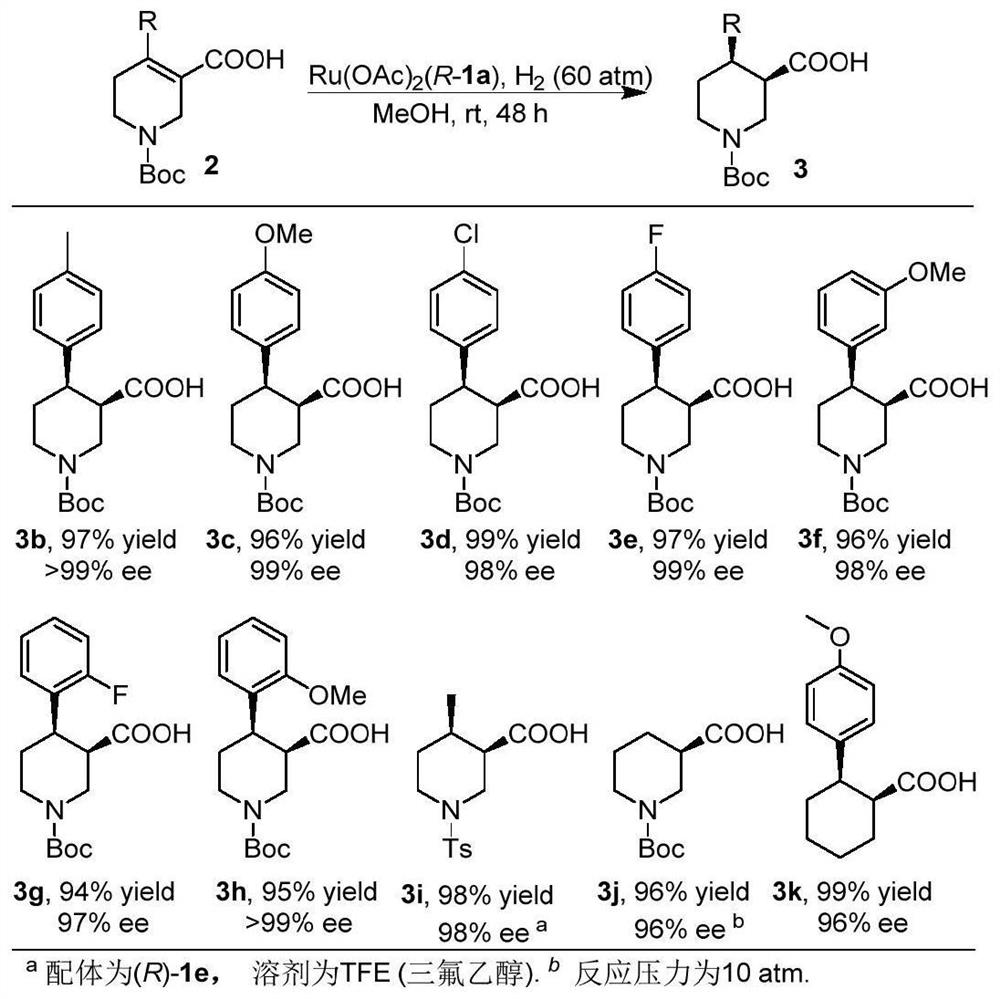
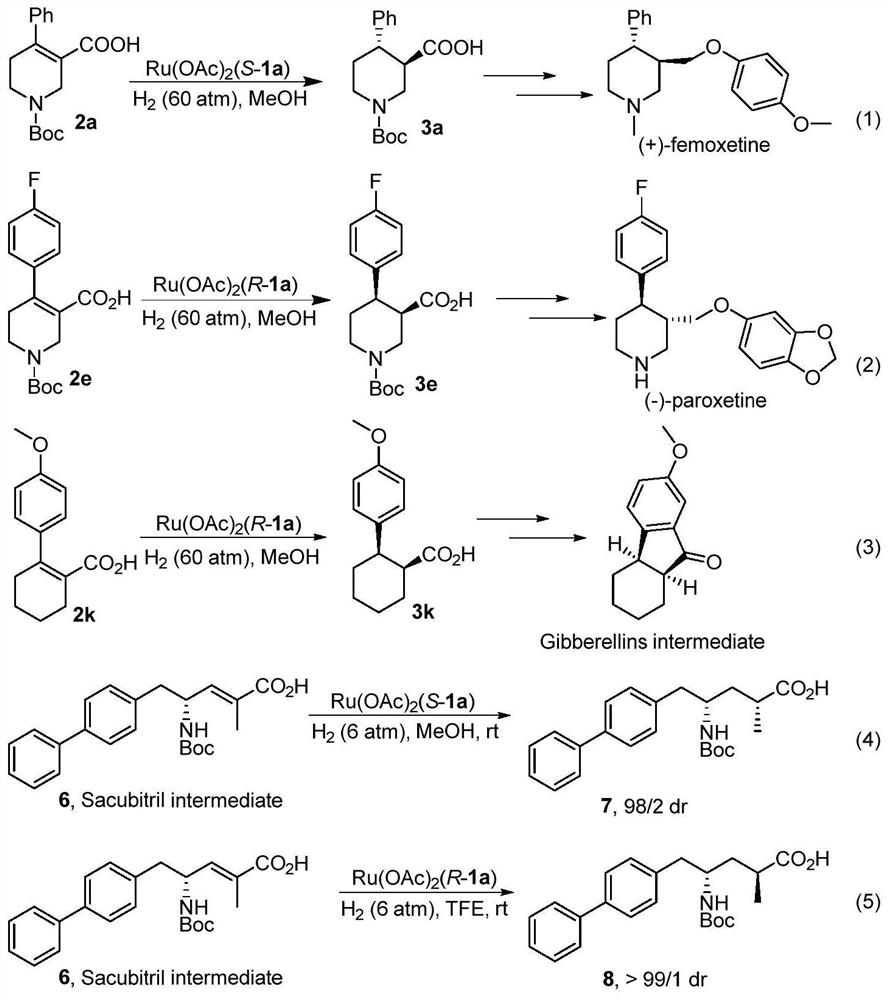
[0058] in N 2 Under atmosphere, add 2a (0.1mmol), catalyst Ru(1a)OAc to the hydrogenation vial 2 (0.8mg, 0.001mmol) and 1mL of methanol. After 24 h under a hydrogen atmosphere of 60 atm, all the raw materials were converted into products. 29.0mg, product yield=95%,>99%ee, [α] 25 D =+38.0 (c=0.5, CHCl 3 ), yellow oil. 1 H NMR (400MHz, CDCl 3 )δ7.29-7.24(m,2H,Ar),7.23-7.17(m,3H,Ar),4.44(d,J=12.7Hz,1H,CH 2 ), 4.26 (d, J=9.0Hz, 1H, CH 2 ), 3.16(d, J=11.1Hz, 1H, CH), 3.01-2.82(m, 3H, CH 2 ),2.55(dt,J=12.0,8.6Hz,1H,CH),1.68(dd,J=13.0,2.8Hz,1H,CH 2 ),1.39(s,9H,CH 3 ). 13 C NMR (101MHz, CDCl 3 )δ176.9, 154.7, 142.1, 128.3, 127.4, 126.6, 79.8, 46.1, 45.2, 43.8, 43.0, 28.2, 25.6. HRMS (ESI) calcd.for C 17 h 22 NO 4 [M-H] - :304.1554, Found: 304.1556.HPLC conditions: Daicel AD-3, injection volume 2μL (c=1mg / mL), Hexane / IPA=97 / 3, 1.0mL / Min, 208nm, t R (major) = 29.6Min,t R (minor) = 31....
the structure of the environmentally friendly knitted fabric provided by the present invention; figure 2 Flow chart of the yarn wrapping machine for environmentally friendly knitted fabrics and storage devices; image 3 Is the parameter map of the yarn covering machine
Login to View More
PUM
Login to View More
Abstract
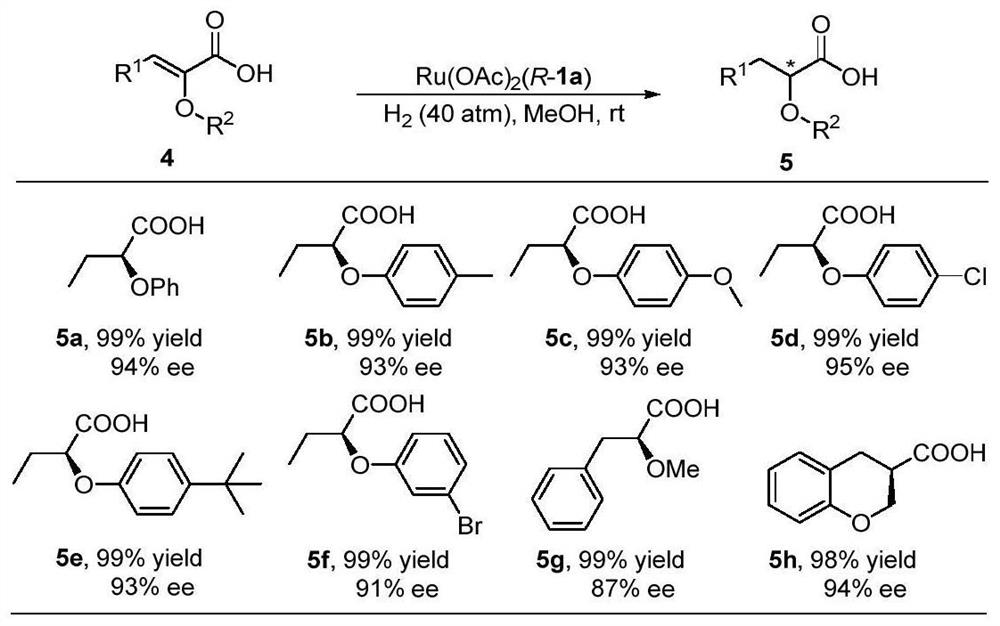
An oxaspirocyclic bisphosphorus ligand provided by the present invention has the structure of the following general formula (I): wherein, in the general formula (I): R 1 , R 2 , R 3 and R 4 Same, it is an alkyl group, an alkoxy group, an aryl group, an aryloxy group or a hydrogen atom, and the R 1 , R 2 , R 3 and R 4 Including the form of ring formation, non-ring formation, any two formation of rings or the formation of multiple rings between two pairs; R 5 , R 6 is an alkyl group, an aryl group or a hydrogen atom; R 7 , R 8 Alkyl or benzyl or aryl. The present invention also provides an application of O-SDP, an oxaspirocyclic bisphosphine ligand, in the asymmetric hydrogenation of α, β-unsaturated carboxylic acids. Its complexes with ruthenium exhibit excellent activity and enantioselectivity in the asymmetric hydrogenation of various types of α, β-unsaturated carboxylic acids, and can obtain chirality with an enantioselectivity as high as 99%. Carboxylic acid products. This synthesis method can be applied to the construction of the core skeleton of chemical molecules with important biological activities such as Paroxetine, Femoxetine, nipecotic acid and Sacubitril.
Description
technical field [0001] The invention relates to an oxaspirocyclic bisphosphine ligand O-SDP and its application in the asymmetric hydrogenation of α,β-unsaturated carboxylic acids. Background technique [0002] Chiral carboxylic acids and their chiral carboxylic acid derivative fragments widely exist in biologically active drug molecules and natural products, and have high potential application value in the field of asymmetric catalysis. Catalytic asymmetric hydrogenation of α,β-unsaturated carboxylic acids is one of the most direct and efficient methods to construct chiral carboxylic acid compounds. Over the past few decades, this field has undergone rapid development with the development of chiral bisphosphine ligands. DIOP synthesized by Kagan group (see Dang, T.P.; Kagan, H.B.J. Chem. Soc. D: Chem. Commun. 1971, 481.), BINAP developed by Noyori group (see Miyashita , A.; Yasuda , A.; Takaya , H.; Toriumi , K.; Ito , T.; Souchi , T.; Noyori R.; J. Am. Chem. ...
Claims
the structure of the environmentally friendly knitted fabric provided by the present invention; figure 2 Flow chart of the yarn wrapping machine for environmentally friendly knitted fabrics and storage devices; image 3 Is the parameter map of the yarn covering machine
Login to View More
Application Information
Patent Timeline
Application Date:The date an application was filed.
Publication Date:The date a patent or application was officially published.
First Publication Date:The earliest publication date of a patent with the same application number.
Issue Date:Publication date of the patent grant document.
PCT Entry Date:The Entry date of PCT National Phase.
Estimated Expiry Date:The statutory expiry date of a patent right according to the Patent Law, and it is the longest term of protection that the patent right can achieve without the termination of the patent right due to other reasons(Term extension factor has been taken into account ).
Invalid Date:Actual expiry date is based on effective date or publication date of legal transaction data of invalid patent.


 Login to View More
  Login to View More